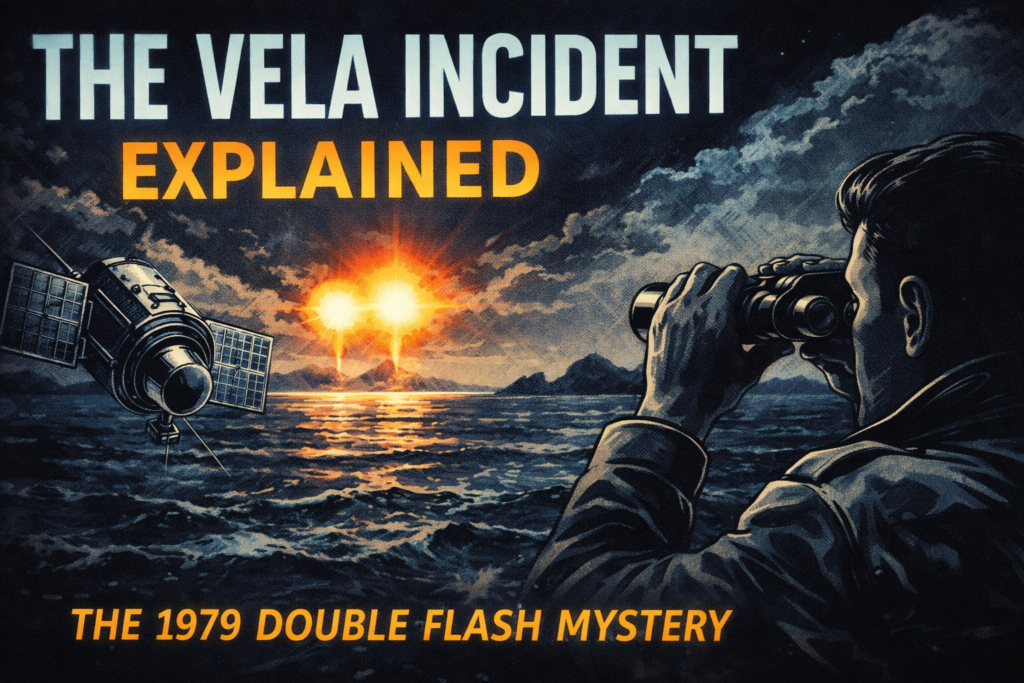
The Vela Incident Explained
On the morning of September 22, 1979, two U.S. satellites designed to detect nuclear detonations recorded a signature that made analysts freeze: a distinctive “double flash”-the kind of optical pattern historically associated with an atmospheric nuclear explosion. The location appeared to be the South Atlantic / Southern Indian Ocean region, far from major population centers, in the cold, gray stretch of water near the Prince Edward Islands.
The world never received a clean, universally accepted answer. Was it a clandestine nuclear test? A sensor glitch? A rare natural phenomenon? Or something stranger-an event that looked nuclear, behaved nuclear, and yet remained politically inconvenient to confirm?
This article explains the Vela Incident in plain English: what happened, what the satellites actually saw, the strongest competing theories, and why the mystery still matters for modern detection systems, geopolitics, and the way governments manage uncomfortable evidence.

What Was the Vela Incident?
The Vela Incident (sometimes called the “South Atlantic Flash”) refers to a controversial event detected by U.S. Vela satellites on September 22, 1979. The Vela program was built to enforce the logic of the Cold War: if someone conducted a nuclear test in the atmosphere (or near space), the United States wanted evidence that could not be easily denied. Vela satellites carried specialized sensors-especially bhanga meters-to spot the characteristic light pattern of a nuclear explosion.
What made this detection explosive wasn’t just the flash itself-it was the pattern. Analysts had learned that atmospheric nuclear detonations tend to produce a brief, intensely bright flash followed by a second, longer flash as the fireball expands and interacts with the surrounding air. Vela recorded an optical signature that seemed to match this “double flash” profile.
The “Double Flash” in Simple Terms
Imagine a camera pointed at a dark ocean. A nuclear explosion in the atmosphere produces an extremely sharp pulse of light. But the physics doesn’t stop there: the shockwave and expanding fireball can briefly alter how light escapes, creating a second light curve. The classic “double flash” isn’t magic-it’s the result of how energy couples to air, plasma forms, and radiation is momentarily blocked then re-emerges. The Vela sensors were built to recognize this pattern quickly and reliably.
That’s why the Vela Incident became a historical knot. It wasn’t “a weird glow.” It was a signal type designed to say: “This is what a bomb looks like.”
Where Did It Happen?
Estimates placed the event in the remote oceanic region between southern Africa and Antarctica, often discussed in relation to the Prince Edward Islands (a South African territory). The area is isolated, cold, and strategically convenient: far from shipping lanes, away from most radar coverage, and difficult to monitor with conventional aircraft.
A key complication: remote oceans are challenging environments for verification. Weather, sea state, cloud cover, and distance make it hard to gather decisive follow-up evidence. In a perfect world, you would cross-check the optical detection with additional data: acoustic signals, radiation traces, seismic readings, and other satellite sensors. In reality, each source comes with uncertainty.
Why the Event Triggered Political Shockwaves
If the event was a nuclear test, it had major implications. By 1979, nuclear testing was politically sensitive, and many states had strong incentives to avoid confirmed atmospheric tests. A secret test could imply treaty violations, trigger sanctions, and shift regional balances.
The controversy also reveals a deeper truth about intelligence: detection is not the same thing as proof. Governments often live in the gap between “high confidence” and “officially acknowledged.” The Vela Incident sits right inside that gap.
The Main Theories (Ranked by Plausibility)
1) A Clandestine Nuclear Test
This is the theory that made the headlines and never fully disappeared. Supporters argue that Vela’s double flash pattern was too specific to ignore. They also point to the geopolitics of the time: if a state wanted to test discreetly, an isolated southern ocean location would be an obvious choice.
Why this theory persists: nuclear tests leave multiple signatures, but not all are guaranteed to be detected or recoverable. Optical evidence might be strong while other lines of evidence remain weak due to distance, timing, or environmental conditions. In intelligence work, “missing evidence” is often the norm rather than the exception.
2) A Sensor or Satellite Degradation Problem
Skeptics have argued that the satellite involved may have been aging, and that the detection could have been an anomaly. Systems in orbit are subject to harsh radiation, micrometeoroids, and hardware degradation. If the sensor produced a false positive, then the double flash could be a coincidence of instrumentation.
Why this theory is attractive: it offers a clean exit. No new nuclear actor, no crisis, no escalation-just a technical “ghost.” But critics note that the Vela system was explicitly designed to avoid being fooled by common false signals.
3) A Natural Phenomenon (Meteor, Lightning, or Unusual Atmospheric Event)
Some theories propose a meteor entering the atmosphere, a rare lightning event, or an unusual interaction between sunlight, clouds, and the ocean surface. Nature can produce dramatic flashes, especially over water.
The challenge: the Vela “double flash” profile wasn’t based on generic brightness-it was based on a time-structured signature that matched known test data. To fully replace the nuclear explanation, a natural phenomenon must mimic both the intensity and the timing behavior closely enough to fool a dedicated detection system.
4) A Non-Nuclear Human-Made Explosion
Could it have been a large conventional blast, a rocket-related accident, or an engineered event that produced a similar optical profile? In theory, massive explosions can look bright. In practice, achieving a nuclear-like double flash without nuclear physics is difficult. This theory tends to be proposed as a compromise: “human-made, but not nuclear.”
What Evidence Would Settle It?
In a clean forensic world, investigators would seek:
- Radiological evidence: airborne or oceanic traces of nuclear byproducts (specific isotopes).
- Hydroacoustic signals: underwater sound waves consistent with a blast near or over water.
- Seismic correlations: signals that align with time and location.
- Independent satellite confirmation: other sensors seeing the event from different angles.
- Physical debris: incredibly unlikely in an open ocean scenario, but decisive if found.
The controversy lives because none of these lines of evidence emerged publicly in a way that forced a single conclusion. Some data may have been ambiguous, classified, or simply not collected at sufficient resolution. Additionally, “public evidence” is not the same thing as “evidence that exists.” Intelligence records often remain sealed for decades.
Why Governments Might Avoid a Definitive Answer
People often assume that once a government knows something, it will say it. In reality, states routinely keep conclusions private when disclosure would create more problems than it solves. If the Vela Incident was a nuclear test, confirming it publicly could have:
- forced diplomatic action against an ally or strategically useful partner,
- triggered treaty enforcement pressures,
- caused escalation or retaliation,
- exposed intelligence capabilities and detection methods.
If it was not a nuclear test, declaring “false alarm” could still be embarrassing-especially if it implied vulnerabilities in high-stakes detection systems. Sometimes, ambiguity becomes an unofficial policy choice.
The Vela Incident as a Lesson in Detection Systems
The story is bigger than 1979. It’s about how modern societies detect and interpret rare signals. In any high-stakes system-nuclear monitoring, cybersecurity, financial fraud detection-there’s a persistent tension between:
- false positives (declaring a threat that isn’t real), and
- false negatives (missing a threat that is real).
The Vela Incident is a case study in what happens when a detection signal appears strong, but cross-confirmation is weak or politically complicated. It also shows why layered detection matters: the best systems are not “one sensor that never fails,” but networks of sensors that validate each other.
Timeline: A Clean Narrative of the Mystery
- Before 1979: Vela satellites are deployed to detect nuclear tests, especially in the atmosphere.
- Sep 22, 1979: a Vela satellite detects a “double flash” over the South Atlantic region.
- After detection: analysis begins, competing interpretations emerge, and the event becomes controversial.
- Decades later: the incident remains debated, referenced in discussions about monitoring and clandestine tests.
Common Myths (and What to Do With Them)
Myth 1: “If it was nuclear, everyone would know.”
Not necessarily. Remote locations and limited confirmation tools can keep events ambiguous. Also, “knowing” inside governments doesn’t guarantee public acknowledgment.
Myth 2: “Satellite sensors can’t be fooled.”
No sensor is perfect. Even highly specialized detectors can encounter edge cases-rare natural events, degradation, or unexpected interactions that designers didn’t model.
Myth 3: “It was definitely a glitch.”
Glitch explanations can be correct, but they must account for why the signature matched the profile the system was built to detect. “It was a glitch” is not a complete answer unless it identifies a plausible mechanism.
Why the Mystery Still Pulls People In
The Vela Incident persists because it’s the perfect blend of themes: Cold War secrecy, advanced technology, a remote ocean “crime scene,” and a signal that seems to mean one thing while official conclusions remain cautious. It’s also a rare case where the core evidence is not a rumor-it’s a recorded detection event whose interpretation remains contested.
For readers who enjoy “history’s unresolved files,” Vela is a particularly high-value mystery: it sits at the intersection of physics, geopolitics, and the information problem-how societies decide what is true when evidence is incomplete and incentives are distorted.
So… Was It a Nuclear Test?
The honest answer is that the public record does not offer a single, universally accepted conclusion. A clandestine test remains one of the most discussed interpretations because the “double flash” was specifically associated with nuclear signatures. At the same time, skeptics point to the difficulty of cross-confirmation and the possibility of anomalies or rare natural events.
The Vela Incident is best understood not as a solved riddle, but as a real-world example of how uncertainty survives inside systems that are designed to eliminate it. Whether the flash came from a bomb or not, the incident reveals how fragile “certainty” can be-especially when technology, oceans, and politics collide.
Related Reading (Internal Links)
- Project Xanadu explained: the internet that almost was
- Dyatlov Pass case file: why mysteries survive decades
- How satellites detect events: from optical flashes to modern sensors
FAQ
What is the Vela Incident in one sentence?
The Vela Incident is a 1979 satellite-detected “double flash” over the South Atlantic that resembled a nuclear test signature but was never conclusively confirmed publicly.
What does “double flash” mean?
It refers to a two-pulse optical light pattern commonly associated with atmospheric nuclear detonations, which Vela satellites were built to identify.
Where did the Vela Incident happen?
The event is generally placed in the remote South Atlantic / Southern Indian Ocean region, often discussed near the Prince Edward Islands.
Why is it still debated?
Because optical evidence suggested a nuclear-like signature, but other confirmation signals were not publicly decisive, and political incentives favored ambiguity.