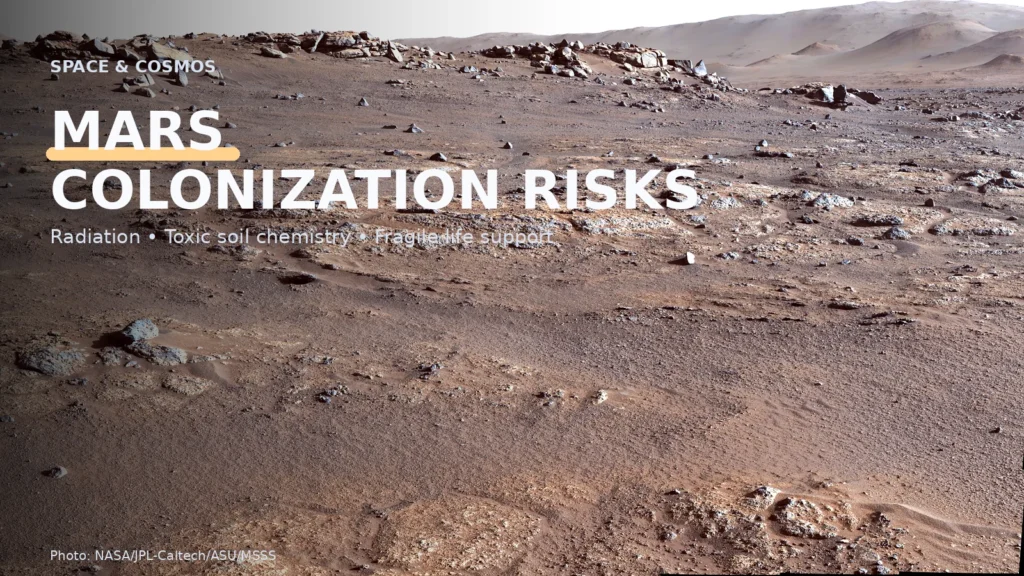
I’ve lost count of how many times I’ve heard Mars pitched as a backup drive for humanity. The sales line is always the same: multi-planet species, bold frontier, insurance policy.
Then you look at the physics, the chemistry, the biology, and the human factors, and you realize why Mars colonization risks deserve to be treated like a brutal audit-of our engineering, our governance, and our ability to tell ourselves the truth.
Here’s my heretical take: the hardest part of Mars isn’t rockets. It’s the boring stuff nobody wants on a poster-closed-loop life support that doesn’t drift, supply chains that can’t be “overnighted,” and habitats that don’t turn into slow-motion accidents. If a civilization can’t manage those, it doesn’t matter how many flags it can plant.
And if you’re wondering why that matters beyond space nerd debates, look up at the night sky and ask the oldest uncomfortable question in tech: where is everybody? The Fermi Paradox keeps hanging over us because it suggests intelligent life may be common, but long-lived, spacefaring civilizations are not.
Maybe the Great Filter is behind us. Or maybe it’s right in front of us-disguised as a hype cycle with inspirational B-roll.
The Fermi Paradox isn’t a punchline; it’s a warning label for Mars
When people talk about the Fermi Paradox, they often jump straight to aliens and UFO hot takes. That’s entertainment. The useful version is colder: if technological civilizations should be able to spread, why don’t we see evidence of them? One answer is the Great Filter-some set of hurdles that most civilizations fail to clear.
What does that have to do with building domes on Mars? Everything. Mars forces a civilization to prove it can keep complex systems stable for years under isolation, scarcity, and compounding failure modes. That’s exactly the kind of hurdle that could wipe out a society that’s clever but sloppy at coordination.
Mars is a stress test for “civilization ops”
On Earth, when a system fails, we patch it with logistics. A part breaks? Ship a replacement. People get sick? Send them to a hospital. Politics gets messy? Shift budgets. Mars removes most of those escape hatches. You can’t hand-wave a supply chain across tens of millions of miles. You can’t vote your way out of radiation. You can’t PR your way out of a habitat leak.
I’ve sat through enough product postmortems to recognize the pattern: teams optimize for launch day, not year three. Mars punishes that mindset. Mars also punishes the “it’ll work itself out” culture that thrives on Earth because the downside is distributed. On Mars, the downside is inside the room with you.
Selection effects hide the bodies
Part of why the Fermi question nags is selection bias: we’re observing from a planet that made it this far, so we underestimate how many dead ends exist. Mars makes those dead ends visible. It turns small design compromises into existential problems.
That’s why I think the Great Filter framing is fair. Not because Mars is “impossible,” but because it exposes whether we can run high-stakes systems without constant external rescue. If we can’t, it’s not just a Mars problem. It’s a “complex civilization” problem.
And the irony is that we already have the data to be humble. Space agencies publish radiation risk assessments and mitigation research precisely because the environment is hostile in ways we can’t wish away. :contentReference[oaicite:0]{index=0}
The unsexy killers: radiation, toxic dust chemistry, and the long tail of human health
If you want to start an argument at a Mars conference, don’t mention budgets. Mention biology. Mars is not just cold and far; it’s actively unfriendly to the human body over long durations. The radiation environment is a known problem with ugly uncertainty bands, and the health risks don’t politely stop at “cancer.” NASA has extensive work outlining the broader human health risks of space radiation, including degenerative effects and the complexity of countermeasures. :contentReference[oaicite:1]{index=1}
Then there’s the regolith: the dust that gets everywhere, grinds seals, irritates lungs, and carries chemical hazards. Perchlorates-chlorine-oxygen compounds found in Martian soil-are a major concern because they complicate water processing, agriculture, and human exposure. Recent scholarly work continues to synthesize gaps in perchlorate knowledge and stresses how much we still need targeted sampling and lab priorities. :contentReference[oaicite:2]{index=2}
Radiation isn’t a single problem; it’s a portfolio of problems
People talk about “shielding” as if it’s one design choice. It’s not. Shielding is mass, mass is cost, cost is schedule, schedule is politics. And even with shielding, radiation is not a binary safe/unsafe dial. It’s a chronic exposure problem that interacts with mission duration, habitat design, solar activity, and human variability.
Here’s the part that makes me nervous: organizations are great at managing risks that have immediate feedback. Radiation doesn’t give you that. It’s slow. It’s probabilistic. It’s easy to discount. That’s how you end up with a program that “works” until the health bill shows up later, when accountability has moved on.
Toxic chemistry turns “living off the land” into a chemistry lab
“ISRU” (in-situ resource utilization) is treated like a magic acronym: make fuel, make water, grow food. But perchlorates and dust complexity mean you’re not just farming-you’re doing industrial purification in a harsh environment. Every “simple” Martian greenhouse concept quietly balloons into a chain of filters, sensors, redundancy, maintenance procedures, and waste handling.
And yes, humans are adaptable. But adaptation is not the same as safety. A colony that relies on heroic workarounds is a colony that’s already in trouble. Mars colonization risks don’t have to be dramatic to be fatal; they can be the steady erosion of margins until one bad week finishes the job.
- Acute failures: decompression, fire, power loss, contamination events
- Chronic failures: radiation dose accumulation, immune changes, dust exposure, psychological drift
- Systemic failures: spare parts shortages, flawed procedures, governance breakdown under stress
The real choke point is closed-loop life support, not propulsion
Rockets get you there. Systems keep you alive. That sounds obvious, yet the cultural prestige in spaceflight still tilts toward vehicles and launches. Life support is treated like plumbing-until it fails. And Mars is the place where “plumbing” becomes destiny.
Closed-loop is harder than it sounds
On Earth, we’re “closed-loop” only because the planet is huge and forgiving. On Mars, your loop is a small box where tiny inefficiencies compound. Filters clog. Biological systems fluctuate. Microbes do what microbes do. Sensors drift. Spare parts run out. If your margins are thin, you end up spending your days maintaining the loop rather than living.
I’ve covered enough outages in the tech world to know how humans behave under persistent low-grade failure: they normalize it. They add manual steps. They skip tests to save time. They start believing the system is stable because it hasn’t collapsed yet. That’s how fragile operations become “standard practice.”
Failure cascades are the enemy
Mars habitats are tightly coupled systems. Tight coupling means that a failure in one subsystem can propagate quickly: power affects thermal control; thermal affects water; water affects hygiene and health; health affects labor; labor affects maintenance; maintenance affects power. You don’t get isolated bugs. You get cascades.
And here’s the governance sting: many cascades are not engineering failures first. They’re management failures. Deferred maintenance. Overconfident schedules. Incentives that punish bad news. A culture that treats “concerns” as negativity. If you’ve worked in a fast-moving org, you know exactly what I’m talking about.
The US audience should recognize this pattern from aviation, healthcare, and critical infrastructure: safety is not a vibe. It’s a discipline enforced by process, transparency, and real consequences.
Psychology is life support too
We also underprice human factors because they’re messy to model. Isolation, monotony, and conflict under confinement don’t just reduce happiness; they reduce operational performance. A stressed crew makes mistakes. Mistakes in a habitat are expensive. Repeated expensive mistakes become existential.
If Mars is going to be more than a stunt, the culture has to shift from “exploration heroism” to “reliability engineering.” That’s not as cinematic, but it’s how you survive year five.
JWST keeps teaching the same lesson: the universe is full of complexity we underestimate
I like to use the James Webb Space Telescope as an intellectual antidote to Mars bravado. Webb keeps showing us that even things we thought we understood-planet formation, galaxy evolution, the distribution of matter-contain surprises that force us to rewrite assumptions.
One example: Webb observed evidence of crystalline silicates forming in hot inner regions of a young star’s disk and being transported outward into colder regions-an important clue for how comet-like materials end up where they do. :contentReference[oaicite:3]{index=3}
Another: researchers used Webb observations to build a higher-resolution map of dark matter through gravitational lensing, revealing finer structure across vast cosmic time. :contentReference[oaicite:4]{index=4}
And on the exoplanet side, Webb has detected molecules like methane and carbon dioxide in the atmosphere of K2-18 b, fueling debate about what such signals do-and don’t-imply about habitability. :contentReference[oaicite:5]{index=5}
What does that have to do with Mars?
Everything, if you’re honest. Webb reminds us that nature loves edge cases. Systems behave differently when you change conditions. Small processes can dominate outcomes. That’s the same story Mars will tell us about habitats: the edge cases will matter more than the happy path.
When the public hears “Webb discovery,” they hear triumph. I hear something else: humility. Webb’s job is to reduce uncertainty, and it keeps revealing how much uncertainty remains. That is not a reason to stop exploring. It’s a reason to stop overselling certainty.
Don’t mistake “possible” for “operational”
Yes, humans can survive in harsh places. We do it on Earth-Antarctica, submarines, remote oil platforms. But those systems are backed by a planet-wide logistics base and fast rescue options. Mars is a different class of operational risk.
Webb’s discoveries are a reminder that our models are always incomplete. On Mars, incomplete models don’t just make you wrong on Twitter. They can get people killed.
Key insight: JWST shows the cosmos is richer than our assumptions; Mars will punish us the same way-through surprises that compound.
A Mars plan that isn’t theater: what has to be true before we send “civilization” to another planet
So what would a serious Mars program look like-one that treats risk like engineering, not like marketing? First, it would stop pretending that “boots on Mars” is the metric. The metric is sustained, safe operations with declining risk over time.
Prove closed-loop living on Earth, publicly, for years
Before we ship people to Mars, we should be able to run multi-year, closed-loop habitats on Earth with transparent reporting. Not a short demo. Multi-year. With stress testing. With real failure injection. With third-party audits. If a system can’t survive a controlled test environment, it won’t survive Mars.
Build redundancy like you mean it
Redundancy is expensive. It also works. A Mars program that’s serious will spend more mass and money on reliability than on aesthetics. It will design for maintainability. It will assume component failure as normal. It will treat dust intrusion as inevitable, not hypothetical.
Governance is a life-support system
Here’s the part that makes some people angry: governance is not optional. You need decision rights, safety authority, incident reporting norms, and clear liability. If the program is run like a hype-driven startup, you’ll get startup-grade safety outcomes.
And if you want the Fermi Paradox tie-in, that’s probably the point. The Great Filter might be the moment a civilization gains the ability to build high-powered, fragile systems faster than it can build the institutions to keep them safe.
Mars doesn’t let you hide from that. It forces you to pay the bill in the currency of survival. If we can treat it with the seriousness it demands, we might earn a future off-world. If we can’t, Mars colonization risks won’t be a debate topic-they’ll be the reason the “backup planet” story ends as a cautionary tale.