

AI Control Financial Markets: 10 Risks, Limits, and Real Possibilities
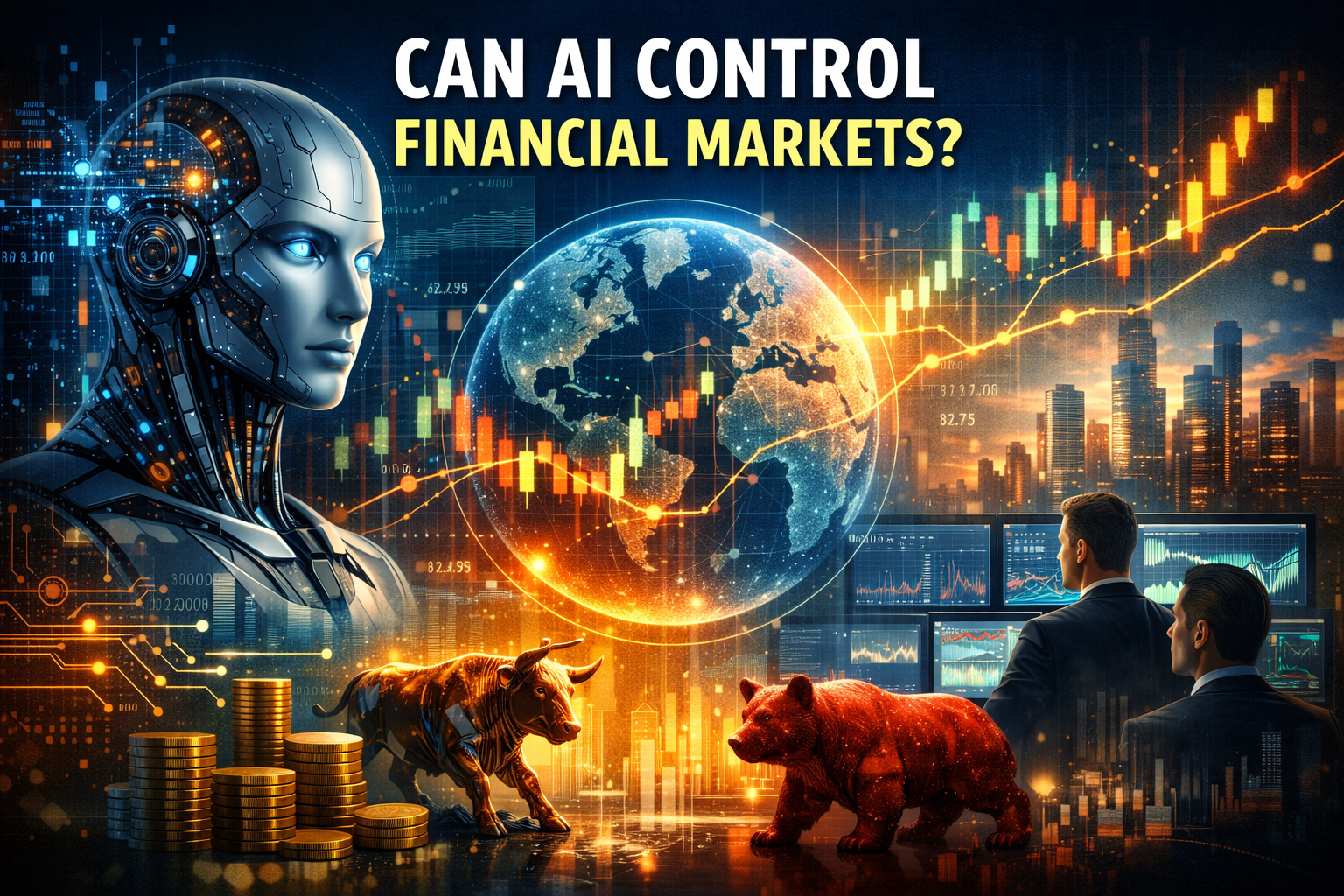
AI Control Financial Markets…. What if I told you that a mere algorithm, devoid of human emotion, could dictate the rise and fall of billions in global wealth? As financial markets become increasingly intertwined with advanced technologies, the question looms larger: Can artificial intelligence truly control these markets? With AI systems already executing trades at lightning speed and analyzing data beyond human capability, we stand at the precipice of a new era in finance. Join us as we explore the potential and pitfalls of AI’s role in shaping the future of our economic landscape.
Can Artificial Intelligence Control Financial Markets?The intersection of artificial intelligence (AI) and financial markets is a hot topic that blends cutting-edge technology with the intricate world of finance. As AI continues to evolve, many are left wondering: can it truly control financial markets? Let’s dive into this fascinating question and explore the capabilities, implications, and risks associated with AI in the financial sector.
The Rise of AI in FinanceAI has made significant inroads into the financial sector over the past few years. Here are some key developments:
AI’s ability to analyze and react to market data raises questions about its influence on market dynamics. Here’s how AI can shape financial markets:
To better understand the differences between AI-driven trading and traditional human trading, let’s look at the following comparison:
| Aspect | AI Traders | Human Traders | |
| Speed | Milliseconds to execute trades | Seconds to minutes for execution | |
| Data Analysis | Processes vast amounts of data | Limited to experience and intuition | |
| Emotional Influence | No emotions, purely data-driven | Prone to emotional decisions | |
| Adaptability | Quickly adapts to new information | Slower to adjust strategies | |
| Risk Management | Uses complex algorithms | Relies on experience |
While the use of AI in financial markets offers exciting prospects, there are also pressing concerns:
The future of AI in financial markets seems promising, yet challenging. Here are some potential developments:
In conclusion, while AI has the potential to significantly influence and even control aspects of financial markets, it is essential to approach this powerful tool with caution. The interplay between AI and human intuition, the ethical implications, and the need for regulatory frameworks will shape the future landscape. So, can AI control financial markets? The answer might be a resounding “yes” in certain contexts, but it will always need to be tempered with human insight and oversight. The world of finance is evolving, and AI is at the forefront, ready to revolutionize how we understand and interact with markets.
In conclusion, while artificial intelligence holds significant potential to influence and enhance financial market operations through advanced data analysis and predictive modeling, it also raises important questions about stability, accountability, and ethical considerations. The interplay between AI systems and market dynamics could lead to both opportunities and risks that need careful management. What do you think are the most critical factors to consider as AI continues to evolve in the financial sector?
AI Control Financial Markets and What That Really Means
The idea that artificial intelligence could control financial markets sounds dramatic, but the truth is more complex. AI does not sit above the market like a master switch deciding every price movement. What it can do is shape behavior at scale. It can execute trades faster than humans, scan huge data streams, identify patterns, react to news instantly, and influence liquidity, volatility, and price discovery in ways that are increasingly difficult to separate from the market itself. That influence can feel like control, especially when so much of modern trading happens through automated systems.
Still, control is not the same as domination. Financial markets are made up of governments, central banks, institutions, hedge funds, retail investors, corporate actions, regulation, geopolitics, human fear, and human greed. AI operates inside that environment. It can accelerate trends and change decision-making, but it does not remove the broader forces that move markets. To understand whether AI can control financial markets, it helps to ask a better question: where does AI have real power, and where do its limits become obvious?
The Difference Between Influence and Control
AI already influences markets in many ways. That part is not theoretical. It helps firms price risk, route orders, detect anomalies, optimize portfolios, generate signals, manage execution, and respond to changing conditions faster than any human desk could. But influence becomes control only when one system or group can reliably direct outcomes in a sustained way. Financial markets are usually too large, too adaptive, and too contested for that kind of complete control to remain stable for long.
Markets also fight back against predictability. If too many systems exploit the same pattern, the pattern weakens. If one strategy becomes dominant, competitors adapt. If a model overreacts, regulators, liquidity providers, or other market participants respond. This self-correcting pressure is one reason full AI control is unlikely in the strongest sense. AI can concentrate power in certain moments, sectors, or strategies, but permanent one-sided control is much harder to achieve.
Where AI Already Has Real Power
AI is strongest where speed, scale, and pattern recognition matter most. High-frequency trading is the obvious example. Algorithms can read market signals and place orders in fractions of a second, exploiting opportunities that humans cannot see or act on quickly enough. In these settings, AI does not just assist human traders. It defines the pace of the environment. Price changes, order flow, liquidity shifts, and micro-movements often happen at machine speed.
AI is also powerful in predictive analytics. Financial firms use machine learning to identify relationships across economic data, news flows, earnings reports, social sentiment, options activity, and historical pricing patterns. These models can detect weak signals hidden inside massive datasets. The result is not magic forecasting, but better probability estimates and faster reactions. In markets where speed creates advantage, that matters enormously.
How AI Changes Market Structure
One of the biggest effects of AI is structural rather than dramatic. It changes how the market functions beneath the surface. Order routing becomes more efficient. Arbitrage gaps may close faster. Risk models update continuously. Liquidity providers adjust spreads in real time. Fraud detection systems flag suspicious activity earlier. Portfolio tools rebalance automatically. On paper, many of these changes improve efficiency. In practice, they also create a market environment that is more automated, more tightly connected, and more dependent on digital systems behaving as expected.
This matters because the more structure AI controls, the more systemic its failures can become. When many large institutions rely on related data sources, similar optimization logic, or overlapping model assumptions, the market may become faster but also more synchronized. That synchronization can reduce slack in the system. Everything works beautifully until too many machines start moving in the same direction at once.
Can AI Predict Markets Better Than Humans?
In some narrow contexts, yes. AI can outperform humans in tasks that depend on rapid calculation, large-scale data processing, and repeated signal extraction. It is especially effective when markets are producing structured patterns that models can learn from historical relationships. This is why firms use AI for pricing models, short-term execution, risk scoring, and signal generation. Machines do not get tired, emotional, or distracted. They also do not miss subtle correlations simply because there are too many variables to hold in working memory.
But prediction in finance is never only a technical task. Markets are adaptive systems influenced by policy shifts, political shocks, human behavior, sudden narratives, and unexpected crises. AI can process the past and react to the present, but it does not truly understand the future in a human sense. It does not possess judgment, context, or lived intuition. It works through patterns, probabilities, and statistical relationships. When those relationships change sharply, even strong models can fail.
The Black Box Problem in Financial AI
One of the most serious concerns around AI in finance is opacity. Many advanced models, especially deep learning systems, do not provide clear explanations for why they produced a certain decision. They may identify a pattern successfully without making the reasoning transparent to managers, regulators, or even the developers who deployed them. In a low-stakes recommendation engine, this is frustrating. In financial markets, it can be dangerous.
If a model begins taking large positions, adjusting risk aggressively, or reacting strangely to volatility, firms need to know why. A black box system can perform well during normal conditions while hiding unstable logic that only becomes visible under stress. That creates a dangerous asymmetry: confidence builds during calm markets, but the real weaknesses appear only when stakes are highest. This is one reason many institutions still combine machine-driven tools with human oversight rather than handing full authority to fully opaque systems.
Could AI Trigger a Major Market Crisis?
It is possible, not because AI is malicious, but because speed and scale can amplify mistakes. If large firms deploy similar models, use overlapping data, and react to the same triggers, a small signal can cascade through the system rapidly. Orders may hit the market at once. Liquidity may vanish. Volatility can spike. A model that is rational at the individual level can create instability at the collective level. This is one of the hidden risks of automation: local optimization can produce systemic fragility.
Flash crashes are the most well-known example of automated instability, but the broader issue is not limited to one type of event. AI could worsen selloffs, amplify momentum, misprice assets in thin markets, or create reinforcing loops across multiple asset classes. The more interconnected the system becomes, the more important resilience and kill-switch design become. Speed without governance is not progress. It is just acceleration.
AI Control Financial Markets Through Sentiment and Narrative
Markets do not move on numbers alone. They also move on stories. Expectations, fear, confidence, and narrative framing are central to pricing behavior. AI increasingly operates in this emotional layer too. Models now scan earnings calls, headlines, analyst notes, social media, and even the tone of executive language. That means AI is not just trading on hard data. It is trading on interpreted meaning.
This expands its influence dramatically. If enough systems read the same news negatively and respond instantly, price moves can happen before humans have fully processed the event. In that sense, AI helps turn narrative into market action faster than ever before. But this also creates vulnerability. Biased data, misread sarcasm, manipulated content, or coordinated misinformation could distort the inputs feeding these systems. When machines trade on sentiment at scale, false signals can become expensive very quickly.
Can AI Be Used to Manipulate Markets?
Yes, and this is one of the most important risks. AI can be used not only for efficient analysis but also for strategic manipulation. Sophisticated actors could use automated systems to spread misleading signals, influence sentiment, generate fake engagement, exploit retail behavior, or test how markets react to different information patterns. In the wrong hands, AI becomes a tool not just for reading the market, but for nudging it.
Traditional market manipulation already exists, but AI raises the speed, precision, and scale of what can be attempted. That is why regulators will increasingly need technical expertise, not just legal authority. Monitoring old-style abuse in a machine-driven environment is not enough. Oversight systems must be fast enough and smart enough to recognize new forms of strategic distortion that emerge in AI-shaped markets.
Why Human Oversight Still Matters
The strongest argument against full AI control is that markets still require judgment. Humans are still needed to question assumptions, interpret unusual events, understand regulatory context, weigh political developments, and decide when model behavior no longer makes sense. A system can optimize for the wrong goal very efficiently. It takes human oversight to notice when efficiency is moving in the wrong direction.
This is especially important during regime shifts. Markets do not behave the same way in all eras. Inflation changes, central bank policy changes, war changes, energy shocks change, elections change, and investor psychology changes. A model trained on one regime may struggle badly in another. Human beings are imperfect, but they can reason about structural change in ways purely pattern-based systems cannot fully replicate. The best financial firms understand this and treat AI as force multiplication rather than total replacement.
What Regulators Need to Worry About
Regulators face a difficult challenge. If they move too slowly, markets become more dependent on systems they do not fully understand. If they regulate too rigidly, innovation shifts elsewhere or becomes harder to supervise. The real task is not stopping AI, but building rules that recognize where AI concentrates systemic risk. That includes model transparency, accountability, testing under stress, audit trails, manipulation safeguards, market access controls, and clear responsibilities when automated systems cause damage.
There is also a fairness question. If elite firms have access to better data, faster infrastructure, and stronger models, AI may widen existing inequalities in finance. Markets have never been perfectly level, but advanced automation may deepen those asymmetries. Regulation will have to think not only about stability, but also about market integrity and participation.
Retail Investors in an AI-Driven Market
Retail investors are already feeling the effects of AI even if they never use the term directly. Recommendation engines, robo-advisors, sentiment tools, trading alerts, and AI-driven market commentary are increasingly shaping how individuals understand investing. This can be helpful. AI can improve access to information, simplify portfolio management, and reduce some barriers that once favored institutions heavily.
But it can also create false confidence. An investor may believe that because a tool feels smart, the risk has disappeared. It has not. AI can help with analysis, but it cannot eliminate uncertainty. Retail users are especially vulnerable when AI outputs look authoritative without showing their limits. This is why education matters. Better tools do not replace the need for judgment, risk awareness, and skepticism.
Five Big Limits on AI Market Control
- Markets are adaptive. Once a profitable pattern becomes crowded, it tends to weaken or disappear.
- Policy still matters. Central banks, regulators, and governments can change the rules in ways models do not easily anticipate.
- Human behavior remains central. Fear, panic, greed, politics, and trust still shape markets in ways that resist neat modeling.
- Data is never perfect. Biased, delayed, manipulated, or incomplete data can distort even advanced systems.
- Systemic fragility grows with automation. The more dependent markets become on similar models, the more unstable they can become during stress.
What the Future Probably Looks Like
The most likely future is not one where AI fully controls financial markets, but one where AI becomes embedded in almost every layer of them. Trading, execution, risk, compliance, research, fraud monitoring, portfolio design, client service, and sentiment analysis will all become more automated. The question will shift from whether AI is in the market to how deeply it is integrated and how well its risks are governed.
This means power in finance will increasingly belong to those who can combine computational strength with institutional discipline. Firms that treat AI as an unchecked miracle will expose themselves. Firms that treat it as a powerful tool requiring controls, stress testing, and human review will likely perform better over time. The winners will not be the ones who remove humans entirely. They will be the ones who design stronger human-machine systems.
So, Can Artificial Intelligence Control Financial Markets?
AI can shape, accelerate, distort, stabilize, destabilize, and influence financial markets in very real ways. In certain segments, especially fast trading and analytics-heavy environments, it already dominates the pace and structure of market behavior. But total control is a stronger claim than strong influence. Markets remain too broad, too political, too emotional, and too adaptive to be ruled completely by algorithms alone.
A better conclusion is that AI is becoming one of the most powerful actors inside the market without becoming the market itself. It changes how information becomes price, how risk is measured, how trades are executed, and how narratives spread. That is enormous power. But it is still bounded by regulation, competition, human judgment, and the unpredictable nature of economic life. In the years ahead, the key challenge will not be stopping AI from touching markets. It will be making sure the systems that increasingly shape global wealth remain understandable, governable, and aligned with real-world stability.