

AI CRM for Small Business: 14 Practical Ways to Improve Sales and Customer Retention
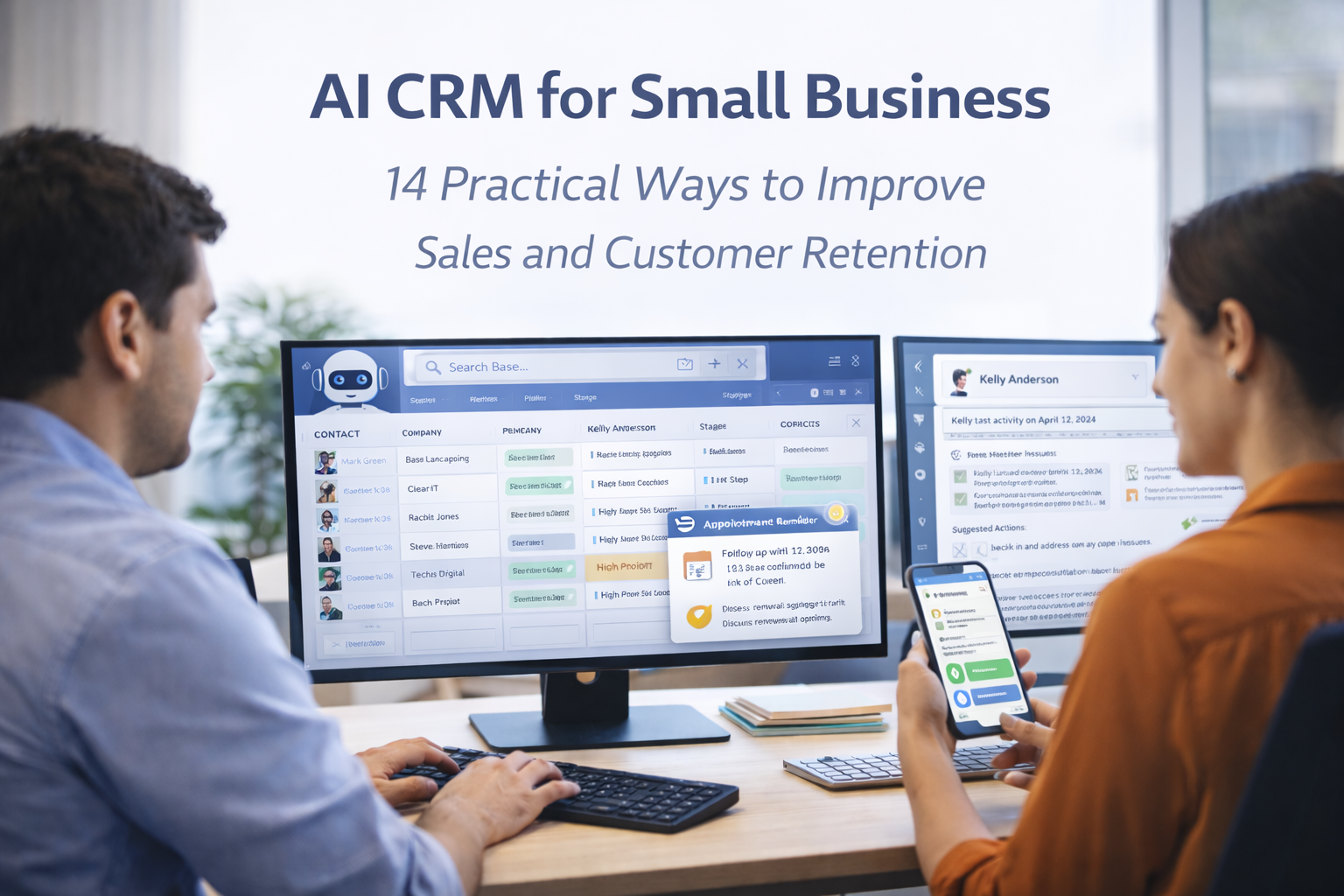
Small businesses rarely lose growth opportunities because they lack effort. More often, they lose them because customer information is scattered, follow-ups happen too late, sales notes are inconsistent, and promising leads disappear into the routine pressure of daily work. A founder replies to inquiries from a phone, a salesperson stores notes in a spreadsheet, a support message contains important buying signals that never reach the sales team, and a returning customer goes months without meaningful follow-up. None of these moments looks dramatic by itself. Yet together, they quietly weaken revenue performance.
That is why ai crm for small business has become such an important topic. Small companies are no longer asking only whether they need a CRM. Many already understand that customer relationship management matters. The deeper question is how to make a CRM truly useful without creating another system that staff ignore after the first few weeks. They want a platform that not only stores customer data, but also helps the business act on it. They want better lead handling, better timing, better visibility, and fewer missed opportunities.
An AI-powered CRM promises exactly that when used correctly. It helps businesses organize customer relationships in a more intelligent way. It can summarize conversations, identify deal signals, suggest next actions, prioritize leads, support faster follow-ups, surface risk patterns, and reduce the manual burden that causes teams to fall behind. For small businesses, this matters because they do not have the luxury of wasting good demand. A missed lead, a forgotten renewal, or a weak handoff can have a real effect on monthly performance.
The strongest argument for using AI inside a CRM is not that it feels modern. It is that it makes the sales and retention process more manageable. Small businesses often work with lean teams. One person may handle prospecting, customer communication, proposals, renewals, and post-sale follow-up all in the same week. Without structure, that workload becomes reactive. Important relationships are then managed through memory rather than process. That is a risky way to grow.
When CRM systems are enhanced with AI, they become more than contact databases. They become operating systems for relationship-driven growth. Instead of forcing staff to manually review every note, every email, every stage update, and every next step, the system helps move customer relationships forward with more consistency. That support is especially valuable for smaller teams that need strong execution without adding unnecessary administrative work.
Why Customer Relationship Management Breaks Down in Small Businesses
Many small businesses begin with informal relationship management. Leads arrive through email, social media, phone calls, form submissions, referrals, or messaging apps. At first, a founder or manager can keep track of everything mentally. The pipeline looks small enough to manage without much structure. But as the business grows, complexity rises faster than expected.
More leads means more conversations. More conversations mean more notes, more promises, more quotes, more follow-up dates, and more chances for misalignment. Different team members may speak to the same customer across sales, support, and operations. The customer history becomes fragmented. Important information lives in inboxes, chat apps, notebooks, browser tabs, and memory. Even with good intentions, consistency starts to break down.
The result is not only inefficiency. It is also lost revenue. One lead does not receive a second follow-up because nobody logged the first conversation properly. Another customer shows signs of churn, but that warning sits hidden inside a support interaction rather than being surfaced in the account record. A returning buyer is ready for another purchase, but the business has no system reminding the team to re-engage at the right time. These failures are common precisely because small businesses are busy, not because they are careless.
A traditional CRM helps organize some of this information, but many teams still struggle with adoption. If entering data feels tedious, records become incomplete. If searching the CRM feels slow, staff go back to older habits. If the system only stores information but does not help interpret it, people stop trusting it as a daily tool. This is where AI changes the equation. It reduces the manual work required to keep the CRM useful and increases the system’s ability to surface what matters when it matters.
What AI CRM Actually Means in a Small Business Environment
An AI CRM for small business is not simply a customer database with a chatbot added on top. In practical terms, it is a CRM system that uses artificial intelligence to improve how customer data is captured, summarized, prioritized, and acted on. The goal is not to make the platform look more advanced. The goal is to make relationship management more effective with less manual effort.
For example, AI can summarize a sales call and write structured notes directly into the contact record. It can identify whether a lead appears high-intent based on message content, urgency, budget signals, or service fit. It can suggest the next follow-up step after an email exchange. It can detect when deals are stalling, when customers may be at risk of churn, or when certain accounts show signs of expansion potential. It can also help draft outreach messages, standardize data fields, classify inbound inquiries, and surface important customer history before a team member responds.
In other words, AI improves the movement of information through the relationship lifecycle. That matters because small businesses do not usually suffer from lack of contact data alone. They suffer from weak timing, incomplete visibility, and inconsistent execution. AI can help close those gaps if it is connected to the workflows that matter most.
The workflow connection is critical. AI is not valuable just because it can generate text or summarize a conversation. It becomes valuable when it supports the daily rhythm of lead handling, pipeline management, account nurturing, renewals, reactivation, and customer communication. Without that operational connection, it remains a novelty feature rather than a business system.
14 Practical Ways AI CRM for Small Business Improves Sales and Retention
1. It helps capture lead details more consistently
Many small businesses lose useful information at the first point of contact. A prospect may describe their needs in a form, email, or chat message, but only part of that context makes it into the CRM. AI can help extract key details such as service interest, urgency, industry, location, and budget signals so that the contact record starts with better structure from day one.
2. It prioritizes higher-intent leads faster
Not every inquiry deserves the same response strategy. Some leads are casually exploring. Others are ready to buy soon. AI can help score or prioritize incoming leads based on message content, behavior patterns, fit, and urgency. For lean teams, this is valuable because time should go first to the leads most likely to convert.
3. It reduces manual note-taking after calls and meetings
One reason CRM records become weak is that staff dislike writing detailed notes after conversations. AI can summarize calls, meetings, and email threads into usable CRM notes, making documentation faster and more consistent. Better records lead to better handoffs and more confident follow-up.
4. It suggests next steps after customer interactions
Teams often know they should follow up but are not always sure how or when. AI can help suggest practical next actions, such as sending a case study, booking a demo, checking in after a proposal, or scheduling a renewal conversation. This reduces indecision and keeps momentum moving.
5. It improves follow-up timing
Follow-up is one of the biggest weaknesses in small business sales processes. Staff get busy, priorities shift, and promising leads go quiet. AI-supported CRM workflows can remind teams when follow-up is due, identify accounts that have gone too long without contact, and reduce the number of opportunities lost to silence.
6. It makes pipeline reviews more useful
Pipeline meetings often become guesswork when CRM data is incomplete or outdated. AI can summarize deal status, highlight stalled opportunities, identify missing information, and make reviews more grounded in actual activity. This helps owners and managers understand pipeline health more clearly.
7. It surfaces churn risk earlier
Customer retention is rarely lost all at once. Risk often appears through subtle signals such as lower engagement, unresolved support issues, weaker usage patterns, delayed renewals, or slower communication. AI can help identify these patterns sooner, giving the team a chance to intervene before the customer is lost.
8. It reveals upsell and expansion opportunities
Existing customers often represent some of the best growth potential in a small business, yet expansion opportunities are frequently missed because nobody is tracking them carefully. AI can surface accounts showing readiness for additional services, larger plans, renewal conversations, or cross-sell offers based on behavior and history.
9. It improves personalization at scale
Customers respond better when outreach feels relevant. AI can help summarize previous interactions, product interests, objections, and account history so that messages feel better informed. For small businesses, this supports more personalized communication without requiring long manual review every time.
10. It standardizes CRM data quality
A CRM is only as useful as the quality of its records. In many small businesses, data becomes inconsistent because different people write notes differently, skip fields, or label opportunities in their own way. AI can assist with data normalization, structured summaries, and more consistent record creation, which makes reporting stronger.
11. It connects customer-facing teams more effectively
Sales, support, and account management often operate with partial visibility into the same relationship. AI can help summarize interactions across functions and bring them into a clearer contact history. This reduces miscommunication and helps the business respond as one organization rather than separate departments.
12. It speeds up proposal and outreach preparation
Preparing follow-up emails, proposals, recap messages, or reactivation outreach can consume more time than expected. AI can assist with first drafts based on CRM context, helping staff move faster while still reviewing tone and accuracy before sending.
13. It improves forecasting and decision-making
Owners need to know whether the pipeline is healthy, whether retention is weakening, and where effort should be focused. When AI helps keep CRM activity cleaner and more complete, forecasting becomes more reliable. That leads to better staffing, planning, and sales decisions.
14. It reduces dependence on memory and heroic effort
Many small businesses run on the strength of a few highly responsible people who remember everything. That may work for a while, but it does not scale well. An AI-enhanced CRM creates a stronger system so the business is not dependent on heroic memory to keep relationships moving.
Why Small Businesses Need CRM Intelligence, Not Just CRM Storage
A common mistake is treating a CRM as a passive storage tool. Contacts go in, notes are added occasionally, and the system becomes a digital filing cabinet rather than an engine for growth. This is one reason some small businesses feel disappointed after adopting CRM software. The platform exists, but the business does not operate differently.
What smaller teams actually need is not just storage. They need guidance, visibility, and momentum. They need a system that helps them know which lead matters most today, which customer is going quiet, which opportunities need attention, and which relationships are strongest. AI adds that interpretive layer.
This matters because small businesses do not have time to manually analyze every account record in detail. They need help identifying patterns and priorities quickly. A CRM that only stores information still leaves too much work on the team. A CRM that helps interpret activity becomes far more useful in day-to-day operations.
That difference also affects adoption. Staff are more likely to trust and use a system when it actively helps them perform their job better. If the CRM feels like a place where work is entered for management reporting only, adoption stays low. If it helps salespeople follow up faster, helps support teams see relationship history, and helps owners understand pipeline risk, usage becomes more natural.
How AI CRM Supports Better Lead Management
Lead management is often the first major win for a small business using AI in its CRM. Most businesses generate more inquiries than they consistently handle well. Some leads get strong follow-up, others receive a delayed response, and others are logged poorly from the beginning. This inconsistency usually comes from capacity strain rather than lack of demand.
AI improves lead management by reducing the friction around intake and prioritization. It can classify the inquiry type, summarize the need, highlight urgency, and support better assignment logic. Instead of leaving someone to manually read each inquiry and decide what to do next, the CRM can help structure the decision.
That first layer of clarity matters. It shortens response time, improves routing accuracy, and reduces the number of promising leads that go cold due to indecision. In businesses where speed matters, this alone can create a meaningful difference in conversion performance.
Lead nurturing also improves. AI can help identify when a lead has stalled, when a message should be sent, or when a prospect may respond better to a different type of content. While human judgment remains important, the system can reduce the chances that opportunities are forgotten simply because the team became busy.
Why Customer Retention Should Be Part of the CRM Conversation
Many small businesses think about CRM mainly in terms of sales. That is understandable, but incomplete. The quality of customer relationship management also affects retention, renewals, referrals, and account expansion. In many businesses, the easiest revenue to lose is revenue that already exists.
Customers rarely leave without signals. They may engage less, delay responses, raise repeated issues, stop using a service fully, or begin purchasing less frequently. These patterns can be hard to notice when teams are busy and information is fragmented. AI can help bring these signals into view sooner.
A well-implemented AI CRM helps the business treat retention as an active process rather than a passive hope. It can prompt check-ins, flag renewal windows, highlight support friction, and surface accounts that deserve a proactive conversation. For service businesses and recurring-revenue models, this is especially valuable. Even one prevented churn event can be worth far more than many new leads.
Retention also shapes brand strength. A business that manages existing relationships well appears more reliable, more responsive, and more attentive. That often leads to stronger reviews, more referrals, and more stable growth over time. CRM intelligence therefore supports not only revenue operations, but also overall reputation.
Where Small Businesses Should Start First
The smartest starting point is usually not a full CRM transformation all at once. Small businesses tend to get better results when they begin with the workflows causing the greatest friction. In many cases, that means lead intake and follow-up. In others, it may mean renewal tracking, proposal follow-up, or customer reactivation.
If the biggest problem is inconsistent response to new inquiries, start there. Let AI support lead capture, qualification, and next-step reminders. If the biggest problem is weak account visibility, begin by improving conversation summaries and shared customer history. If churn or missed renewals are the pain point, focus on customer health signals and proactive reminders.
The main principle is simple: choose a repeatable process with clear revenue impact. The more often it happens, the more valuable automation and AI support become. Businesses should avoid beginning with edge cases or overly complex journeys that are hard to measure. Early wins build confidence and reveal where to expand next.
Common Mistakes to Avoid With AI CRM
The first mistake is expecting AI to fix a broken sales process by itself. If the business does not have a clear definition of lead stages, follow-up ownership, customer segmentation, or account priorities, the CRM will remain messy even with advanced features. AI improves systems, but it does not replace process clarity.
The second mistake is collecting too much data without using it. Some teams become obsessed with adding fields, tags, and notes but do not build workflows that turn this information into action. A useful CRM should help the business do something better, not simply store more detail.
Another common mistake is over-automating customer communication. AI can help draft messages and identify timing, but relationship quality still depends on judgment. Sensitive renewals, pricing conversations, complaints, or strategic accounts should not feel fully robotic. Businesses should automate structure and support personalization, while preserving human review where trust matters most.
Data hygiene is another issue. Duplicate contacts, outdated records, unclear stage definitions, and inconsistent note quality weaken the entire system. AI can help improve cleanliness, but the team still needs ownership and standards. A CRM without discipline quickly becomes less trusted.
Finally, many businesses fail to measure outcomes. They add AI features because they sound useful, but do not track whether response time improved, follow-up compliance increased, churn decreased, or conversion rates changed. Without measurement, improvement remains vague and optimization becomes difficult.
How AI CRM Improves Daily Team Productivity
One of the most overlooked benefits of AI CRM for small business is the effect on team energy. Customer-facing work often becomes exhausting not because the work itself is unimportant, but because so much of it is administrative. Logging notes, checking histories, writing repetitive follow-ups, reviewing stale deals, and cleaning records create constant drag.
AI reduces that drag. It speeds up the small actions that consume mental bandwidth. When teams spend less time reconstructing history and more time acting on clear information, their work becomes more focused. They can respond faster, prepare better, and waste less attention on routine coordination.
This matters especially in smaller companies, where each person often performs several roles. A salesperson may also handle account management. A founder may still review key deals. A support person may notice upsell signals. Productivity gains are therefore multiplied because the same people influence multiple parts of the relationship lifecycle.
Better productivity also leads to better consistency. When work feels lighter to execute, it is more likely to happen on time. Notes get captured, follow-ups get sent, handoffs improve, and customer experience becomes more stable. Those are practical gains, not abstract technology promises.
How to Measure Whether AI CRM Is Working
Small businesses should define success in operational terms rather than feature usage alone. The right question is not whether the team used AI summaries or suggestion tools. The right question is whether customer relationship performance improved.
Lead response time is one important measure. If intake and prioritization are stronger, high-quality leads should receive faster attention. Follow-up completion rate matters as well. If AI reminders and next-step suggestions are useful, fewer opportunities should be left untouched for too long.
Pipeline progression is another valuable measure. Are more qualified leads moving through stages? Are fewer deals stalling without explanation? Retention-related metrics also matter, especially in service businesses or recurring models. Are renewals handled more proactively? Are churn risks being surfaced earlier? Are customer reactivation efforts improving?
Internal metrics matter too. Teams can estimate time saved in note-taking, record cleanup, meeting preparation, and account review. If the CRM is doing its job, staff should feel less dependent on scattered tools and memory. Those efficiency gains may not always appear on a public dashboard, but they matter greatly to operational health.
Why This Topic Matters for Long-Term Site Traffic
Content around CRM, lead management, customer retention, and small business sales operations tends to attract readers who are closer to action than purely general AI audiences. They are often comparing tools, researching workflows, solving active business problems, or planning changes that affect revenue. That makes the topic commercially valuable as well as informationally useful.
It also allows broader topical authority. A strong article on AI CRM for small business can support related content clusters around lead qualification, sales follow-up automation, customer retention workflows, proposal tracking, appointment booking, support-to-sales handoff, and small business productivity systems. In other words, it does not stand alone. It strengthens a wider content strategy.
For a site trying to build traffic, trust, and topical depth, this matters. Stronger traffic growth usually comes from covering a business problem from multiple angles with practical, interconnected content. CRM sits at the center of many of those angles because customer data affects marketing, sales, support, and retention all at once.
Final Thoughts
An AI CRM is not valuable because it sounds advanced. It is valuable because it helps small businesses handle customer relationships with more clarity, better timing, and less wasted effort. It reduces the chances that leads are forgotten, customers drift away unnoticed, or teams work from incomplete information.
For small businesses, that improvement is significant. Every lead matters more. Every retention opportunity matters more. Every follow-up matters more. When the team is small, the cost of inconsistency is high. That is why a smarter CRM can create such an outsized effect.
The best approach is to treat AI as operational support, not a replacement for relationship quality. Let it capture details, summarize context, identify patterns, and suggest action. Then let people bring judgment, trust, and real communication into the moments that matter most. That combination is what turns CRM from software into growth infrastructure.
Done well, an AI CRM helps a business become more organized, more responsive, and more resilient. And for a small company trying to grow without dropping opportunities along the way, that is exactly the kind of system worth building.
Frequently Asked Questions
What is AI CRM for small business?
It is a customer relationship management system enhanced with AI features such as conversation summaries, lead prioritization, next-step suggestions, churn risk signals, and better record organization. Its purpose is to help small businesses manage sales and customer relationships more effectively.
How does AI improve a CRM?
AI helps capture information more consistently, reduces manual note-taking, surfaces relationship insights, supports better follow-up timing, and identifies patterns such as stalled deals or customer churn risk.
Is AI CRM useful only for sales teams?
No. It can also support account management, customer retention, support handoffs, renewal tracking, and cross-team visibility into customer history and needs.
What should a small business automate first in a CRM?
A strong first step is usually lead intake and follow-up, because these workflows happen frequently and directly affect revenue. Other good starting points include renewal reminders and customer reactivation.
Will AI CRM replace human relationship management?
No. The most effective use of AI is to reduce administrative work and surface insights so that people can spend more time on judgment, relationship quality, and better communication.