

AI Email Marketing for Small Business: 10 Smart Ways to Increase Opens and Conversions
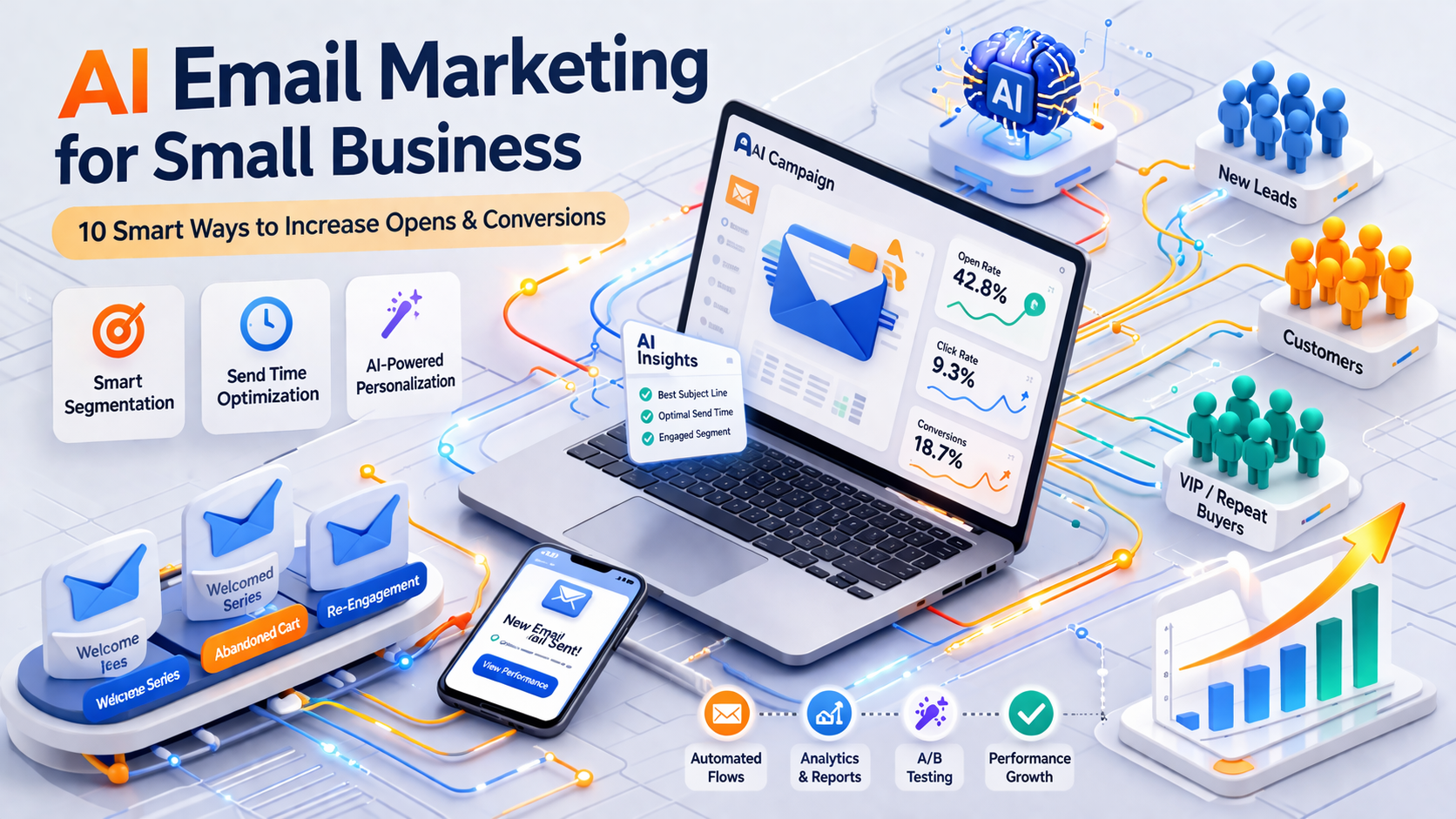
AI Email Marketing for Small Business
Email remains one of the most practical and profitable channels available to small businesses. It does not depend entirely on algorithm shifts, paid reach, or short-term trends. It gives businesses a direct line to prospects, customers, and returning buyers. Yet despite its value, many small businesses still struggle to use email well. Campaigns are sent inconsistently, subject lines feel generic, segmentation is weak, follow-up timing is poor, and the same message gets sent to people with very different needs. As a result, email underperforms not because the channel is weak, but because the workflow around it is underdeveloped.
That is exactly why ai email marketing for small business has become such a useful topic. Small companies are not just looking for another way to write faster. They are looking for a more intelligent way to plan campaigns, personalize messages, improve timing, and turn email into a stronger revenue channel without adding more manual work. They want better outcomes without needing a large marketing team or a complicated enterprise setup.
Artificial intelligence can help make that possible. When used well, it supports better segmentation, stronger subject lines, smarter product or content recommendations, more relevant follow-ups, improved send timing, and cleaner campaign workflows. That does not mean every email should be generated automatically. It means repetitive analysis and repetitive campaign preparation no longer have to consume so much energy. AI gives small businesses a way to work with more precision even when resources are limited.
For many small teams, email marketing breaks down for simple reasons. There is not enough time to review customer behavior closely. There is not enough consistency in campaign production. There is not enough insight into which message should go to which audience. And there is often too much guesswork involved in what to write next. AI helps reduce that guesswork. It gives structure to decisions that were previously based on instinct alone.
The most successful small business email strategies are not built on volume. They are built on relevance, timing, and clarity. A business does not need to send more emails if it can send smarter emails. That is where AI becomes useful. It helps small businesses move away from one-size-fits-all campaigns and toward more targeted communication that actually reflects customer interest, stage, and behavior.
Why Email Marketing Still Matters So Much for Small Businesses
Small businesses often hear constant discussion about social media trends, short-form video, influencer campaigns, and paid ad strategies. These channels can be useful, but they are often harder to control. Email is different. It remains one of the few channels a business truly owns. A mailing list is not borrowed attention in the same way a social feed is. It is a relationship asset that can be developed over time.
That matters because small businesses need stability as much as visibility. A company can spend months building audience interest on external platforms and still see reach drop unexpectedly. Email gives the business a more direct way to nurture interest, guide buying decisions, support retention, and bring customers back. It helps convert attention into relationship.
Email is also highly versatile. It can be used for welcome sequences, promotions, abandoned cart reminders, reactivation campaigns, appointment confirmations, educational content, product launches, repeat purchase prompts, referrals, and loyalty-building communication. Few channels can serve that many functions so efficiently.
The problem is not whether email works. The problem is that many small businesses still treat email as batch sending instead of relationship building. They send the same broad message to an entire list and then wonder why open rates, click rates, and conversions stay weak. Modern email performance depends on relevance. AI helps create that relevance more effectively.
What AI Email Marketing Actually Means in Practice
When people hear the phrase, they often imagine AI writing full campaigns with no human involvement. That is only a small part of the picture. In practical terms, ai email marketing for small business means using artificial intelligence to improve how email campaigns are planned, segmented, personalized, optimized, and measured.
For example, AI can help identify which subscribers are most likely to open, click, or buy. It can suggest subject lines based on past performance. It can help group subscribers by behavior instead of relying only on basic list categories. It can recommend product angles or content topics based on browsing or purchase history. It can assist in writing first drafts, preview text, call-to-action variants, and follow-up flows. It can also help analyze which types of campaigns are weakening over time and which parts of the funnel deserve more attention.
This is important because email marketing is not just a writing task. It is a decision-making task. Which audience should get this campaign? What angle is most relevant to them? When should the message be sent? What should happen if they open but do not click? What should happen if they click but do not buy? AI becomes valuable when it helps answer those questions with more confidence.
For a small business, that decision support matters just as much as content creation. It reduces the workload behind campaign planning and helps the team focus on strategy rather than repetitive setup work.
10 Smart Ways AI Email Marketing for Small Business Improves Results
1. It creates better subject lines with less guesswork
Subject lines carry enormous weight in email performance, yet many small businesses write them quickly and move on. AI can help generate stronger options based on tone, urgency, curiosity, clarity, and historical campaign patterns. This gives marketers a better starting point and often leads to stronger open rates.
2. It improves segmentation beyond basic list categories
Many small businesses still segment only by broad groups such as customers, leads, or newsletter subscribers. AI can help uncover more meaningful patterns, such as purchase intent, engagement depth, product interest, repeat behavior, or inactivity risk. This leads to more relevant campaigns.
3. It helps personalize messages at scale
Personalization is not only about inserting a first name. Real personalization reflects what the subscriber cares about. AI can help tailor product recommendations, message angles, educational content, or offers based on behavior and previous interaction. That makes the email feel more useful and less generic.
4. It supports smarter send timing
Timing affects open and click performance more than many small businesses realize. AI can help identify when different audience groups are more likely to engage. Instead of sending every campaign at the same default time, businesses can optimize timing more intelligently.
5. It reduces campaign production time
Small teams often avoid email consistency because building campaigns takes too long. AI helps reduce production friction by assisting with outlines, campaign structure, CTA options, preview text, draft copy, and follow-up variants. This makes it easier to maintain a healthier campaign rhythm.
6. It improves abandoned cart and follow-up sequences
Some of the highest-value email flows are triggered by behavior. AI can help strengthen these journeys by adjusting messaging based on browsing signals, product interest, hesitation patterns, or previous customer activity. That makes automation more relevant and more effective.
7. It helps revive cold subscribers
Inactive subscribers are a common problem. AI can help identify which contacts are worth trying to reactivate, what type of message may work best, and when it may be smarter to suppress or clean the contact from active campaigns. This improves both engagement and list quality.
8. It supports better content planning
Many businesses run out of ideas or repeat the same email angles too often. AI can help detect content gaps, suggest campaign themes, identify seasonal opportunities, and connect audience behavior to future email ideas. This helps build a more sustainable email strategy over time.
9. It improves testing and optimization
A/B testing is valuable, but many small teams lack time to design strong experiments. AI can help generate better test variations, suggest what to test next, and identify which elements of a campaign likely affected performance. This leads to more disciplined improvement.
10. It makes email marketing more profitable without requiring more staff
Ultimately, the biggest benefit is leverage. AI allows a small business to run more thoughtful campaigns, better flows, and stronger personalization without needing a large in-house marketing department. That makes email a more scalable growth channel.
Why Generic Email Campaigns Usually Fail
One of the most common reasons email marketing underperforms is that the message is too broad. A business creates one campaign and sends it to nearly everyone. The copy tries to appeal to multiple types of people at once, so it ends up speaking clearly to nobody. Existing customers receive acquisition-focused emails. New leads receive messages meant for loyal buyers. Cold subscribers receive offers with no context. The result is low engagement and weak trust.
Generic campaigns fail because customer attention is limited. People open emails that feel relevant to their current interest, need, or timing. They ignore emails that feel like another mass message. Small businesses often know this in theory, but struggle to implement better targeting because segmentation and campaign planning take time. AI helps close that gap.
By making it easier to understand customer behavior and shape different message variants, AI supports more targeted campaigns without making the workflow unmanageable. That is a major difference. Businesses do not need endless complexity. They need practical relevance.
How AI Helps Small Businesses Personalize Without Sounding Robotic
A common concern is that AI-generated email content may feel flat or artificial. This concern is valid when businesses rely on raw output without direction. But personalization does not require robotic writing. In fact, good AI-assisted email marketing should make campaigns feel more human because the content becomes more specific to the reader.
The key is to use AI for pattern recognition, structure, ideation, and first drafts, while keeping brand voice and final messaging under human control. The business should know how it wants to sound. Is the brand direct, practical, friendly, premium, playful, or educational? Once that voice is defined, AI can support consistency rather than weaken it.
Businesses should also avoid pretending that every message is handmade one-to-one communication when it is clearly part of an automated sequence. Good email marketing does not need fake intimacy. It needs relevance, clarity, and timing. Customers respond well when an email solves a real need, arrives at the right moment, and respects their attention.
Which Small Businesses Benefit Most From AI Email Marketing
Almost any business with a subscriber base can benefit, but the strongest gains often appear in businesses that already have repeat purchase opportunities, service follow-ups, quote nurturing, content-based selling, or list growth potential. Ecommerce stores, agencies, coaches, consultants, clinics, local service businesses, SaaS products, education providers, and appointment-led businesses can all use AI-enhanced email more effectively.
Ecommerce businesses benefit from product recommendations, abandoned cart flows, post-purchase sequences, and reactivation campaigns. Service businesses benefit from lead nurturing, appointment reminders, onboarding emails, and repeat booking prompts. B2B businesses benefit from educational sequences, sales follow-ups, case study delivery, and long-cycle relationship nurturing.
The biggest advantage appears where email is already connected to a customer journey. If the business simply sends occasional promotions with no flow logic, the gains will be smaller. But if the business uses email across acquisition, conversion, and retention, AI can improve performance at multiple stages.
How to Choose the First Email Workflow to Improve
The smartest place to start is not always the main newsletter. It is often the workflow with the clearest revenue impact and the highest amount of repeatable behavior. For one business, that may be an abandoned cart sequence. For another, it may be a welcome series. For another, it may be quote follow-up, repeat purchase prompts, or inactive subscriber reactivation.
If open rates are weak, start with subject lines and send timing. If clicks are weak, improve audience-message fit and call-to-action clarity. If conversions are weak, review whether the email offer truly matches subscriber intent. If retention is weak, focus on post-purchase and lifecycle campaigns rather than only promotional blasts.
Small businesses usually get stronger results when they improve one email system properly instead of trying to rebuild everything at once. Once one flow becomes stronger and more measurable, expansion becomes much easier.
Common Mistakes Businesses Make With AI Email Marketing
The first mistake is over-automating the writing while ignoring the strategy. A business may generate lots of email copy but still send the wrong message to the wrong audience. Writing support is helpful, but audience logic matters more.
The second mistake is relying on AI without training it on brand standards. If the tone changes from one campaign to the next, the brand feels inconsistent. The business should define voice, style, audience expectations, and preferred CTA structure before using AI heavily.
Another common mistake is forgetting deliverability basics. AI can improve content and timing, but it cannot compensate for poor list hygiene, spammy behavior, weak consent practices, or an unhealthy sending reputation. Businesses still need sound email fundamentals.
Some companies also make the mistake of chasing novelty over clarity. They create overly clever subject lines, complex personalization gimmicks, or unnatural message structures because AI makes experimentation easy. But email usually performs best when the offer and value are obvious.
Finally, many businesses fail to connect campaign learning back into strategy. AI can help analyze results, but the team still has to make decisions. Which angle worked best? Which audience clicked most? Which segment ignored the message? Which sequence deserves expansion? Without that feedback loop, improvement remains shallow.
How AI Email Marketing Supports Better Conversions
Conversions improve when email feels timely and relevant. A subscriber who recently viewed a product category should not receive a broad message unrelated to that interest. A customer who just bought should not be treated like someone who has never engaged. A lead who opened three educational emails may be ready for a stronger offer than someone who joined the list yesterday.
AI helps businesses respond to these differences more efficiently. It strengthens the connection between behavior and messaging. That leads to campaigns that feel more aligned with where the subscriber is in the journey. Better alignment produces better clicks, better responses, and better buying decisions.
AI can also support stronger conversion paths by improving campaign sequencing. One email may educate, the next may address objections, and the next may prompt action. Instead of relying on disconnected one-off sends, the business can use AI to build more coherent progression across the email experience.
The Retention Value of Better Email Marketing
Email is not only a sales tool. It is also a retention channel. Many small businesses focus so heavily on acquisition that they underuse email after the first purchase or initial inquiry. This is a major missed opportunity. Existing customers are often easier to serve, easier to upsell, and more likely to buy again when communication remains relevant.
AI can support retention by identifying when customers are becoming inactive, what products or services they are most likely to care about next, and which segments deserve re-engagement attention. It can help businesses create post-purchase sequences that educate, reassure, and encourage repeat value instead of going silent after the transaction.
For subscription, service, and repeat-purchase businesses, this is especially important. Retention email flows often produce some of the highest return on effort because the relationship already exists. AI makes it easier to manage these flows with more accuracy and less manual upkeep.
How to Measure Whether It Is Working
Open rate is useful, but it should not be the only metric. A more complete view includes click rate, conversion rate, revenue per email, unsubscribe behavior, subscriber reactivation, flow performance, and audience-level engagement differences.
Businesses should also look at sequence-level outcomes. Is the welcome series producing more clicks than before? Are abandoned cart emails recovering more revenue? Are repeat purchase campaigns bringing customers back sooner? Are inactive subscribers becoming active again? These questions reveal whether the system is improving where it matters.
Internal efficiency matters as well. If AI reduces campaign creation time, improves consistency, and helps the team test more intelligently, those are meaningful gains. The best email systems do not just perform better. They also become easier to maintain.
Why This Topic Is Strong for Site Traffic Growth
Email marketing sits at the intersection of traffic, conversion, and retention. That makes it one of the strongest content areas for building topical authority on a business and AI-focused site. It attracts readers with practical intent: people looking to improve results, choose tools, compare strategies, or solve underperforming campaigns.
It also creates strong internal linking opportunities. A core article on AI email marketing for small business can naturally connect to supporting content around AI copywriting, AI CRM workflows, customer retention automation, lead nurturing, appointment reminders, segmentation strategy, subject line optimization, and ecommerce automation. That makes it valuable not only as a standalone article, but as a hub inside a larger content cluster.
For traffic growth, this matters a great deal. Sustainable SEO often comes from building interconnected authority around a topic rather than publishing isolated articles. Email marketing is one of those topics that can support both breadth and depth.
Final Thoughts
Email remains one of the most effective channels available to small businesses, but only when it is used with enough relevance and consistency. Sending more campaigns is not the answer. Sending better campaigns is the answer.
AI email marketing for small business becomes valuable when it helps the business understand audiences more clearly, personalize communication more intelligently, and improve campaign workflows without increasing team burden. It turns email from a periodic task into a stronger operating system for growth and retention.
The smartest approach is to begin with one workflow that already matters to revenue, such as welcome emails, abandoned cart recovery, repeat purchase prompts, or reactivation. Improve that system first. Measure it carefully. Then expand from there.
Done well, AI does not make email marketing colder. It makes it more useful. And for small businesses trying to grow with limited time, that difference can have a real effect on both traffic and conversions.
Frequently Asked Questions
What is AI email marketing for small business?
It is the use of artificial intelligence to improve email campaign planning, segmentation, personalization, send timing, optimization, and automation for small business marketing workflows.
How does AI improve email marketing?
AI helps businesses write better subject lines, segment audiences more intelligently, personalize content, optimize timing, strengthen follow-up flows, and analyze campaign performance more effectively.
Is AI email marketing only for ecommerce brands?
No. Service businesses, consultants, agencies, local businesses, SaaS companies, coaches, and education brands can all benefit from stronger email workflows powered by AI support.
What should a small business improve first in email marketing?
A good starting point is usually the workflow with the clearest business impact, such as a welcome series, abandoned cart sequence, quote follow-up, repeat purchase prompt, or reactivation campaign.
Will AI make my email campaigns sound robotic?
Not if it is used correctly. The best approach is to use AI for research, structure, ideation, and first drafts while keeping brand voice and final review under human control.