

AI Invoicing for Small Business: 11 Ways to Get Paid Faster and Reduce Admin Work
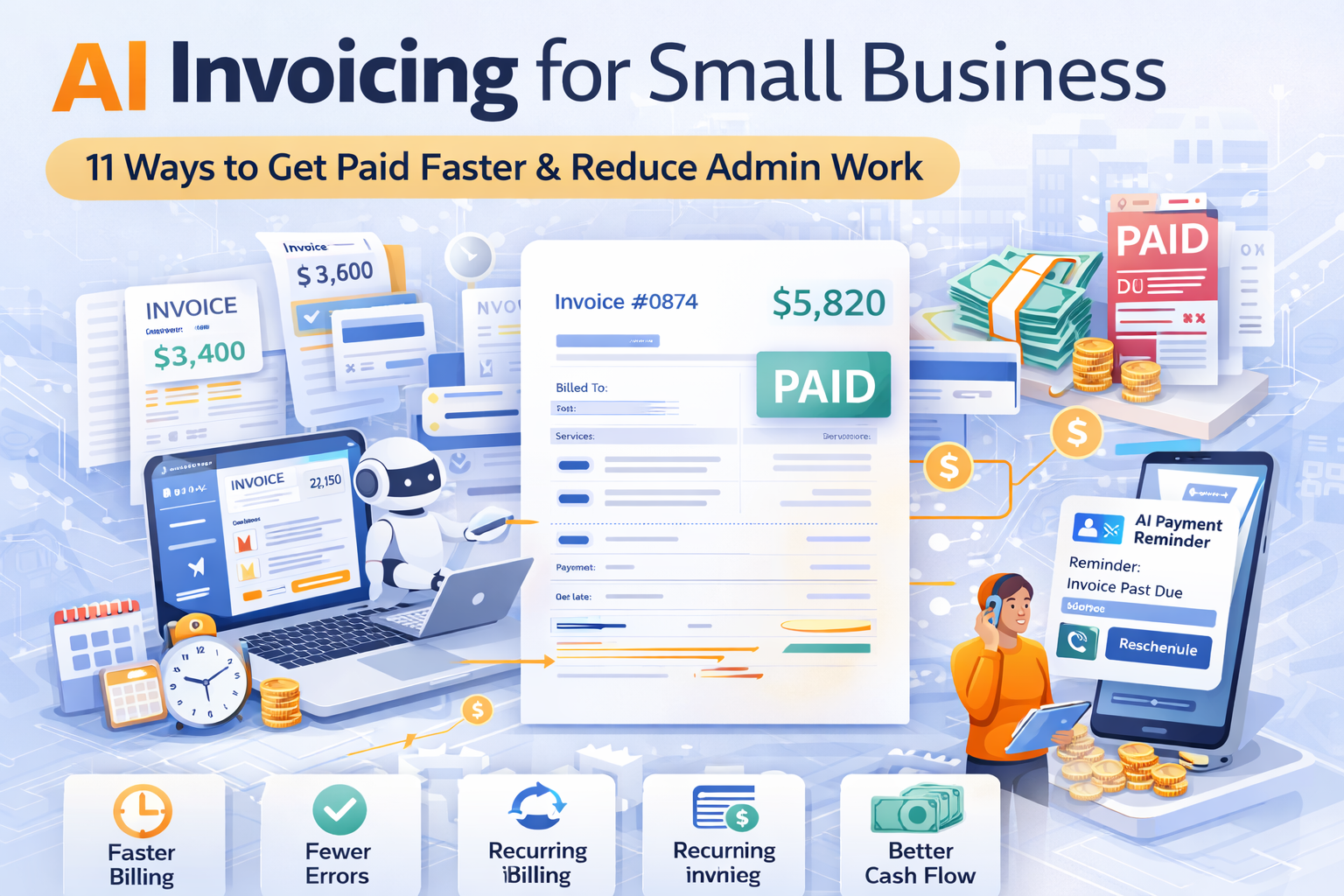
AI Invoicing for Small Business
For many small businesses, invoicing looks simple from the outside. A job is completed, an invoice is sent, and payment eventually arrives. But in day-to-day operations, the reality is far less clean. Invoice details have to be checked, line items have to be entered correctly, payment terms must be added, follow-up reminders need to be sent, and overdue accounts have to be monitored. When the team is busy, invoicing becomes one of those tasks that is always important but rarely urgent until cash flow starts tightening. By then, the damage is already visible.
That is why ai invoicing for small business has become such a practical and commercially valuable topic. Small business owners are not just looking for faster billing. They are looking for a more dependable way to turn completed work into collected revenue without losing time to repetitive admin, missed reminders, inconsistent records, or delayed follow-up. They want to reduce operational friction around one of the most important parts of running a healthy business: getting paid on time.
Artificial intelligence helps because invoicing is not only a finance task. It is a workflow task. The problem usually is not that businesses do not know how to create an invoice. The problem is that the process around invoicing is fragmented. Job details may sit in emails, project tools, notes, or CRM records. Staff may forget to invoice promptly after work is completed. Payment reminders may depend too much on memory. Customer details may be copied manually from one system to another, increasing the chance of avoidable mistakes.
AI-supported invoicing helps reduce this friction by improving how invoices are prepared, checked, categorized, scheduled, and followed up. It can assist with extracting billable details, organizing recurring invoice logic, flagging missing information, drafting payment reminders, and identifying which accounts are becoming payment risks. For small businesses, this matters because cash flow is rarely something they can afford to treat casually.
The strongest businesses are not always the ones making the most sales. They are often the ones converting completed work into collected payment with less delay, less confusion, and less manual effort. A business can look busy on the surface while still struggling underneath because billing workflows are inconsistent. That is why invoicing deserves more strategic attention than it usually gets.
Why Invoicing Becomes a Bigger Problem as a Business Grows
At the earliest stage, invoicing often feels manageable because volume is low. A founder or small team can manually create invoices, send them by email, and keep track of payments in a simple way. But once the business begins handling more clients, more recurring work, more service variations, or more staff involvement, invoicing starts to become more complicated than expected.
Different customers may have different billing schedules. Some require monthly invoicing, while others need milestone billing, retainers, hourly breakdowns, deposits, or expense additions. Some need specific invoice references, tax formatting, or separate billing contacts. In service businesses especially, payment depends on accurate translation of work into billable language. That creates a lot of room for error when done manually.
The real cost of weak invoicing is not limited to paperwork. It appears in delayed revenue, inconsistent follow-up, duplicated work, unclear records, and avoidable tension with clients. If an invoice is sent late, the payment cycle starts late. If it contains errors, trust drops and payment may be delayed further. If reminders are inconsistent, overdue balances start building quietly in the background.
Small businesses feel this pressure more sharply than larger companies because they have less buffer. A few late payments can materially affect operating flexibility. That is why even modest improvements in billing efficiency can create meaningful financial stability.
What AI Invoicing Actually Means
In practical terms, ai invoicing for small business means using artificial intelligence to improve how invoices are created, checked, scheduled, categorized, and collected. It is not only about producing a PDF faster. It is about making the billing workflow more accurate, more timely, and easier to manage.
For example, AI can help extract billable information from project notes, service logs, emails, CRM records, or timesheets. It can suggest invoice line items based on previous jobs or recurring service patterns. It can identify missing fields before the invoice is sent. It can help classify customer billing types, detect unusual payment delays, and draft reminder messages that sound clear and professional rather than repetitive or awkward.
AI becomes even more useful when connected to the wider business system. A completed task triggers invoice preparation. A recurring agreement creates a draft automatically at the correct interval. Payment status updates are monitored. Overdue accounts are identified earlier. Follow-up messages are adjusted based on payment history. That is when invoicing becomes an intelligent process rather than a manual afterthought.
The value is not that the software looks advanced. The value is that the business spends less time chasing administrative details and more time operating with cleaner cash flow and more reliable records.
11 Ways AI Invoicing for Small Business Helps Get Paid Faster
1. It reduces invoice creation time
Many businesses still build invoices manually from scattered information. AI can help pull together service details, customer data, recurring items, and billing notes more quickly, which reduces the time between completed work and invoice delivery.
2. It improves invoice accuracy
Billing errors create delays and weaken trust. AI can flag incomplete fields, suspicious totals, missing dates, inconsistent line items, or unusual pricing changes before the invoice is sent, helping businesses reduce avoidable corrections.
3. It shortens the time between delivery and billing
One of the biggest reasons payments arrive late is that invoices go out late. AI-supported workflows can trigger invoice drafting immediately after a job milestone, appointment, or project phase is completed, which starts the payment cycle sooner.
4. It helps manage recurring invoices more reliably
Retainers, subscriptions, monthly services, and repeat billing arrangements often create repetitive admin work. AI can support recurring logic, reduce missed cycles, and keep billing more consistent across ongoing client relationships.
5. It drafts better payment reminder messages
Many small businesses struggle with reminder emails because they do not want to sound too aggressive or too passive. AI can help generate clear, professional follow-up messages that maintain a good tone while still supporting faster collection.
6. It flags overdue payment patterns earlier
Some customers consistently pay late, while others begin slipping gradually over time. AI can help spot those patterns sooner, allowing the business to adjust reminder timing, payment terms, or collection attention before the issue grows.
7. It supports cleaner customer billing records
Accurate billing depends on consistent customer data. AI can assist with normalizing names, payment terms, contact details, tax fields, and recurring notes so the business has fewer record-related delays.
8. It helps connect invoicing with actual work completed
One common invoicing failure is that finished work is not translated into billing promptly. AI can help connect job completion, service delivery, or logged activity with draft invoice generation, reducing the chance that billable work gets overlooked.
9. It improves cash flow visibility
When invoice data is structured better, business owners can see which invoices are pending, which are overdue, which customers pay slowly, and which parts of the workflow are causing billing delay. That visibility supports better decisions.
10. It reduces repetitive admin burden on the team
Billing work often steals time from client delivery, sales, and operations. AI lowers the mental load by handling repetitive preparation, verification, and reminder support, which helps teams stay focused on higher-value tasks.
11. It creates a stronger financial workflow for growth
As the business grows, invoicing complexity grows too. AI helps small companies build a billing process that remains manageable as more customers, services, and payment cycles enter the system.
Why Sending Invoices Faster Matters More Than Most Owners Think
Many business owners underestimate the impact of invoice timing. They focus on closing deals, completing work, and keeping customers happy, which is understandable. But if invoicing is delayed by several days every time a project, appointment, or monthly cycle ends, the business quietly extends its own payment timeline. That means cash arrives later even when the customer pays on normal terms.
This issue compounds quickly. A three-day delay in invoicing here and a five-day delay there can create major cash flow drag over a month or quarter. It also makes forecasting harder because the business loses clean visibility into what has actually been billed and what is still waiting in someone’s task list or memory.
AI helps solve this by reducing the gap between completed work and invoice issuance. When billing becomes more automatic and less dependent on manual reconstruction, the business gets paid sooner not through pressure, but through process discipline.
How Weak Invoicing Hurts More Than Cash Flow
Cash flow is the most obvious impact, but poor invoicing also creates operational and reputational problems. Customers notice when invoices arrive late, contain unclear descriptions, or require repeated corrections. It makes the business appear less organized, even if the service itself was strong.
Internally, weak billing workflows create tension because finance tasks begin interrupting delivery work. Staff have to stop what they are doing to check details, correct old records, or chase missing information. Over time, this creates frustration and inconsistency across the team.
There is also a strategic cost. When invoice data is messy, business owners lose insight into which services generate the best payment behavior, which clients require the most follow-up, and where margin may be eroded by billing delays or administrative waste. Invoicing is not only a finance process. It is a business intelligence process too.
Which Small Businesses Benefit Most From AI Invoicing
Almost any business that bills clients regularly can benefit, but the strongest gains usually appear in service-heavy and project-based businesses where billing relies on accurate translation of work into invoice detail. This includes agencies, consultants, home service companies, clinics, freelancers, legal and professional service firms, studios, contractors, maintenance businesses, and recurring-service providers.
Businesses with recurring billing benefit because automation and reminder consistency matter a great deal. Project-based businesses benefit because work details are often scattered and invoice preparation takes too long manually. Local service businesses benefit because speed and administrative simplicity often affect whether the business stays financially steady during busy periods.
The more billable activity a company manages with a lean team, the more valuable intelligent invoicing becomes.
How to Choose the First Invoicing Workflow to Improve
The best starting point is usually the billing step creating the most friction. For some businesses, that is late invoice generation. For others, it is manual line-item building. For others, it is overdue reminder management or recurring billing consistency.
If invoices go out too late, start with trigger-based drafting after work completion. If reminders are inconsistent, improve payment follow-up logic and message templates. If billing records are messy, focus on customer data cleanup and invoice field standardization. If recurring invoices are missed or delayed, start with recurring schedule automation and exception handling.
Small businesses usually get the strongest results by solving one invoicing problem well before trying to redesign the whole finance process at once. Early wins create immediate operational relief and often expose the next area worth improving.
Common Mistakes Businesses Make With AI Invoicing
The first mistake is assuming AI can fix a disorganized billing process without clear rules. If the business does not know when invoices should be sent, who owns approval, or how services should be described, AI will only automate confusion faster. Process clarity still matters.
The second mistake is over-automating communication without reviewing tone or context. Payment reminders can be supported by AI, but businesses should make sure messages match the client relationship and payment situation. A reminder to a long-term customer with a one-time delay should not sound the same as a repeated overdue notice to a chronically slow payer.
Another common mistake is failing to connect invoicing to the systems where work is actually tracked. If billable information stays trapped in project tools, emails, or handwritten notes, the invoice process remains weaker than it should be. AI works best when it can access structured signals from real operations.
Some businesses also ignore exception handling. Recurring billing, deposits, discounts, reimbursements, split billing, and partial payments all need clear logic. AI can support those cases, but only if the business defines the rules properly.
Finally, many owners judge invoicing tools by convenience alone instead of outcomes. The real question is whether invoices are sent faster, payment delay is reduced, cash flow visibility improves, and administrative burden drops.
How AI Invoicing Supports Better Client Experience
Clients appreciate billing that feels clear, timely, and professional. An invoice that arrives when expected, contains accurate detail, and matches the work delivered makes the business feel more organized and easier to trust. This matters more than many owners realize, especially in service businesses where client relationships depend on confidence and repeatability.
AI helps improve this experience by reducing sloppy errors, keeping descriptions more consistent, and supporting smoother reminder communication. Instead of awkward last-minute billing or vague line items, the client receives a cleaner financial interaction. That reduces confusion and makes payment easier to justify internally, especially in B2B relationships.
A better billing experience can also reduce disputes and back-and-forth clarification. When invoices are structured clearly, the conversation stays focused on payment rather than on reconstructing what happened. That saves time for both sides.
The Relationship Between Invoicing and Business Stability
Small businesses often focus heavily on sales growth, which makes sense. But growth without disciplined invoicing creates instability. More work means more billing volume, more payment exposure, and more chances for delay if the system does not scale cleanly.
This is why invoicing should be treated as part of revenue operations, not only finance administration. The speed and accuracy of billing directly affect the usefulness of revenue already earned. Money that has not been invoiced properly is not functioning as healthy cash flow. Money tied up in overdue balances creates stress and reduces flexibility.
AI helps businesses protect this stability by making the collection process more organized from the start. Better billing discipline supports stronger forecasting, calmer operations, and better use of working capital.
How to Measure Whether It Is Working
The most important metrics include invoice turnaround time, days to payment, overdue invoice rate, reminder consistency, invoice correction rate, and percentage of recurring invoices sent on schedule. These numbers reveal whether invoicing is becoming more efficient and more reliable.
Businesses should also track internal time savings. Is the team spending less time assembling invoices manually? Are payment reminder tasks becoming easier to manage? Are customer billing records cleaner? Are fewer invoices being delayed because someone has to chase missing information?
Cash flow visibility matters too. If owners can see payment status more clearly and identify slow-paying accounts earlier, the invoicing system is becoming more valuable as a decision tool, not just a billing tool.
Why This Topic Is Strong for Site Traffic Growth
Invoicing is a high-intent topic because the people searching for it are usually dealing with a real business problem. They are not casually browsing. They want to reduce billing time, improve collections, automate repetitive admin, or stabilize cash flow. That makes the topic commercially strong and useful for attracting readers closer to action.
It also supports a wider SEO cluster. A strong article on AI invoicing for small business can connect naturally to related content around AI bookkeeping, AI proposal writing, AI CRM, payment reminders, cash flow management, onboarding workflows, and small business automation systems. That cluster potential makes the topic valuable beyond a single post.
For a site trying to build traffic and authority, this matters. Strong SEO growth often comes from covering practical business workflows deeply and from multiple angles. Invoicing is one of those workflows because it sits between delivery, finance, and operations.
Final Thoughts
AI invoicing for small business matters because billing should not depend on memory, scattered notes, or last-minute administrative effort. The faster and more clearly a business turns completed work into accurate invoices, the healthier its cash flow and the more stable its operations become.
For small teams, AI provides leverage. It helps reduce repetitive billing work, improve accuracy, support better payment follow-up, and create a stronger system for collecting revenue already earned. That is not a minor convenience. It is an operational advantage.
The smartest way to begin is with one billing workflow that causes the most friction right now, whether that is late invoice creation, inconsistent reminders, recurring billing gaps, or manual data entry. Improve that process first. Measure the effect. Then expand gradually.
Done well, AI does not make invoicing impersonal. It makes it cleaner, faster, and more dependable. And for a small business trying to grow without cash flow stress, that can make a significant difference.
Frequently Asked Questions
What is AI invoicing for small business?
It is the use of artificial intelligence to improve how small businesses create, check, schedule, and follow up on invoices so billing becomes faster, more accurate, and easier to manage.
How does AI improve invoicing?
AI helps extract billable details, reduce invoice errors, support recurring billing, draft payment reminders, identify overdue patterns, and improve the connection between completed work and invoice creation.
Is AI invoicing useful only for large businesses?
No. Small businesses often benefit strongly because they have limited administrative time and less room for billing delays or inconsistent payment follow-up.
What should a small business improve first in invoicing?
A good first step is usually the billing problem causing the most friction, such as late invoice creation, weak payment reminders, missed recurring invoices, or messy customer billing records.
Will AI invoicing replace human review?
No. The best use of AI is to reduce repetitive administrative work and improve accuracy while keeping human oversight for approvals, exceptions, and customer-sensitive billing decisions.