

AI Lead Nurturing for Small Businesses: 10 Ways to Turn More Prospects Into Clients
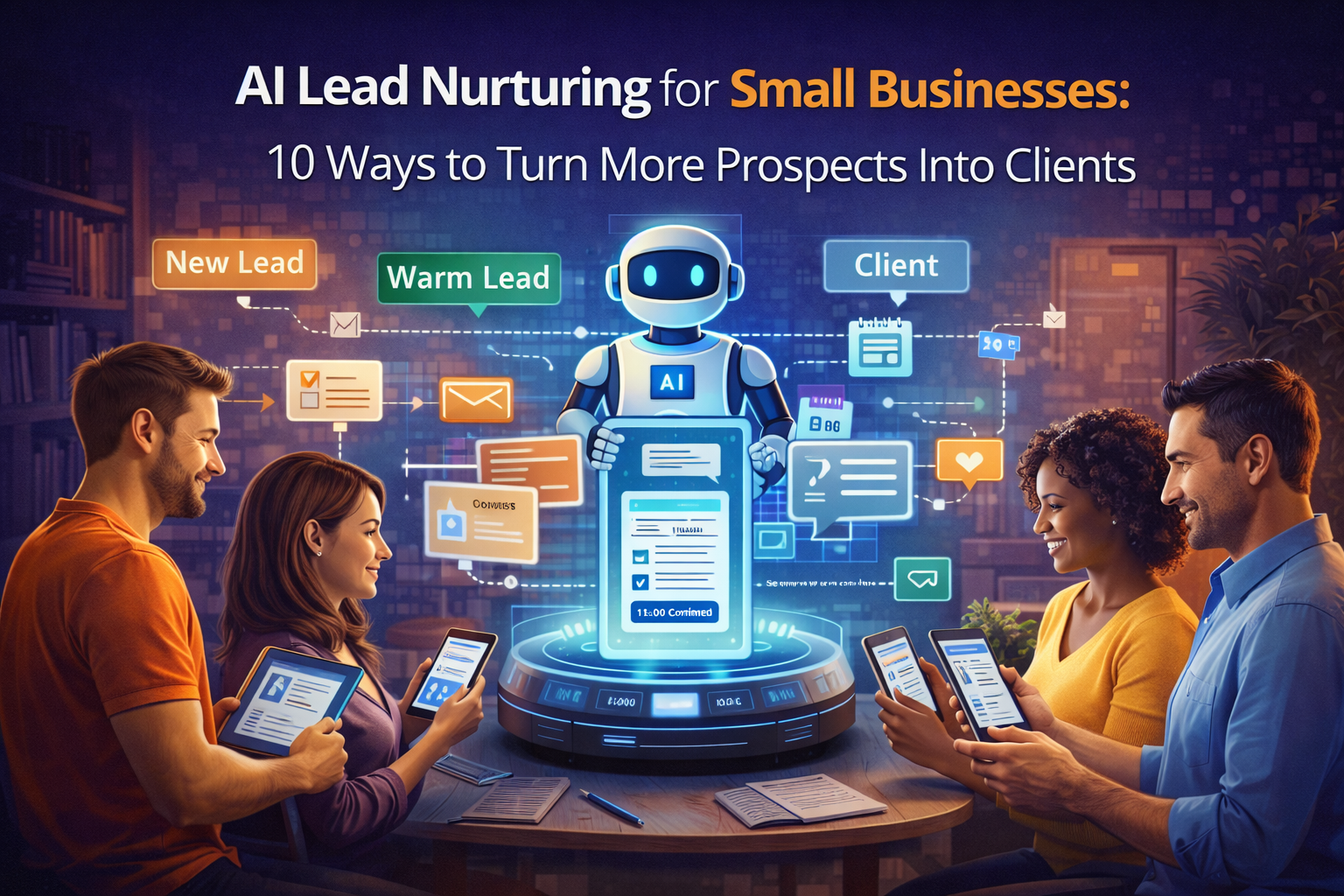
AI lead nurturing for small businesses is becoming one of the most effective ways to improve conversion without constantly chasing more traffic. Many small businesses spend a great deal of time trying to attract new leads through search, ads, referrals, local listings, content, and social media. That effort matters, but traffic alone does not create growth. A business can generate interest and still lose revenue if prospects are not guided properly after the first interaction. This is where lead nurturing becomes critical. It is the process that helps people move from curiosity to confidence, from inquiry to trust, and from interest to action.
For many small business owners, lead nurturing is far weaker than lead generation. They answer inquiries manually, follow up inconsistently, forget warm leads when delivery work gets busy, and depend too heavily on the prospect to restart the conversation. The result is a quiet leak in the business. Good-fit leads do not always say no. Many simply drift away because no clear system kept the relationship moving. In practical terms, this means the business spends time and money bringing people in, then fails to create enough structured communication to help those people decide.
This is exactly why AI has become so useful in this stage of growth. Used well, it does not turn the sales process into a cold automation machine. It helps small businesses stay responsive, relevant, and organized at a scale that would otherwise require much more manual effort. AI can help summarize inquiries, classify lead intent, suggest follow-up timing, draft nurture emails, personalize educational messages, detect engagement patterns, and support the kind of steady communication that turns uncertain prospects into ready buyers.
The real advantage of ai lead nurturing for small businesses is not that it sends more messages. It is that it helps the business send better messages at better moments with less friction. That matters because most prospects do not buy the instant they discover a company. They compare. They hesitate. They get busy. They need reassurance. They want more clarity on outcomes, pricing, timing, fit, or trust. Lead nurturing exists to support that decision journey. AI simply makes it easier to manage that journey more consistently.
For small businesses with limited staff and limited time, this can be a major competitive advantage. Bigger companies may have larger teams, but local and lean businesses often have stronger personal connection, more flexible communication, and more direct understanding of customer concerns. When AI supports those natural strengths instead of replacing them, the result can be a much stronger conversion system. That is why this topic matters so much for businesses trying to grow without wasting the leads they already worked hard to earn.
AI Lead Nurturing for Small Businesses: Why It Matters More Than Ever
Modern buyers rarely move in a straight line. Even when they are interested, they often need several touches before they are ready to commit. A prospect may visit the website, read a service page, leave, come back later, fill out a form, compare other providers, open one email, ignore the next, ask a question, and only then decide whether to move forward. This pattern is normal, but many small businesses still operate as if one inquiry should either close immediately or be forgotten. That assumption creates a huge missed opportunity.
At the same time, competition has increased across nearly every service category. Whether the business is a clinic, agency, contractor, consultant, ecommerce brand, local service company, coach, or software provider, prospects can evaluate multiple options quickly. That means follow-up quality often becomes part of the buying decision. The business that stays helpful, clear, and relevant after the first contact usually has an advantage over the business that responds once and then disappears.
There is also a workload problem. Small teams do not usually fail at lead nurturing because they do not care. They fail because the work is repetitive, scattered, and easy to postpone. Someone has to remember who inquired, what they asked, what stage they are in, when they should be contacted again, which materials would help them decide, and what tone makes sense for the relationship. As lead volume rises, this becomes difficult to manage through memory and inbox habit alone.
AI helps because lead nurturing contains many tasks that are structured but time-consuming. Messages need to be categorized, replies need to be drafted, previous conversations need to be summarized, next steps need to be suggested, and content needs to be matched to buyer intent. These are exactly the areas where AI can reduce manual burden while still leaving the business in control of tone, relationship, and final communication decisions.
That combination is what makes AI lead nurturing so relevant now. It does not just save time. It helps small businesses create a steadier, more trustworthy buying experience in markets where attention is short and buyer hesitation is common. When the nurturing system improves, the business often discovers that growth depends less on getting more leads and more on handling existing leads better.
What AI Lead Nurturing Actually Means
Lead nurturing is sometimes misunderstood as a simple email sequence or a few reminder messages. In reality, it is broader than that. It is the set of communications and decision supports that help a prospect progress through uncertainty. That may include welcome emails, educational content, case studies, follow-up messages, FAQ answers, booking reminders, offer explanations, comparison guidance, review requests, and stage-based check-ins. Good lead nurturing feels useful rather than pushy because it answers the questions that naturally appear as the buyer gets closer to a decision.
AI makes this more practical by helping organize and personalize the process. A lead inquiry can be summarized automatically. The business can detect whether the prospect is asking a pricing question, a timing question, a fit question, or a high-intent service question. AI can help decide what kind of follow-up content is most appropriate, when the next message should be sent, and how the previous conversation should be referenced so the communication feels connected instead of random.
This does not mean AI should run the entire relationship without oversight. The strongest systems use AI as an assistant to the nurturing workflow, not as a replacement for business judgment. The business still decides the tone, checks sensitive messages, and makes sure that personal communication stays human where it matters most. The point is not to automate empathy. The point is to reduce the repetitive work that prevents empathy and consistency from showing up often enough.
For small businesses, a useful definition is simple: AI lead nurturing is using intelligent tools to help prospects receive the right information, at the right stage, in a timely and organized way that increases trust and improves conversion. Everything else is just the method used to achieve that outcome.
1. It Helps Businesses Respond Faster After the First Inquiry
The first follow-up matters more than many small businesses realize. A prospect who fills out a form, sends an email, or asks for information is often actively comparing options. Even if the service is strong, a slow or unclear response weakens momentum immediately. Businesses often assume prospects will wait patiently, but in reality many will move to the next option if the first interaction feels vague or delayed.
AI helps by reducing the lag between inquiry and response. It can summarize the incoming message, identify the likely service category, suggest a first reply, and help the business send a cleaner, more relevant answer faster. That does not mean pressing send without review. It means removing the blank-page delay that often slows down the first interaction unnecessarily.
Speed matters because it signals attentiveness. But relevance matters too. A fast response that ignores the real concern is not helpful. AI supports both when it helps the team understand the inquiry more quickly and begin the relationship with a stronger, more tailored reply.
2. It Keeps Warm Leads From Going Cold Too Early
One of the biggest hidden problems in small business sales is the number of leads that are neither won nor truly lost. They are interested, but undecided. They may need internal approval, more information, better timing, or more trust before they commit. Without a nurturing system, these leads often vanish into silence. The business assumes they were not serious, when in fact they simply were not guided far enough.
AI lead nurturing helps keep these opportunities alive by creating structured follow-up. It can remind the business when a lead has been quiet too long, suggest a relevant check-in message, and help reference previous context so the communication feels intentional instead of generic. This is especially valuable because many follow-up failures are not strategic failures. They are memory failures. The lead disappears not because the business chose to stop, but because no system surfaced the right next action at the right time.
When warm leads are handled more consistently, conversion improves not through pressure but through presence. The business stays visible and helpful during the period where the prospect is still deciding. That is where many deals are actually won.
3. It Improves Message Relevance Based on Buyer Intent
Not all leads need the same communication. Some are price-sensitive and need clarity. Some need education because they are early in the decision process. Some already understand the service and mainly need trust signals. Others need urgency because the problem is immediate. Treating all of these leads the same usually creates weak nurture performance because the message does not match the mindset.
AI can help identify different intent patterns from the way prospects ask questions, the pages they engage with, the forms they submit, or the replies they send. A lead who asks “how soon can you start” is different from one who asks “what is included” or “how much does this usually cost.” Those differences matter. They should shape what kind of message the lead receives next.
This is one of the strongest uses of AI in nurturing. It helps the business communicate with more precision without requiring someone to manually interpret every lead from scratch. Better intent matching usually leads to better response quality and higher trust because the communication feels more relevant to the actual concern.
4. It Makes Educational Follow-Up Easier to Deliver
Many prospects do not convert immediately because they lack confidence, not because they lack interest. They want to understand the process, compare options, learn what affects pricing, or see proof that the business understands their problem. This is where educational nurturing becomes powerful. A helpful guide, a short explanation, a case study, or an FAQ answer can move a lead closer to action without sounding sales-heavy.
AI helps small businesses deliver this kind of education more consistently by matching leads with relevant materials and helping create those materials in the first place. A business can take common prospect questions and turn them into nurture emails, article suggestions, service comparisons, or short explanatory messages. Instead of improvising every time, the business creates a smarter content-supported follow-up system.
This matters because educational nurture builds trust through usefulness. It shows the prospect that the business is not only trying to close them quickly, but also trying to help them make a better decision. That often leads to stronger clients, not just more clients.
5. It Creates Better Follow-Up Timing
Timing is one of the hardest parts of lead nurturing. Follow up too late and the opportunity cools. Follow up too soon and the message can feel impatient or out of touch. Many small businesses default to inconsistent timing because they are relying on memory, calendar notes, or whatever happens to feel urgent that day. That usually means some leads are over-contacted while better leads are forgotten.
AI can improve timing by identifying inactivity, engagement signals, and likely stage progression. It can help suggest whether a lead needs a quick reminder, an educational follow-up, a booking prompt, or simply more time before the next contact. These suggestions do not need to be perfect to create value. Even a modest improvement in timing can reduce awkward communication and preserve more opportunities.
For a small business, better timing often means better professionalism. The follow-up feels measured and useful rather than desperate or random. That helps the nurture process support trust instead of eroding it.
6. It Supports More Personalized Email Sequences
Email remains one of the strongest channels for lead nurturing because it gives businesses a low-cost way to stay present over time. The problem is that many email sequences are too generic. They are written as if every prospect has the same concern, the same stage, and the same urgency. That approach may create some results, but it usually underperforms compared with more tailored communication.
AI can help improve email nurture by segmenting leads more intelligently and generating more context-aware drafts. Instead of sending the same sequence to every new lead, the business can align messaging with service type, stage, concern, or engagement behavior. A lead who downloaded a guide may need a different follow-up than one who requested pricing directly. A lead who clicked a case study may be closer to trust than one who only opened the first welcome email.
This kind of personalization used to feel out of reach for smaller teams. AI makes it more realistic by reducing the manual work required to create and maintain smarter sequences. The result is often better open quality, better replies, and stronger conversion movement across the nurture cycle.
7. It Helps Small Teams Stay Organized Across Many Conversations
Lead nurturing becomes difficult when conversations are scattered across forms, email, chat, DMs, CRM notes, and internal reminders. Many small businesses are not losing leads because their offer is weak. They are losing leads because the communication environment is fragmented. One person responds in email, another sends a text, a third forgets the follow-up entirely, and no one has a clean picture of where the relationship stands.
AI supports organization by summarizing previous interactions, surfacing the most important context, and helping the business see what happened last and what should happen next. This is especially useful in lean teams where the same few people manage many relationships at once. Instead of rebuilding context manually, they can work from a clearer view of the lead’s history.
Better organization leads directly to better nurturing because consistency becomes easier. The business stops acting like each message exists in isolation. The prospect experiences a more coherent journey, which increases the likelihood of trust and response.
8. It Makes Re-Engaging Old Leads More Practical
Some of the most valuable leads in a business are old leads that never fully closed but were never truly disqualified either. These people already know the brand, showed some level of interest, and may be much closer to buying later under different conditions. The challenge is that most small businesses do very little with this group because re-engagement feels like too much work to handle manually.
AI helps by making dormant lead reactivation far more manageable. It can identify stale but relevant opportunities, summarize the original conversation, and suggest re-engagement messages that reference previous context in a natural way. This is much more effective than sending a random generic campaign to everyone who ever inquired.
Re-engagement matters because demand does not always disappear. Timing changes. Budget changes. Priorities shift. When a business has a good way to return to earlier opportunities intelligently, it can create more revenue from leads it already paid to acquire.
9. It Gives Owners Better Visibility Into the Lead Journey
Many small business owners know they have leads coming in, but they do not always know where those leads stall. Do prospects stop after the first email. Do they disappear after receiving pricing. Do they fail to book the consultation. Do they need more proof before they move. Without visibility, the nurturing process stays too vague to improve deliberately.
AI can help surface these patterns by organizing interaction history and summarizing where leads are slowing down. This gives the business a better chance to improve the right stage rather than guessing. Maybe the problem is not traffic. Maybe it is that no one follows up after quoting. Maybe the issue is that the educational sequence is weak. Maybe prospects need stronger trust content earlier. Better visibility helps reveal these realities.
This is where lead nurturing becomes strategic. It stops being a pile of messages and starts becoming a system the business can analyze and strengthen over time. AI supports that shift by making the journey easier to see.
10. It Helps Small Businesses Grow Without Becoming Impersonal
One fear many owners have about AI is that it will make communication feel robotic. That fear is reasonable if the business uses automation badly. But well-designed nurturing does the opposite. It uses AI to reduce repetitive admin so the human side of the business has more room to show up where it matters. Staff spend less time sorting, drafting, and remembering, and more time refining important messages, having better sales conversations, and responding thoughtfully to high-value prospects.
This is especially valuable for small businesses because personal trust is often one of their biggest strengths. They do not need to out-automate giant brands. They need to stay responsive and organized without losing warmth. AI supports this best when it handles structure, timing, and draft preparation while the business still owns tone, empathy, and final relationship decisions.
That balance is what makes AI lead nurturing worth adopting. It does not require the business to become less human to become more efficient. It helps the business become more consistent in the ways that allow its human strengths to show up more often.
What Small Businesses Get Wrong About Lead Nurturing
One common mistake is assuming that no reply means no interest. In reality, many leads disappear because life gets busy, not because the offer was rejected. Another mistake is nurturing too generically. If every prospect gets the same sequence regardless of intent or stage, the messages quickly lose relevance. Businesses also make the mistake of waiting too long between touches, which weakens momentum and reduces recall.
Some owners go too far in the other direction and over-automate everything. That creates follow-up that feels cold or disconnected from the real relationship. AI should support relevance and continuity, not remove judgment. Another mistake is failing to connect nurturing with actual customer questions. If the messages are not built around real concerns, they sound like marketing noise instead of useful guidance.
The best nurturing systems are grounded in real buyer behavior, adjusted for timing, and reviewed with human care. AI improves those systems. It does not replace the need to understand how customers actually make decisions.
How to Build a Better AI Lead Nurturing Workflow
The best place to start is by mapping the stages where leads tend to hesitate. Do they need more clarity after inquiry, more trust before booking, more education after a pricing email, or more reminders after a consultation invite? Once the friction points are visible, AI can be introduced where it reduces the most repetitive work.
Next, build a content base around real customer concerns. FAQs, case studies, short explainer emails, service comparisons, and onboarding previews all make good nurturing assets. AI can help turn those raw materials into stage-specific drafts or sequences. The goal is to make the nurture process more helpful, not just more frequent.
It also helps to start with light automation. Let AI summarize incoming leads, suggest timing, and draft follow-up messages. Keep humans reviewing what matters. As confidence grows, the workflow can become more refined. Strong nurturing systems usually evolve in layers rather than being built perfectly on day one.
Most importantly, judge the system by conversion quality, not message volume. If leads feel more understood, follow-up becomes more consistent, and good-fit prospects move forward more often, the workflow is working.
The Future of AI Lead Nurturing for Small Businesses
The future of ai lead nurturing for small businesses will likely be built around more connected customer journeys. Inquiry forms, email responses, site behavior, call notes, FAQs, and sales content will increasingly work together. AI will help businesses understand not just who the lead is, but what they likely need next. That could mean a case study, a short explanation, a booking prompt, a comparison guide, or a timely reminder based on earlier behavior.
This matters because the businesses that win in the future will not necessarily be the ones with the biggest ad budget. They will often be the ones that follow up better, educate more clearly, and guide uncertainty more effectively. Lead nurturing sits at the heart of that advantage because it determines whether demand turns into trust and whether trust turns into action.
Small businesses are especially well positioned here. They often have stronger real-world understanding of their customers than larger competitors do. AI helps them operationalize that understanding with more consistency and less manual burden. That is what makes it powerful. It translates everyday sales wisdom into a repeatable communication system.
In the end, growth does not always come from attracting more people. Often it comes from taking better care of the people who already showed interest. That is exactly why AI lead nurturing matters. It helps small businesses protect the value of every inquiry, build trust more deliberately, and convert more opportunities without needing to multiply stress at the same rate as lead volume.