

AI Proposal Writing for Small Business: 12 Ways to Close More Clients Faster
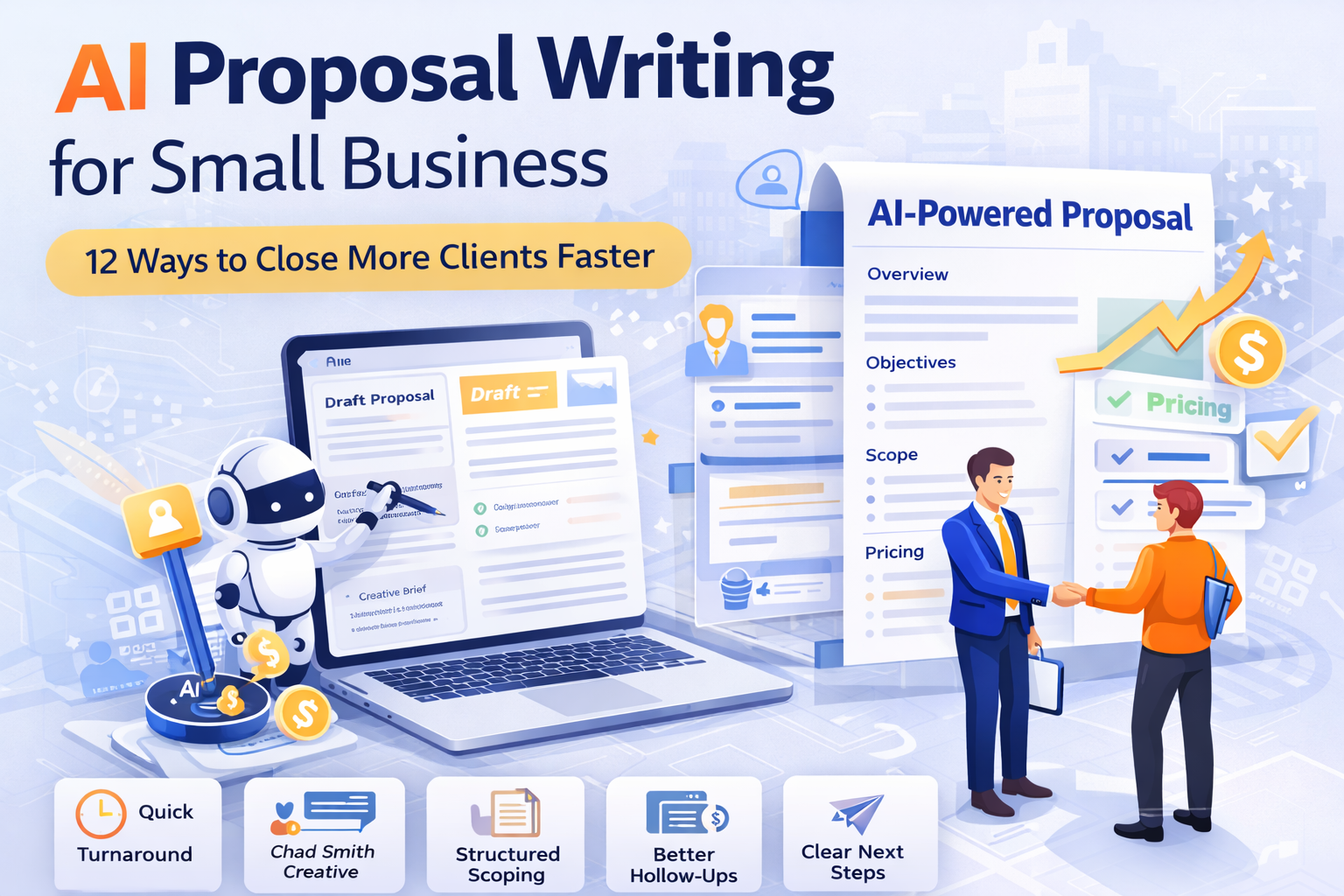
AI Proposal Writing for Small Business
For many small businesses, proposals are where interest turns into revenue. A prospect may like the service, trust the conversation, and feel positive about the business, but the proposal is often the moment when everything becomes real. It is where scope, value, pricing, timing, professionalism, and confidence all meet in one document. That is why proposal quality matters so much. Yet in many small companies, proposals are still created in a rushed, repetitive, and inconsistent way.
One week, a proposal is detailed and persuasive because the team had enough time to prepare it properly. The next week, another proposal is delayed, too generic, or missing important context because daily operations became busy. A founder pulls old wording from past documents, edits a few lines, changes the price, and sends it out quickly. Another team member creates a completely different style for the next lead. Over time, this creates a serious business problem. The company may be delivering strong work, but its proposals fail to present that value clearly and consistently.
That is exactly why ai proposal writing for small business has become such a valuable subject. Small businesses are no longer looking only for faster writing. They are looking for a better system for turning qualified opportunities into clear, persuasive proposals without losing hours to repetitive document work. They want proposals that feel tailored, professional, and strategically structured, but they do not want every sales opportunity to require rebuilding the document from scratch.
Artificial intelligence helps make that possible when used correctly. It can support proposal drafting, scope framing, service explanation, pricing presentation, objection handling, tone consistency, next-step clarity, and document personalization. It can reduce the blank-page problem and speed up first drafts dramatically. But more importantly, it can help small businesses create a repeatable proposal process that is more reliable under pressure.
This matters because proposals are not just administrative documents. They are sales assets. They shape how the buyer understands the offer. They influence how professional the company appears. They affect how clearly expectations are set before work begins. And they often determine whether the client moves forward quickly, asks for revisions, delays the decision, or chooses another provider.
The strongest small businesses are not always the ones with the best service alone. They are often the ones that communicate their value more clearly at the right moment. A strong proposal is one of the clearest tools for doing that. AI becomes useful because it helps smaller teams create stronger proposals more consistently without needing a full-time proposal department.
Why Proposal Writing Is Harder Than It Looks
Many people assume proposals are simple documents. They imagine them as basic price quotes with a short service description attached. But in reality, good proposals do much more than list deliverables. They translate a client’s problem into a structured offer. They show understanding. They remove uncertainty. They define what is included, what is not included, how the process works, what outcomes are expected, and why the business is the right choice.
That requires both clarity and judgment. A proposal that is too short may feel vague or careless. A proposal that is too long may feel bloated and difficult to scan. A proposal that focuses too heavily on the company may fail to connect with the client’s real concerns. A proposal that discusses price without enough strategic framing may invite unnecessary discount pressure.
For small businesses, this challenge is intensified by limited time. Proposals are often created while the same people are also handling delivery, customer support, scheduling, invoicing, and business development. Even highly capable teams can end up sending weaker proposals simply because document preparation competes with too many other priorities.
This is why proposal performance often becomes inconsistent. Not because the business lacks expertise, but because it lacks a repeatable writing system. AI helps reduce this inconsistency by improving how proposals are structured, drafted, refined, and personalized across repeated sales situations.
What AI Proposal Writing Actually Means
In practical terms, ai proposal writing for small business means using artificial intelligence to improve how proposals are planned, written, tailored, and delivered across the sales process. It is not only about generating paragraphs. It is about supporting a stronger workflow from client discovery to final document.
For example, AI can help turn meeting notes into a draft proposal outline. It can summarize a prospect’s key problems and convert them into a clearer problem statement. It can recommend stronger service framing, improve transitions, rewrite overly generic language, and help create clearer scope descriptions. It can also assist with pricing explanation, timeline formatting, value positioning, and next-step sections such as approvals or kickoff instructions.
That makes proposal writing far more manageable for small teams. Instead of starting from a blank page every time, businesses can use structured prompts, approved messaging, and reusable context to create better first drafts quickly. The result is not only faster writing. It is more reliable writing.
AI is most useful when attached to a real proposal workflow. A lead becomes qualified, discovery notes are collected, the service need is categorized, the proposal structure is selected, AI helps draft the initial version, and a human reviews the document for accuracy, strategy, and tone. This is what turns AI from a writing shortcut into a business system.
12 Ways AI Proposal Writing for Small Business Helps Close More Clients Faster
1. It reduces proposal turnaround time
One of the biggest reasons businesses lose momentum is slow proposal delivery. A prospect finishes a call feeling interested, but the proposal arrives too late. AI helps reduce the drafting time between conversation and delivery, which keeps sales momentum stronger.
2. It makes proposals feel more personalized
Generic proposals often weaken trust. AI can help incorporate the client’s industry, goals, pain points, and priorities more consistently into the document so the offer feels more directly connected to the conversation.
3. It helps turn discovery notes into structure
Many businesses gather good discovery information but fail to translate it into a compelling proposal. AI can summarize call notes and organize them into sections such as objectives, scope, deliverables, timeline, and expected outcomes.
4. It improves clarity in service descriptions
Service language is often too vague or too internal. AI can help rewrite unclear sections so clients understand what the business is actually delivering and why it matters.
5. It supports stronger value framing
Price is easier to resist when value is poorly explained. AI can help strengthen proposal language around results, business impact, process quality, and strategic benefit so the document feels more persuasive rather than purely transactional.
6. It reduces repetitive writing fatigue
Small businesses often describe the same services repeatedly with slight variations. AI helps reduce that repetitive workload while still allowing customization for different clients and project types.
7. It improves consistency across the sales team
When multiple people create proposals, messaging often becomes uneven. AI-supported drafting based on approved positioning can help maintain more consistent tone, structure, and professionalism.
8. It helps address common objections earlier
Strong proposals answer concerns before the prospect has to ask. AI can help identify missing reassurance around timeline, deliverables, scope boundaries, onboarding, revisions, or ROI language and make the document stronger before it is sent.
9. It makes scope sections easier to define
Poor scope writing leads to confusion, weak expectations, and avoidable revisions. AI can help organize scope into clearer components so the client understands what is included and the business protects itself from vague agreement terms.
10. It supports better next-step conversion
Some proposals explain the work but fail to clearly explain how to move forward. AI can help improve approval language, calls to action, onboarding instructions, and decision steps so the proposal feels easier to accept.
11. It improves proposal quality under time pressure
Busy periods are when proposal quality usually drops. AI helps businesses maintain a stronger baseline even when the team is overloaded, reducing the chance of sending rushed or incomplete documents.
12. It creates a scalable sales asset library
Over time, AI-assisted proposal writing helps businesses build better templates, reusable sections, and winning language patterns. This creates compounding value because each proposal improves the next one.
Why Good Proposals Win More Often Than Cheap Proposals
Many small businesses fall into the habit of thinking that price is the main reason proposals are rejected. Sometimes that is true, but often it is not the full story. In many cases, proposals lose because they do not create enough confidence. The buyer may not fully understand the process, may not clearly see the value, or may worry that the business does not fully understand the problem.
A strong proposal reduces that uncertainty. It shows that the company understands the situation. It frames the work clearly. It presents the offer in a way that feels organized and dependable. In many competitive sales situations, this matters as much as price, and sometimes more.
Cheap proposals may attract interest quickly, but stronger proposals often attract better clients. They help set expectations, improve trust, and reduce the risk of misaligned projects. That is especially important for small businesses, where each client relationship can have an outsized impact on revenue, referrals, and reputation.
AI helps here by giving businesses a more disciplined way to communicate value. Instead of rushing out a document that looks like a quote sheet, the business can create something more strategic and more persuasive without needing excessive manual effort every time.
How AI Changes the Proposal Workflow
Traditional proposal writing is often slow because too much thinking and too much formatting happen at the same time. The writer is trying to remember the client conversation, decide what to include, choose the right structure, explain the offer, and polish the language all in one sitting. That is tiring and inefficient.
AI changes the workflow by separating these stages more effectively. First, it can help summarize the client need. Then it can propose a structure. Then it can draft sections. Then it can help refine wording and consistency. This layered approach makes proposal development much easier to manage.
It also helps businesses move from reactive writing to systemized writing. Instead of treating every proposal like an entirely new document, they can develop proposal patterns by industry, service type, project scope, or customer segment. AI makes those patterns easier to apply and adapt quickly.
This is especially useful for agencies, consultants, service providers, local businesses, B2B firms, and project-based companies that repeat similar commercial conversations with different details. The more repeatable the proposal need, the more valuable AI support becomes.
Which Small Businesses Benefit Most From AI Proposal Writing
Almost any service-based business can benefit, but the strongest gains usually appear in businesses where proposals are frequent, revenue per deal is meaningful, and trust is a major factor in closing. This includes agencies, consultancies, software services, creative studios, marketing firms, legal and professional service providers, home service businesses, developers, coaches, trainers, and B2B solution providers.
These businesses often win deals not only by being available, but by presenting a solution well. Their buyers want to understand process, timing, deliverables, and expected value before making a decision. That means proposal quality can directly affect close rates.
Businesses with longer sales cycles often benefit even more. In those cases, proposals serve as internal decision documents inside the client organization. The clearer and more persuasive the proposal is, the easier it becomes for the buyer to justify the purchase to others.
Even small one-person businesses can benefit if proposal writing consumes time and delays sales. AI is useful not because the company is large, but because the company wants to close more efficiently without lowering quality.
How to Choose the First Proposal Workflow to Improve
The best place to start is usually the most repetitive proposal type in the business. For one company, that may be website projects. For another, it may be monthly retainers. For another, it may be consulting packages, creative services, or implementation work.
If proposals take too long to produce, start with outline structure and first-draft generation. If proposals get opened but not accepted, improve value framing, clarity, and next-step language. If clients often ask the same questions after receiving the proposal, strengthen scope explanation and objection handling sections. If teams produce inconsistent documents, focus on standardizing proposal components and tone.
Small businesses get the best results when they improve one recurring proposal path first rather than trying to redesign every sales document at once. Once that system becomes stronger, it becomes much easier to expand to other offer types.
Common Mistakes Businesses Make With AI Proposal Writing
The first mistake is using AI to produce generic text and sending it without strategic review. AI can write quickly, but speed alone does not create persuasion. A proposal still needs human judgment around positioning, scope, pricing, and sales context.
The second mistake is failing to define a house style. If every proposal uses different structure, tone, and service framing, the business appears inconsistent. AI works much better when it is guided by approved proposal standards and messaging.
Another common mistake is overloading the document with unnecessary language. Because AI can generate more content easily, some businesses end up sending bloated proposals that bury the key message. The goal is not to sound impressive through volume. The goal is to make the decision easier for the buyer.
Some businesses also forget to align the proposal with the actual delivery model. The document may promise flexibility, revisions, or outcomes that the team has not clearly defined operationally. This creates risk later. AI can help write, but the offer still needs to match how the business truly works.
Finally, many companies do not measure proposal outcomes carefully. They may generate documents faster but never examine whether close rates improved, turnaround time decreased, or proposal-to-deal conversion became stronger. Without that measurement, optimization stays shallow.
How AI Proposal Writing Supports Better Sales Conversion
Sales conversion improves when the proposal arrives quickly, matches the buyer’s need, explains the offer clearly, and makes the next step easy. AI supports all of these factors. It shortens delay, improves relevance, and helps businesses build more complete documents under real-world time pressure.
It also supports better alignment between the sales conversation and the written offer. When discovery notes can be converted into structured proposal language more efficiently, the final document feels more connected to what the prospect actually cares about. That increases trust.
AI can also help proposal sequences after the document is sent. For example, it can support follow-up email drafts, recap language, summary versions, or objection-response messaging tied to the proposal itself. This makes the proposal part of a stronger close workflow rather than a standalone attachment.
In many small businesses, opportunities do not disappear because the service is weak. They disappear because the written sales process loses momentum. AI helps reduce that loss.
The Operational Value Beyond Closing Deals
Proposal improvement does not only help with conversions. It also improves operations. Better scope writing reduces misunderstandings after the sale. Better expectation setting reduces unnecessary revisions and confusion. Better process explanation makes onboarding smoother because the client already understands the working model.
This means good proposals create downstream value as well. They help the business sell better and deliver better. That is especially important in small businesses where sales and delivery are closely connected and mistakes in expectation setting can create costly pressure later.
AI supports this by making it easier to define the offer clearly before the work begins. It helps turn scattered service language into a more disciplined commercial document. That benefits both the business and the client.
How to Measure Whether It Is Working
The most obvious metrics are proposal turnaround time and proposal acceptance rate. If AI support is helping, businesses should usually see faster delivery and, over time, stronger close performance on qualified opportunities.
But other signals matter too. Are clients asking fewer clarifying questions after receiving the proposal? Are scope misunderstandings decreasing? Are follow-up cycles becoming shorter? Are proposals more consistent across the team? Are staff spending less time rebuilding similar documents from scratch?
Businesses should also review which proposal sections appear to influence wins most strongly. It may be the executive summary, the scope clarity, the pricing explanation, or the next-step simplicity. Once those patterns become visible, AI can help reinforce them even more effectively.
The goal is not simply to produce more proposals. It is to create better commercial documents with less friction and better outcomes.
Why This Topic Is Strong for Site Traffic Growth
Proposal writing is a highly practical topic with clear business intent. People searching for it are often not casually browsing. They are trying to win clients, improve sales process quality, reduce turnaround time, or systemize how offers are presented. That makes the topic commercially valuable for SEO.
It also connects naturally to a wider content cluster. A core article on AI proposal writing for small business can support and link to related pieces around AI CRM, lead qualification, sales follow-up automation, invoicing, onboarding, contract workflows, email outreach, and service business productivity.
That cluster potential matters because stronger site traffic usually comes from topical depth rather than isolated posts. Proposal writing sits in the middle of acquisition, sales, and operations, which makes it a strong content hub for a business-focused site.
Final Thoughts
AI proposal writing for small business matters because proposals are too important to remain inconsistent. They affect how quickly opportunities move, how clearly buyers understand the offer, and how professionally the business presents itself at a critical decision point.
For small teams, AI provides leverage. It reduces drafting friction, supports stronger personalization, improves structure, and helps maintain quality even when the business is busy. That does not replace judgment. It supports it.
The smartest way to start is with one proposal type that appears often and directly affects revenue. Build a better structure for it. Use AI to speed up first drafts and improve clarity. Review the results carefully. Then expand from there.
Done well, AI does not make proposals generic. It makes them more usable, more consistent, and more effective. And for a small business trying to close more clients without losing time, that is a meaningful advantage.
Frequently Asked Questions
What is AI proposal writing for small business?
It is the use of artificial intelligence to improve how small businesses draft, structure, personalize, and refine sales proposals so they can be delivered faster and converted more effectively.
How does AI improve proposal writing?
AI helps summarize discovery notes, create stronger first drafts, improve clarity, personalize sections, define scope more clearly, and support better next-step language in commercial proposals.
Is AI proposal writing only useful for agencies and consultants?
No. Any service-based or project-based small business that sends proposals, quotes, or structured offers can benefit from a faster and more consistent proposal workflow.
What should a small business improve first in proposal writing?
A good starting point is usually the most common proposal type in the business, especially one that affects revenue often and currently takes too long to build manually.
Will AI make proposals sound generic?
Not when it is used properly. The best approach is to use AI for structure, drafting, and refinement while keeping human control over strategy, tone, pricing, and final review.