

Bananas Are Technically Berries, But Strawberries Are Not: 11 Shocking Botanical Facts
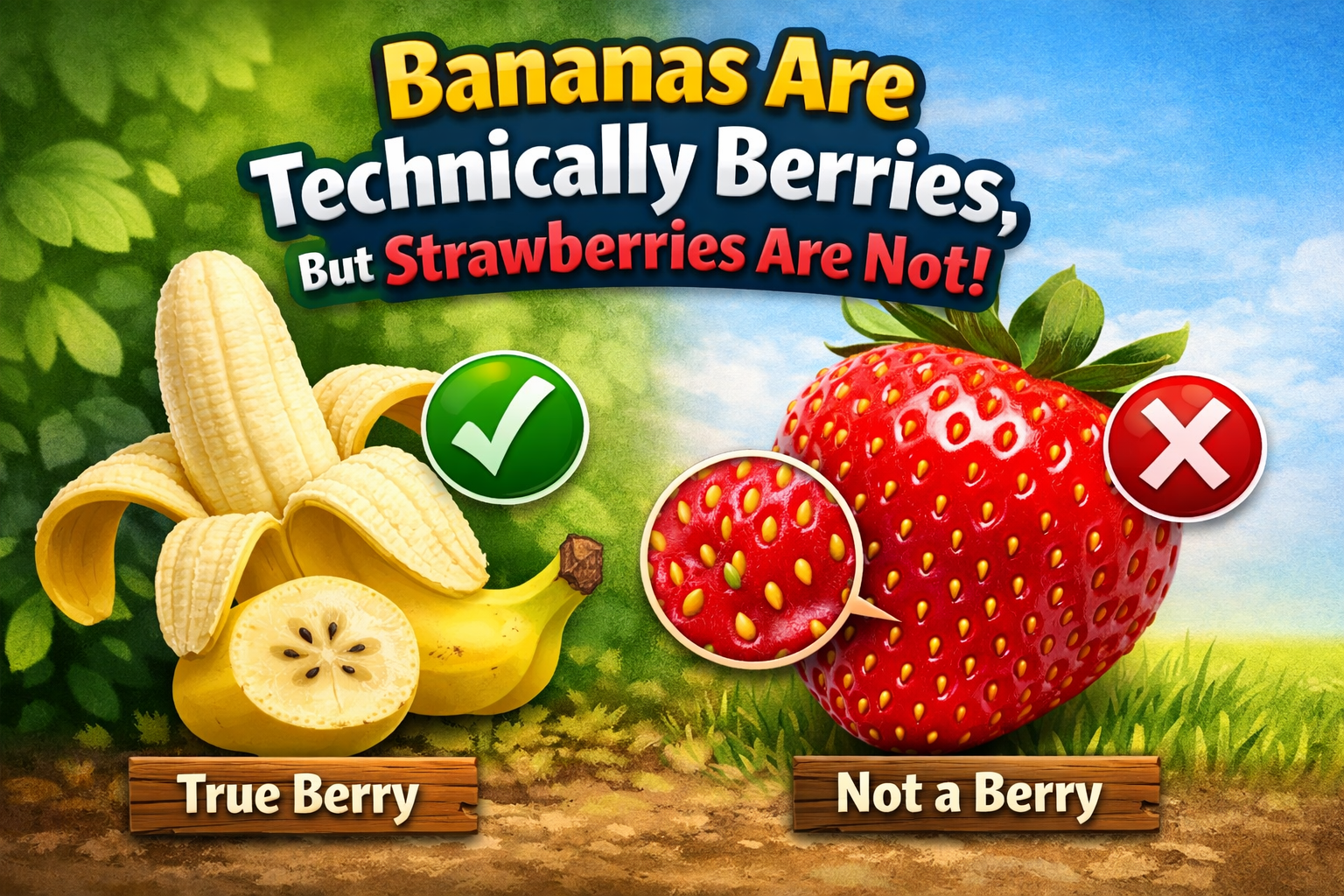
Bananas Are Technically Berries, But Strawberries Are Not… Did you know that the banana, a staple fruit in kitchens worldwide, is classified as a berry, while the beloved strawberry is not? This surprising twist in the botanical world challenges our everyday perceptions of fruit. As we peel back the layers of this fruity conundrum, we’ll explore the fascinating science behind these classifications, revealing the quirky rules of nature that govern what makes a berry a berry-and what doesn’t. Prepare to have your understanding of fruits flipped upside down as we dive into the intriguing world of botanical definitions!
Bananas Are Technically Berries, But Strawberries Are NotWhen it comes to fruit, most of us have a pretty straightforward understanding of what belongs where. Apples are apples, oranges are oranges, and strawberries are… well, strawberries. However, the world of botany is far more complex than the simple categorization we often use. One of the most surprising revelations in this fruity world is the fact that bananas are classified as berries, while strawberries are not. Let’s peel back the layers and explore this fascinating topic!
What Makes a Berry a Berry?In botanical terms, a berry is defined as a fleshy fruit produced from a single ovary of a flower, containing one or more seeds. This definition might seem simple, but it encompasses a wide variety of fruits that don’t necessarily align with our culinary expectations.
#
Key Characteristics of Berries:Bananas are one of the most commonly consumed fruits worldwide, but few people know that they fall under the berry category. Here’s why:
On the other hand, strawberries are often mistakenly grouped with berries because of their name and appearance. However, they don’t fit the botanical definition of a berry. Here’s why:
Here’s a quick comparison of bananas and strawberries based on their botanical classifications:
| Feature | Bananas | Strawberries | |
| Botanical Classification | Berry | Aggregate Fruit | |
| Origin | Single ovary | Multiple ovaries | |
| Structure | Fleshy throughout | Fleshy receptacle | |
| Seeds | Inside (non-functional) | Outside (functional) |
Understanding the botanical classifications of fruits can be a delightful journey into the world of science. While bananas might seem like an ordinary fruit, they hold the esteemed title of “berry” under scientific scrutiny. On the flip side, strawberries, despite their name, fall short of the berry label due to their unique structure and characteristics. So, the next time you enjoy a banana or a strawberry, you can impress your friends with your newfound knowledge about these beloved fruits. Who knew fruit could be so fascinating?
In conclusion, the classification of fruits can be surprising, as demonstrated by the fact that bananas fit the botanical definition of berries while strawberries do not. This distinction highlights the complexities of plant taxonomy and challenges our everyday understanding of these familiar fruits. What are your thoughts on this classification-do you find it surprising, or did you already know this fun fact?
Why Botanical Definitions Often Clash With Everyday Language
If this fruit fact sounds strange, that is because science and everyday speech often describe the same thing in very different ways. In the kitchen, people usually group foods by taste, texture, and how they are used. Sweet plant parts are casually called fruits, leafy plants are called vegetables, and anything small, juicy, and colorful may get called a berry. Botany works differently. It looks at how a fruit develops from a flower, how many ovaries are involved, where the seeds are located, and which structures become fleshy as the fruit matures. That scientific approach creates categories that are precise, but not always intuitive.
This is why common language and botanical language frequently collide. Tomatoes are fruits in botany but vegetables in cooking. Peanuts are not true nuts in the strict botanical sense. And of course, bananas qualify as berries while strawberries do not. The lesson is not that people are wrong to use familiar names in daily life. Rather, it shows that the scientific system answers a different question. Instead of asking, “What does this food look or taste like?” botany asks, “How did this structure develop?” Once you understand that difference, the banana and strawberry mystery becomes much easier to grasp.
The Flower Structure Behind Fruit Classification
To understand why bananas and strawberries fall into different categories, it helps to start with the flower. Every fruit begins as a flower, and the parts of that flower determine the final structure of the fruit. The ovary is the key part in fruit formation. After fertilization, the ovary typically develops into the fruit, while the ovules become seeds. In a simple berry, the fruit forms from a single ovary, and the outer layer and inner tissues all become part of one fleshy structure.
That is exactly what happens in a banana. It develops from one ovary and forms a fleshy fruit with seeds embedded inside, even if the seeds in cultivated bananas are tiny and mostly undeveloped. A strawberry follows a very different path. It develops from a flower with many separate ovaries. Each tiny ovary forms into a small dry fruit on the outside of the strawberry. Those little specks people call seeds are actually individual fruits. The red, juicy part is not the matured ovary at all. It is the enlarged receptacle, the part of the flower that supports the ovaries.
This is why botanical classification can feel so counterintuitive. The part we eat and focus on visually is not always the part that matters most in scientific naming. What matters is origin and development. Once you follow the path from flower to mature fruit, the logic of classification begins to make sense.
Bananas Are Technically Berries, But Strawberries Are Not in Scientific Terms
The phrase sounds like a trick question, but it is completely grounded in botanical rules. A true berry in botany is a simple fleshy fruit that develops from a single ovary and generally contains seeds within the flesh. Bananas meet that definition. Their fruit wall develops as one continuous fleshy structure, and their seeds are internal. Wild bananas make this even clearer because they contain larger, harder seeds than the nearly seedless bananas sold in supermarkets.
Strawberries, meanwhile, are classified as aggregate accessory fruits. “Aggregate” means they form from multiple ovaries of a single flower. “Accessory” means part of the fruit we eat comes from tissue other than the ovary itself. In strawberries, the juicy red body is enlarged floral tissue, while the actual fruits are the tiny achene structures on the surface. This is why strawberries fail the berry test in botany even though their name strongly suggests otherwise.
The surprise comes from the fact that common naming traditions are older than modern scientific definitions. People named strawberries based on culture, appearance, and familiarity, not on anatomical flower analysis. So the confusion is understandable. Science did not rename strawberries out of spite. It simply described them more accurately according to how they develop.
Examples of Fruits That Are True Berries
Once people learn that bananas are berries, the next question is usually, “What else counts?” The answer is more surprising than most expect. In botanical terms, grapes are berries. Tomatoes are berries. Kiwis can be classified as berries. Eggplants are berries too. Even some peppers fit the botanical definition. These fruits all develop from a single ovary and contain seeds within fleshy tissue.
This creates an amusing picture of the fruit world. Items people rarely associate with berries may be scientifically accepted as berries, while iconic “berries” in everyday language may not qualify. Cranberries and blueberries are closer to the true berry definition. Raspberries and blackberries, however, are not true berries in botanical terms because they are aggregate fruits made of many small drupelets. Mulberries are also not true berries in the strictest sense because they develop from a cluster of flowers.
The more examples you explore, the more obvious it becomes that common food language and botanical classification simply serve different purposes. One helps us shop and cook. The other helps scientists describe plant reproduction with precision.
Why Strawberries Are Called Aggregate Fruits
The term “aggregate fruit” sounds technical, but the idea is fairly simple. When a single flower contains multiple ovaries, and each ovary develops into a small fruit, the final result is an aggregate fruit. In strawberries, the flower has many separate ovaries. After fertilization, each ovary becomes one tiny dry fruit called an achene. The familiar red part grows underneath and around them, creating the plump shape people recognize.
This means the outside surface of a strawberry tells the real story. Each tiny speck is not just attached to the fruit. Each one is a fruit. That is one reason strawberries are so fascinating from a botanical perspective. They challenge the assumption that fruit is always a single solid structure. Instead, strawberries are more like a coordinated collection of tiny fruits sitting on a fleshy floral base.
Because the edible portion comes largely from non-ovarian tissue, strawberries are also considered accessory fruits. Apples share a similar concept in a different form because much of the flesh we eat in an apple also comes from accessory tissue rather than only the ovary. So strawberries are not unusual because they are wrong or broken. They are simply built in a different and more complex way than a true berry.
The Evolution of Seedless Bananas
One detail that confuses many people is the seed issue. If berries usually contain seeds, how can a supermarket banana be a berry when it appears seedless? The answer lies in cultivation and domestication. Wild bananas once had large, hard seeds that made the fruit far less convenient to eat. Over time, humans favored varieties with softer flesh and reduced seeds. Modern edible bananas are usually propagated vegetatively rather than grown from viable seeds, which allows those seed-reduced traits to continue.
If you look closely at a banana cross-section, you can still spot tiny dark specks inside. These are remnants of seed structures. They are not functional in the same way wild banana seeds are, but they reflect the fruit’s botanical history. Classification does not suddenly change because human breeding altered convenience traits. The underlying developmental pattern remains that of a berry.
This is a useful reminder that scientific categories are based on origin and structure, not on whether a fruit matches the version sold in modern stores. Agriculture can transform texture, sweetness, color, and seed development, but those changes do not necessarily rewrite the fruit’s botanical identity.
How Human Language Shapes Food Misconceptions
Much of the banana-strawberry confusion comes from language habits that feel natural. In common speech, people often call any small juicy fruit a berry. The word suggests sweetness, bright color, softness, and snackable size. That is why strawberries, raspberries, and blackberries feel like obvious berries to most people. Bananas feel too large and too peel-heavy to fit the idea. But common language is based on appearance and experience, not developmental anatomy.
This mismatch happens all over the food world. We describe peanuts as nuts because they behave like nuts in snacks and recipes. We describe rhubarb as if it were a fruit in desserts even though the edible part is a stalk. We describe coconuts as nuts despite their very different botanical identity. None of this is a problem in ordinary life. It only becomes surprising when someone compares familiar names to scientific rules.
That contrast is part of what makes fruit facts so memorable. They expose the invisible assumptions built into everyday language. Once those assumptions are challenged, even simple supermarket produce starts to look more interesting.
Other Famous Botanical Surprises
If the banana and strawberry example has already flipped your expectations, there are plenty of other botanical twists worth knowing. Tomatoes are fruits, specifically berries in botanical terms, because they develop from a single ovary and contain seeds within fleshy tissue. Avocados are also classified as berries by some botanical definitions. Pumpkins, cucumbers, and watermelons belong to a special berry subtype called pepos, which have a thick rind. Oranges are hesperidia, another specialized berry type with leathery skin and segmented interiors.
Meanwhile, raspberries and blackberries are aggregate fruits rather than true berries. Pineapples are multiple fruits because they develop from an entire cluster of flowers that fuse together. Figs are even stranger, developing within an enclosed structure that contains many tiny flowers inside. These examples show that fruit classification is wonderfully diverse. The labels may sound odd at first, but they reflect the incredible variety of ways flowering plants package and protect seeds.
In that sense, botanical terminology is less about making food confusing and more about documenting nature’s creativity. What seems inconsistent from a grocery-store point of view often becomes elegant when viewed through plant development.
Why This Fact Captures So Much Attention Online
The idea that bananas are berries and strawberries are not has become one of the internet’s favorite science facts for a reason. It combines surprise, simplicity, and a touch of intellectual rebellion. People enjoy learning information that sounds incorrect but turns out to be true. It feels like discovering a hidden rule behind everyday life. The fact is easy to repeat, easy to remember, and guaranteed to spark conversation.
It also works so well because fruit is familiar to everyone. You do not need advanced scientific knowledge to appreciate the twist. Anyone who has ever eaten a banana or strawberry can instantly feel the gap between expectation and reality. That makes the fact accessible in a way many scientific topics are not.
At the same time, it opens the door to deeper learning. A person who starts with this one surprising fact often becomes curious about ovaries, aggregate fruits, accessory tissues, and plant reproduction. In that way, a simple viral fact can become a gateway into real scientific understanding.
The Importance of Botanical Precision
Scientific classification exists for a practical reason. Researchers need consistent language that describes structures accurately across species and regions. Common names vary from place to place, and they often reflect tradition more than anatomy. Botanical terminology creates a shared system that allows scientists, farmers, educators, and horticulturists to speak with precision.
For example, understanding whether a fruit is simple, aggregate, or multiple can affect how botanists study plant development and evolution. It can influence breeding programs and clarify relationships among plant families. The terms may seem unnecessarily detailed in casual conversation, but they become extremely useful in scientific work.
This precision does not invalidate common language. Both systems have value. One helps with communication in daily life. The other helps describe biological reality in a rigorous way. The confusion only appears when people assume both systems were designed for the same purpose.
Bananas in Culture, Agriculture, and Science
Bananas are not only botanically interesting. They are also one of the world’s most economically and culturally significant fruits. They serve as staple foods in many regions, appear in desserts and breakfasts across continents, and have become symbols of convenience and nutrition. Their soft texture, natural sweetness, and portable peel make them one of the most practical fruits humans consume.
Scientifically, bananas are just as fascinating. Their domestication story shows how humans shape crops across generations. The most common commercial bananas are genetically similar, which raises concerns about disease vulnerability. Plant diseases such as Panama disease have threatened banana cultivation and forced researchers to explore resistant varieties. So while the berry classification is fun, bananas are also central to discussions about biodiversity, food security, and agricultural resilience.
That wider context makes the berry fact even richer. It is not merely a clever trivia line. It is a doorway into plant anatomy, crop evolution, and the global systems that bring food to our tables.
Strawberries as a Botanical and Culinary Icon
Strawberries deserve just as much appreciation, even if they are not true berries. Their status as aggregate accessory fruits makes them one of the most visually distinctive fruits in the world. The bright red flesh, surface achenes, fragrant aroma, and soft bite have made strawberries a favorite in jams, pastries, drinks, and fresh fruit bowls.
From a cultivation perspective, strawberries are delicate and highly prized. Their flavor can vary dramatically depending on variety, climate, soil, and freshness. Unlike bananas, which ripen in a relatively predictable way after harvest, strawberries are fragile and perishable. This gives them a different role in food culture, one tied to freshness, seasonality, and indulgence.
Botanically, their structure is a reminder that the most familiar foods are often more complex than they seem. The next time you notice the tiny specks on a strawberry, it becomes harder to see them as simple seeds. They are evidence of the flower’s many ovaries and the remarkable architecture hidden beneath a common snack.
How to Explain This Fact Simply
If you want to share this fact with someone else without sounding overly technical, there is an easy way to frame it. You can say that in everyday language, strawberries are berries because that is what people have always called them. But in botany, a berry must come from one ovary and have seeds inside the fleshy part. Bananas fit that rule. Strawberries do not because they form from many ovaries, and the red part is not the ovary itself.
That explanation keeps the surprise while making the science understandable. It avoids turning the conversation into a vocabulary test and instead highlights the difference between common naming and scientific classification. Most people find that distinction intuitive once it is stated clearly.
Good science communication often works this way. Rather than overwhelming people with terminology, it shows how a hidden rule changes the way we interpret something familiar. The banana and strawberry example is ideal because the rule is neat, the evidence is visible, and the conclusion is unforgettable.
A Closer Look at Berry Subtypes
Even within botany, “berry” is not always a one-size-fits-all term. There are subtypes based on fruit structure. Pepos include fruits such as cucumbers, squash, and melons, usually characterized by a hard outer rind. Hesperidia include citrus fruits such as oranges and lemons, which have a leathery rind and segmented interiors. These subcategories show that the berry family is broader and stranger than most people imagine.
Bananas belong to the broader berry concept because they still satisfy the core rule of developing from a single ovary into a fleshy fruit with seeds inside. The fact that they do not resemble a blueberry or grape does not matter. Shape and culinary identity are secondary. Developmental origin comes first.
This broader perspective helps explain why scientific naming sometimes appears to gather together fruits that seem unrelated on the surface. It is not trying to mirror taste or appearance. It is tracing structure and formation from flower to seed-bearing fruit.
What This Tells Us About Nature
One of the most delightful parts of this fact is that it reminds us nature does not organize itself around human expectations. We like neat categories based on appearance and convenience. Nature evolves structures for reproduction, protection, dispersal, and survival. Our labels come later. Sometimes they match the underlying biology, and sometimes they do not.
That is why scientific learning can feel so satisfying. It reveals the hidden logic behind forms we thought we already understood. A banana becomes more than a lunchbox fruit. A strawberry becomes more than a sweet red snack. Both become examples of how plant evolution creates diverse solutions to the challenge of reproduction.
In that sense, the fact is not just quirky. It is educational in a deeper way. It encourages curiosity, skepticism, and a willingness to revise assumptions when evidence points somewhere unexpected.
Final Thoughts on a Fruit Fact That Never Gets Old
The reason this botanical surprise continues to fascinate people is simple: it changes how we see ordinary things. Bananas are technically berries because they develop from a single ovary and contain internal seeds, even if those seeds are reduced in cultivated varieties. Strawberries are not true berries because they form from multiple ovaries, and the juicy part we eat comes largely from the flower’s receptacle rather than from a single ovary.
That distinction may sound small, but it reveals an entire world of hidden structure in the foods we eat every day. It shows how science can turn a common grocery item into a lesson about flowers, seeds, anatomy, and classification. It also proves that some of the best facts are the ones that overturn our assumptions without requiring a laboratory to appreciate.
So the next time someone reaches for a banana or tops a dessert with strawberries, you will know there is a lot more going on than the names suggest. In everyday speech, we can keep calling strawberries berries without any problem. But in the language of botany, bananas take the title while strawberries step aside. That odd little truth is exactly what makes the natural world so endlessly fascinating.