

11 Cognitive Tools That Help You Make Better Decisions Under Pressure
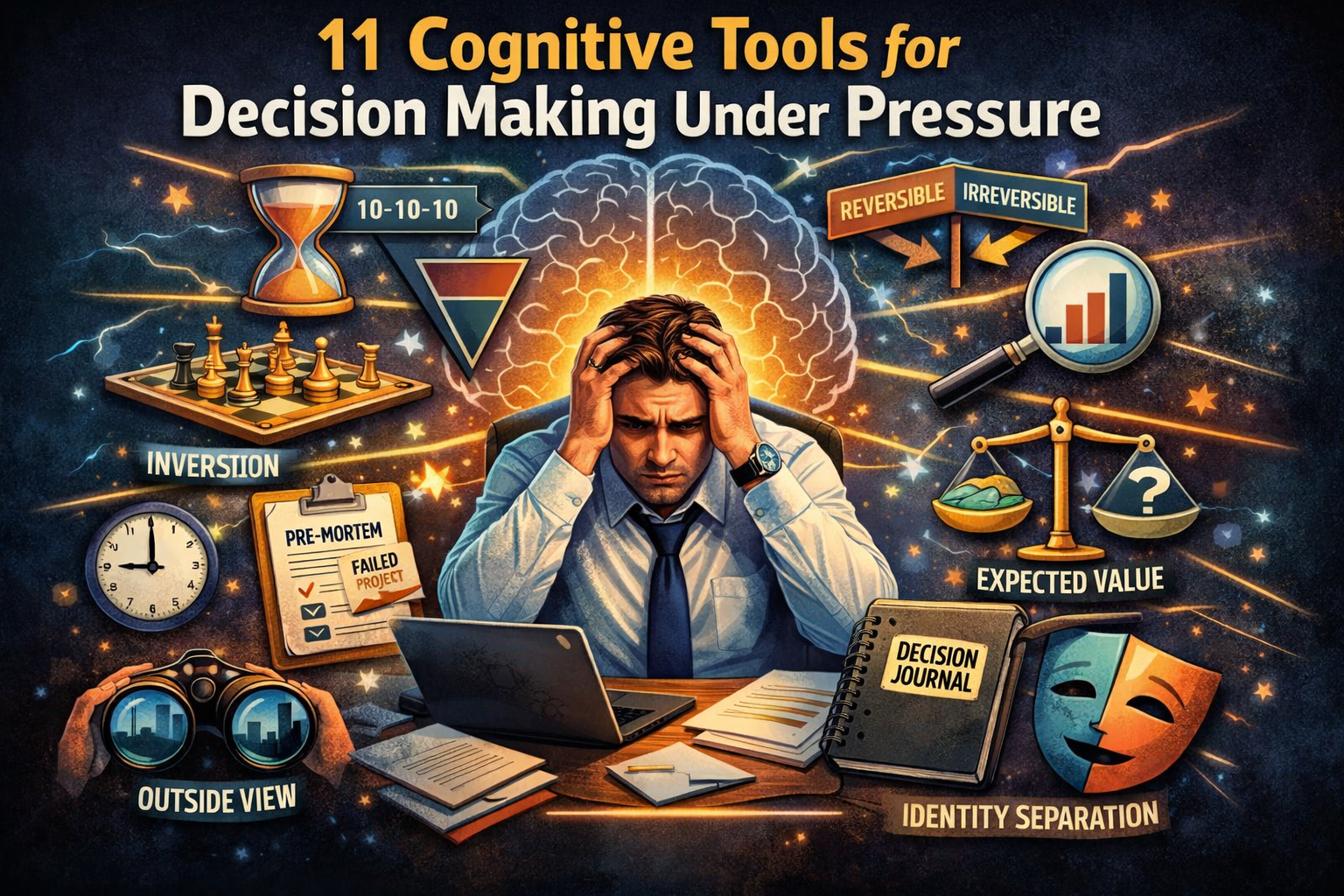
Cognitive tools for decision making… Good decisions rarely happen in perfect conditions. Most real decisions happen when time is short, emotions are loud, information is incomplete, and the consequences feel personal. You need to respond quickly in a meeting, choose a direction during uncertainty, handle conflict without overreacting, decide whether to take a risk, or separate a real threat from a temporary feeling. Under pressure, even intelligent people can become impulsive, rigid, distracted, or overly confident. The issue is not usually a lack of intelligence. The issue is that stress changes how thinking works.
When pressure rises, the brain naturally looks for speed over depth. It wants shortcuts, familiar patterns, emotional certainty, and immediate relief. This is useful in situations where rapid action matters more than precision. But in modern life, many high-pressure situations are not true emergencies. They are complex judgment problems. A rushed business choice, a reactive text, an emotional purchase, a panicked career move, or an ego-driven argument can create damage that lasts much longer than the stress that triggered it. In these moments, people do not just need calm. They need tools.
Cognitive tools are practical thinking frameworks that help you process reality more clearly, especially when your instincts are being pulled in the wrong direction. They do not eliminate emotion, and they do not turn difficult decisions into mathematical certainty. What they do is create better structure. They help you slow down where slowing down matters, challenge assumptions without becoming paralyzed, and avoid the most common errors that occur when the mind is overloaded.
The best cognitive tools are not abstract concepts you admire from a distance. They are mental instruments you can actually use in the middle of a real situation. A strong tool changes the quality of your next decision, not just your opinion about how thinking should work. It gives you a better question to ask, a better angle to inspect, or a better way to separate signal from noise.
That matters because pressure does not simply make people emotional. It distorts perception. It narrows attention, exaggerates urgency, and rewards the kind of mental behavior that feels decisive in the moment but proves costly later. People become attached to the first explanation that reduces uncertainty. They confuse familiarity with truth. They defend previous commitments because changing course feels humiliating. They overvalue recent information and undervalue base rates. They mistake intensity for importance. Under pressure, the mind does not always become irrational in an obvious way. More often, it becomes selectively rational in service of immediate psychological relief.
This is why cognitive tools matter so much. They act as mental guardrails when your internal environment becomes noisy. They do not guarantee perfect outcomes, but they significantly improve the odds that your decisions will be grounded, proportionate, and resilient. Over time, these tools also build something even more valuable than isolated good choices: they build judgment. Judgment is not the same as raw knowledge. It is the ability to think clearly when clarity is hardest to maintain.
In this article, we will explore eleven cognitive tools that can help you make better decisions under pressure. These are not gimmicks, and they are not productivity slogans disguised as wisdom. They are durable mental frameworks that can be applied to work, relationships, money, creativity, stress, conflict, and everyday uncertainty. Used consistently, they help you move from reaction to reflection, from confusion to structure, and from mental noise to useful thought.
1. The 10-10-10 Rule
One of the most effective ways to reduce pressure-driven distortion is to change the time horizon of the decision. Under stress, the mind tends to overweight the immediate moment. It cares intensely about how something feels now, how embarrassing it may be today, how uncomfortable the next few hours might become, or how much relief a quick answer could provide. The 10-10-10 rule interrupts that tunnel vision by asking a simple question: how will I feel about this decision in 10 minutes, 10 months, and 10 years?
This tool is powerful because it forces the brain to step out of emotional immediacy. A decision that feels urgent in the next ten minutes may look completely different when examined over ten months or ten years. A defensive reply in an argument may feel satisfying now but foolish later. A decision to quit impulsively, invest recklessly, or avoid a necessary conversation may reduce discomfort today while creating larger problems down the road.
The 10-10-10 rule is especially useful when short-term emotional relief is competing with long-term values. It does not tell you that the long term always matters more. Sometimes a short-term choice is exactly right. But it ensures that you are not making a permanent decision inside a temporary emotional storm without acknowledging the future cost.
What makes this tool practical is that it does not require a perfect forecast. You are not trying to predict life with precision. You are simply widening the frame. Pressure shrinks perspective. The 10-10-10 rule restores it. Even a brief pause to consider future emotional distance can reduce impulsive action significantly.
When applied consistently, this tool trains a vital habit: refusing to let the emotional weather of the present become the sole judge of what is wise. That alone can improve decisions in work conflicts, romantic tension, career stress, financial temptation, and moments of ego threat.
2. Reversible vs. Irreversible Decisions
Not every decision deserves the same amount of stress. One reason people feel overwhelmed under pressure is that they treat many choices as if they are irreversible when they are not. This creates unnecessary anxiety and slows action. At the same time, some truly high-consequence decisions are made too casually because they are emotionally packaged as ordinary. A useful cognitive tool is to separate decisions into two broad types: reversible and irreversible.
A reversible decision is one you can change later with relatively low cost. You can test a process, try a draft, move a meeting, experiment with a tool, adjust a plan, or make a provisional commitment that can be revisited. An irreversible decision is much harder to unwind. It may involve reputation, money, legal consequences, trust, timing, or structural commitments that are costly to reverse.
This distinction matters because pressure often creates a mismatch between decision type and emotional response. People agonize over reversible choices because they want certainty before action. Meanwhile, they rush irreversible choices because urgency, fatigue, or social pressure makes quick closure feel attractive.
Once you identify the decision type, your strategy becomes clearer. Reversible decisions usually benefit from speed, experimentation, and learning. Irreversible decisions deserve more caution, more outside perspective, and more deliberate thinking. The goal is not to overcomplicate everything. It is to align your depth of thought with the actual stakes.
This tool also reduces perfectionism. When you realize that a decision is reversible, you stop demanding impossible levels of certainty from yourself. You can move, observe, and adapt. In high-pressure environments, that flexibility is incredibly valuable. Many people create pressure not from reality itself, but from the mistaken belief that every decision is a referendum on their intelligence or identity. Distinguishing reversible from irreversible decisions breaks that illusion.
3. Second-Order Thinking
Under pressure, most people think only about first-order consequences. They ask, “What happens next?” and stop there. But many poor decisions are not caused by misunderstanding the immediate result. They are caused by ignoring what happens after the immediate result. Second-order thinking is the habit of asking what the consequences of the consequences will be.
Suppose you accept a project because saying yes solves a short-term problem. The first-order consequence is relief. The second-order consequence may be overcommitment, reduced quality, resentment, and damage to other priorities. Suppose you avoid a difficult conversation to keep the peace. The first-order consequence is temporary calm. The second-order consequence may be confusion, distance, and a bigger conflict later. Suppose you slash a budget to feel decisive. The first-order consequence is visible savings. The second-order consequence may be weaker performance, lower morale, or future costs that exceed the original cut.
Pressure encourages first-order thinking because the brain wants immediate clarity. It wants a direct move that appears to solve the obvious issue. But many systems-relationships, careers, teams, finances, habits-are shaped by delayed effects. If you only think one step ahead, you will repeatedly choose options that feel effective at first and backfire later.
Second-order thinking does not mean endless complexity. It simply means asking one more layer of question before acting. If I do this, what becomes easier? What becomes harder? What incentives does this create? What pattern does this reinforce? What future tradeoff am I quietly accepting?
This tool is especially valuable in leadership, parenting, investing, negotiation, and self-management. It helps you see beyond the emotional seduction of immediate solutions. Sometimes the right move under pressure is not the one that resolves discomfort fastest. It is the one that creates the healthiest downstream effects.
4. Base Rate Thinking
When people are under pressure, they often become obsessed with the uniqueness of the current situation. Everything feels personal, exceptional, and emotionally charged. As a result, they may ignore one of the most useful sources of clarity available: the base rate. Base rate thinking means asking what usually happens in situations like this before assuming your case is radically different.
If you are considering a risky investment, what is the historical success rate for similar opportunities? If you are estimating project completion, how often do similar projects actually finish on time? If you are interpreting a dramatic message, how often do these situations end the way your anxious mind is predicting? If you are thinking about leaving a stable role for a new promise, what do comparable transitions usually look like?
The power of base rates lies in their ability to counter emotional storytelling. Under stress, the brain becomes highly sensitive to narratives that feel vivid and convincing. It tells itself that this situation is unlike all others, that intuition alone can see what statistics cannot, or that a desired outcome is more probable because it feels meaningful. Base rates cut through that distortion by reintroducing reality at the population level.
This does not mean your specific case is irrelevant. Context still matters. But context should refine the base rate, not erase it without reason. Many bad decisions are made by people who skipped directly from emotion to exception. They assumed they were the special case without doing the work to justify that belief.
Base rate thinking is humbling, and that is part of why it is so useful. It reminds you that the world contains patterns beyond your current mood. It asks you to respect what tends to happen, not just what you hope or fear will happen. In high-pressure decision-making, that humility can prevent costly overconfidence.
5. Inversion
People often get stuck trying to find the perfect path forward, especially under pressure. The mind keeps asking, “What is the best choice?” and spirals because certainty is unavailable. Inversion offers a different route. Instead of asking only how to succeed, ask how you could fail. Instead of focusing only on what to do, ask what to avoid.
This tool is deceptively simple and remarkably effective. If you want a productive meeting, ask what would make it a disaster. If you want a healthy relationship decision, ask what behavior would predictably make things worse. If you want to avoid a terrible hire, ask what signals usually point to a bad fit. If you want to make a better career move, ask which mistakes would trap you in a decision you later regret.
Inversion works because failure is often easier to recognize than success is to define. Under pressure, the mind may not know the ideal move, but it can often identify obvious traps: acting in anger, ignoring evidence, confusing urgency with importance, making promises you cannot keep, investing money you cannot afford to lose, or choosing relief over reality.
One reason inversion is so effective is that it lowers the burden of genius. You do not always need a brilliant strategy. Sometimes you need to avoid stupid mistakes. In complex environments, consistently avoiding obvious failure points can produce better results than chasing elegant but fragile solutions.
This tool is also emotionally useful. Pressure often creates the illusion that you must produce the perfect answer immediately. Inversion relieves that burden by shifting the question. You may not know the best possible move right now, but you may know what would clearly make things worse. That knowledge is enough to improve the quality of your next step.
6. The Outside View
Under pressure, people become trapped inside the emotional logic of the moment. The situation feels bigger, stranger, and more consuming because they are standing in the middle of it. The outside view is a cognitive tool that asks you to imagine looking at the situation from a distance, as if it belonged to someone else or to a larger category of similar events.
A practical version of this tool is to ask: what advice would I give a friend in this exact situation? Another version is: if I observed someone I respect making this choice, what would I notice? A more analytical version is: what does this look like from ten thousand feet instead of from inside my current emotional state?
This shift matters because the mind often grants more wisdom to distance than to immediacy. When the problem belongs to someone else, we see patterns more clearly. We notice emotional distortion faster. We detect self-deception more easily. We weigh tradeoffs more calmly. That difference is not because other people’s lives are simpler. It is because our nervous systems are less entangled in their outcomes.
The outside view does not eliminate the reality that your own decision has personal stakes. But it reduces identification. It weakens the grip of panic, pride, embarrassment, and fear of immediate discomfort. It helps you see the decision as part of a pattern instead of as a dramatic referendum on your worth.
This tool is especially useful when you feel emotionally flooded. If your mind keeps rehearsing the same internal script, the outside view can break the loop. It gives you perspective without requiring perfect objectivity. Often, the quality of your advice to others is much closer to wisdom than the quality of your self-talk under pressure. The outside view lets you borrow that wisdom for yourself.
7. The Pre-Mortem
Most people evaluate a decision by asking whether it seems likely to work. The pre-mortem goes further. It asks you to imagine that the decision has already failed and then explain why. This is a deeply useful tool because it gives doubt a structured role before reality does it for you.
Imagine you launch a project, make a hire, enter a partnership, or commit to a plan. Now imagine that six months later it clearly did not work. What went wrong? Did you underestimate the timeline? Ignore personality conflicts? Misread incentives? Fail to clarify ownership? Overestimate demand? Assume motivation would compensate for weak systems? Trust a vague promise instead of a measurable process?
The pre-mortem works because pressure often silences legitimate concerns. People do not want to appear negative, indecisive, or fearful. In urgent environments, optimism can become socially rewarded even when realism is needed more. The pre-mortem creates psychological permission to surface problems before they become expensive.
This tool is not about becoming cynical. It is about improving robustness. By imagining failure in advance, you are not trying to kill momentum. You are trying to strengthen the plan against predictable weaknesses. In many cases, the pre-mortem does not change the decision itself. It changes the execution. You still move forward, but with safeguards, clearer responsibilities, better timing, or more realistic expectations.
It is hard to overstate how valuable this is under pressure. When people are rushed, they often confuse decisiveness with preparedness. The pre-mortem reminds you that a fast decision can still benefit from intelligent skepticism. Better to feel uncomfortable for ten minutes now than surprised for six months later.
8. Expected Value Thinking
Pressure can make people think in binary terms. They label choices as good or bad, safe or risky, success or failure. But many decisions are not binary. They involve probabilities, tradeoffs, and ranges of outcome. Expected value thinking is a tool that asks you to consider both the likelihood of an outcome and the magnitude of its consequences.
This matters because people often overreact to dramatic possibilities without weighing how probable they are, or they ignore smaller but highly probable outcomes because they lack emotional intensity. Expected value thinking brings discipline to that confusion. A low-probability event with huge upside may still be worth pursuing in a limited way. A high-probability event with modest downside may deserve more attention than a vivid but unlikely disaster.
For example, consider a professional opportunity with uncertain payoff. The right question is not only, “Will this definitely work?” A better question may be, “If this has a reasonable chance of meaningful upside and the downside is manageable, what is the smart exposure level?” Likewise, if a decision has a small chance of catastrophic damage, that downside may dominate even if the average case looks fine.
Expected value thinking is not about turning life into spreadsheets. It is about becoming less emotionally primitive in how you judge risk. Under pressure, the brain can become seduced by certainty, even false certainty. It wants a simple answer. But reality often offers only weighted possibilities.
When you use this tool, you become better at sizing decisions appropriately. You stop asking whether an uncertain decision is “worth it” in vague emotional terms and start asking what the actual balance of upside, downside, and probability looks like. This leads to more nuanced and often more intelligent choices under uncertainty.
9. Identity Separation
One of the most underrated cognitive tools for decision-making under pressure is the ability to separate your identity from the outcome. Many bad decisions happen because people are not simply evaluating facts. They are protecting an image of themselves. They stay committed to failing plans because changing course feels like admitting weakness. They refuse feedback because criticism feels like disrespect. They escalate conflicts because backing down feels like humiliation. They cling to previous beliefs because being wrong feels like a threat to self-worth.
Identity separation means asking: if my ego were not involved, what would this situation look like? If this were not about proving something, defending consistency, or preserving self-image, what would be the wisest move? This tool is difficult because the ego is rarely obvious while it is operating. It disguises itself as principle, conviction, loyalty, courage, or certainty.
But under pressure, identity distortion becomes especially dangerous. It turns learning into defeat, adaptation into shame, and evidence into insult. That makes flexibility almost impossible. People would rather preserve a story about themselves than revise a decision in light of reality.
Identity separation does not mean becoming passive or detached from values. It means refusing to let your need to look a certain way overpower your need to see clearly. It allows you to ask better questions. Am I continuing this because it is right, or because I do not want to appear inconsistent? Am I rejecting this idea because it is wrong, or because I did not create it? Am I fighting for truth, or for self-protection?
The ability to separate ego from analysis is a major marker of mature judgment. Under pressure, it becomes even more important. The less your identity is fused with a position, the more intelligently you can respond when the facts change.
10. The Minimum Sufficient Action
Pressure creates a strong temptation to overreact. When people feel uncertain, they often try to regain control through large, dramatic moves. They send the long message, make the sweeping promise, redesign the whole system, quit the role, cut off the relationship, or commit fully to a plan that has not been tested. Big action feels powerful, especially when emotion is intense. But it is not always wise.
The tool of minimum sufficient action asks a different question: what is the smallest intelligent step that meaningfully improves this situation? This is not the same as avoidance. It is disciplined proportionality. Instead of doing everything at once, you do enough to create traction, gain information, or reduce damage without making the problem larger.
In practice, this may mean asking one clarifying question before making a major judgment. It may mean drafting a response but waiting before sending it. It may mean running a small experiment instead of a full launch. It may mean taking temporary protective action while gathering more evidence. It may mean committing to a conversation rather than to a conclusion.
This tool is powerful because many high-pressure situations are not solved by intensity. They are solved by sequence. The right next move is often smaller than the emotional brain wants and more strategic than the impulsive brain can imagine. Minimum sufficient action gives you a way to move without overcommitting, to respond without escalating, and to learn without gambling everything at once.
People who lack this tool often confuse inaction with caution and dramatic action with courage. In reality, measured action is often the strongest move available. It respects complexity without surrendering initiative. Under pressure, that balance is rare and valuable.
11. Decision Journaling
One of the best ways to improve future decisions under pressure is to create a record of how you think before outcomes are known. Decision journaling means writing down the key elements of a decision at the time you make it: what you believe, what you fear, what assumptions you are using, what alternatives you considered, how confident you are, and what would change your mind.
This tool may seem less immediate than the others, but it creates enormous long-term value. Human memory is not a reliable archive of judgment. After outcomes happen, people rewrite their own thinking. They remember being more certain than they were, more rational than they were, and more accurate than they were. This makes learning difficult. If you cannot see how you actually reasoned, you cannot improve how you reason next time.
Decision journaling breaks that illusion. It gives you a clean snapshot of your thinking under real conditions. Later, when the results are visible, you can ask better questions. Was my logic good even if the outcome was bad? Was I lucky even though I felt smart? Did I ignore key evidence? Did I overweight one fear? Did I confuse confidence with accuracy?
Over time, this practice sharpens calibration. You begin to recognize your recurring blind spots under pressure. Maybe you become too optimistic when excited, too pessimistic when anxious, too rigid when embarrassed, or too fast when tired. A decision journal turns vague self-awareness into usable feedback.
It also changes how you make decisions in the moment. When you know you may revisit your reasoning later, you naturally think more clearly now. You become less performative and more precise. You stop optimizing for the feeling of decisiveness and start optimizing for the quality of the thinking itself. That is one of the most valuable shifts any decision-maker can make.
How to Use These Cognitive Tools in Real Life
Reading about cognitive tools is easy. Using them in the middle of stress is harder. That is why the goal should not be to memorize eleven frameworks and deploy them all at once. The goal is to build a small, repeatable decision ritual that fits your life. For example, when pressure is high, you might pause and ask five quick questions. Is this reversible or irreversible? What are the second-order effects? What do base rates suggest? What would I tell a friend? What is the minimum sufficient action right now?
That brief structure can transform the quality of your thinking. You do not need perfect calm to think better. You need a system that protects you from your most predictable distortions. Over time, the tools become more automatic. You stop seeing them as special exercises and start experiencing them as part of judgment itself.
It also helps to match specific tools to recurring problem types. If you tend to send reactive messages, the 10-10-10 rule and minimum sufficient action may help most. If you tend to overcommit professionally, reversible versus irreversible decisions and second-order thinking may be critical. If you tend to become overconfident during opportunities, base rate thinking and pre-mortems may protect you. If you struggle with ego-driven persistence, identity separation may be your highest-value tool.
In other words, these frameworks are not just general advice. They are practical antidotes to common failure modes in human thinking. The better you understand your own patterns, the better you can choose the right tool at the right time.
Why Pressure Reveals the Quality of Your Thinking
Anyone can sound wise in calm conditions. The real test of cognitive maturity is what happens when certainty disappears, emotions intensify, and time feels scarce. Pressure reveals whether your mind defaults to structure or to chaos. It reveals whether you can hold uncertainty without forcing premature answers. It reveals whether your intelligence remains useful when your nervous system wants relief more than truth.
This is why cognitive tools matter beyond isolated decisions. They help shape who you become in difficult moments. They make you less governable by panic, less manipulated by urgency, and less attached to whatever explanation reduces discomfort fastest. They increase not just decision quality, but self-command.
That matters in every domain of life. Relationships improve when people do not react as if the present emotion is the entire truth. Work improves when teams distinguish reversible from irreversible choices and examine second-order effects. Money decisions improve when risk is judged with probabilities instead of adrenaline. Personal growth improves when identity is loosened from being right. A calmer, more structured mind does not guarantee easier circumstances, but it creates better behavior inside hard circumstances.
Final Thoughts
The best decisions under pressure are rarely the fastest, loudest, or most emotionally satisfying ones. They are usually the ones shaped by perspective, humility, and structure. That is what cognitive tools provide. They help you think when thinking is hardest. They create space between impulse and action. They protect you from the kinds of errors that feel reasonable in the moment and expensive in hindsight.
You do not need to become perfectly rational to benefit from these tools. No one is perfectly rational, especially under stress. What you need is a set of repeatable ways to interrupt distortion before it becomes behavior. The eleven cognitive tools in this article do exactly that. They widen time horizons, expose hidden assumptions, restore proportion, reduce ego interference, and improve your ability to act without surrendering to mental noise.
In a world full of urgency, reaction, and overstimulation, that is a serious advantage. Better decisions are not usually the result of more intensity. They are the result of better thinking patterns. And when pressure arrives-as it always does-those patterns become the difference between regret and judgment, between reaction and wisdom, and between temporary panic and lasting clarity.