

Digital Detox Morning Routine: 9 Screen-Free Steps for Better Focus
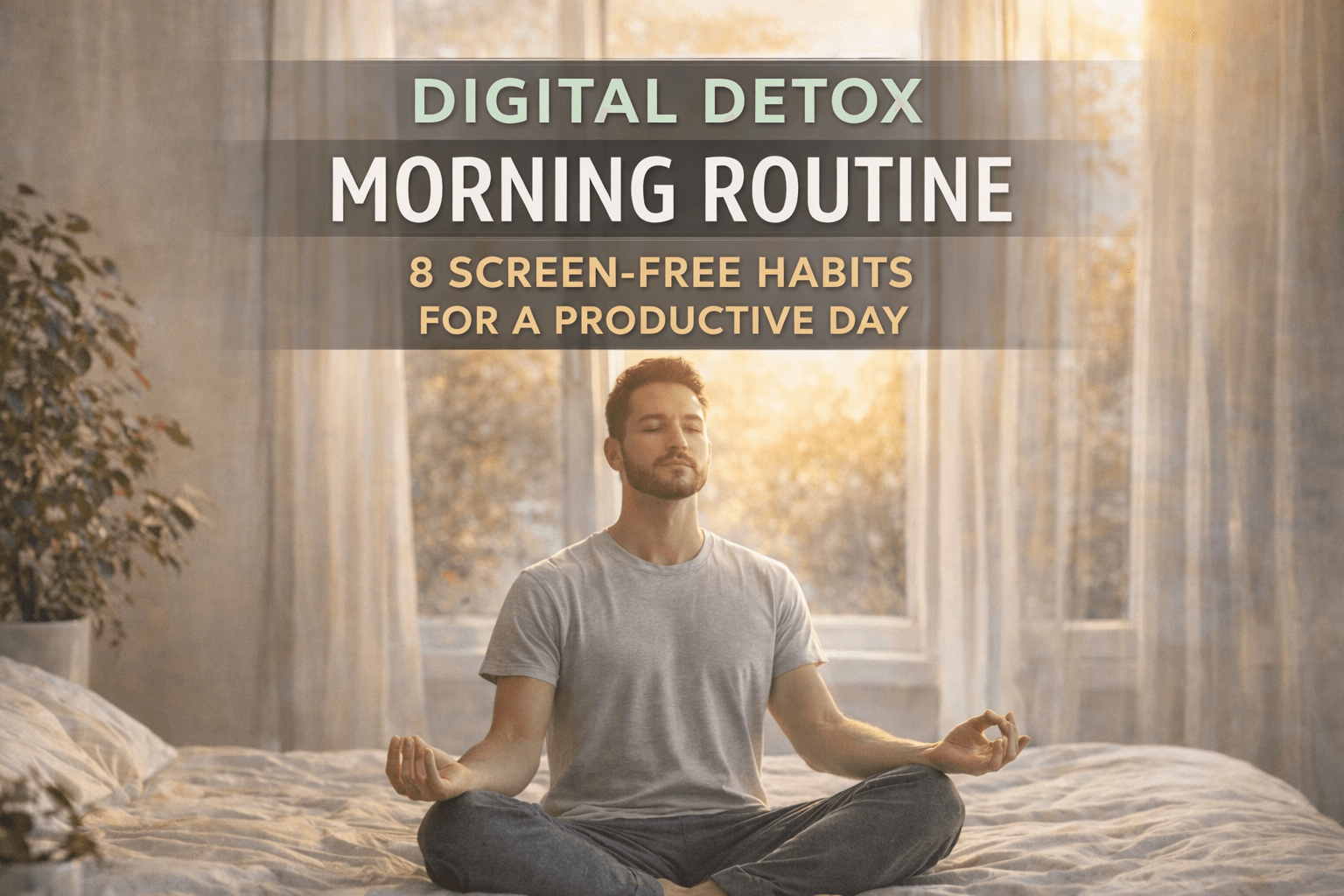
Digital Detox Morning Routine: 9 Screen-Free Steps for Better Focus… Modern life often means waking up and immediately grabbing our smartphones. In fact, surveys show that 70-80% of people check their phones within 10 minutes of waking up. Unfortunately, starting the day this way can set a negative tone. Research warns that “excessive smartphone use upon waking” can raise stress and anxiety while reducing productivity. Instead of doomscrolling, many experts now recommend a screen-free morning
The High Cost of Smartphone Addiction
We tend to think of our phones as harmless, but studies show heavy screen time can harm our brains and mental health. For example, researchers have linked social media and constant connectivity to “low self-esteem, sleep problems, anxiety and depression”. Every swipe or notification gives our brain a tiny dopamine hit
In other words, a habit as simple as grabbing your phone in bed can prime you for distraction all day. One health report explains that being connected 24/7 has a price: many people experience “anxiety, depression, and burnout linked to excessive screen time”. When your brain is flooded with notifications and endless feeds, it never really gets a chance to “reset” or focus on the moment. That’s why experts say a digital detox
Why a Screen-Free Morning Matters
Your morning routine sets the tone for the whole day. Starting off glued to a screen is like launching a rocket with too much fuel
On the other hand, delaying phone use can give you a major head start. By avoiding screens for the first 30-60 minutes, you create a pocket of calm where you can wake up on your own terms. Instead of reacting to other people’s messages or feeds, you can focus on yourself: have a quiet breakfast, stretch, meditate or read a book. Over time, this can lead to better mood, more energy and even improved sleep at night. One survey-based study found that replacing morning screen-time with positive activities is rated as a relaxing way to ease into the day. Even just a few mindful minutes
The Benefits of a Morning Digital Detox
So what good does it do to keep your phone away for a bit? The benefits are surprisingly wide-ranging. First, it boosts productivity. Without distractions, you can plan your day or tackle an important task (like exercise or journaling) when your willpower is strongest. According to the University of Nebraska wellness program, a digital detox “boosts your productivity at work” by preventing early-day interruptions. It also frees up mental space
Second, it improves mental health. Morning sunlight and movement (without screens) raise endorphins and regulate cortisol (the stress hormone). Several studies have shown that less screen time correlates with lower anxiety and better sleep. You’ll likely notice you feel calmer and more focused during the day, since you didn’t start off bombarding your senses. One expert summary even notes that a digital detox “enhances your well-being” by allowing your body and mind to fully engage with reality.
Finally, a habit like this improves relationships. When your first interaction in the morning is your family or a morning walk
All of these gains

8 Tips for Your Digital Detox Morning Routine
Ready to try it? Here are some actionable tips to build a peaceful, productive morning without your phone:
- Keep your phone out of arm’s reach. Charge your phone away from your bedside
- Use a traditional alarm clock. Rather than relying on your phone’s alarm, pick up an old-school alarm clock or a sunrise lamp. This removes the temptation to check emails or notifications as soon as you wake. Setting a device-free alarm creates a clear boundary: when your phone isn’t on your bedside table, you’re in control of when (and if) you decide to turn it on in the morning.
- Delay the screen time. Commit to a no-phone rule for at least the first 30 minutes after you wake up. Even resisting for an extra half hour can make a big difference to your mindset. Use that time for something positive: drink a glass of water, make tea, or simply sit quietly and stretch. By giving yourself this buffer, you avoid letting a barrage of apps and messages hijack your early energy.
- Move and breathe before you scroll. Physical activity is a powerful counter to the urge to reach for your device. Try 5-10 minutes of gentle stretching or yoga as soon as you get up. Or step outside and take a few deep breaths of fresh air. Morning exercise (even a short walk) not only wakes your body
- Journal, plan or read. With your phone off-limits, pick up a notebook or a book instead. Spend a few minutes writing down your thoughts, gratitude or your goals for the day. Journaling can clarify your priorities and reduce anxiety. Alternatively, read a chapter of an uplifting book or some inspirational quotes. Even light reading engages your mind productively
- Soak up natural light. Opening the curtains or stepping outdoors exposes you to sunlight, which quickly signals your body that it’s time to wake up. Sunlight early in the day helps regulate your internal clock, improve sleep at night, and give you a shot of vitamin D. If possible, spend a few moments on the porch or by a window. Even a short walk in daylight can improve mood and alertness. Pair this with your stretches or breathwork for double impact.
- Establish quick no-screen rituals. Create a simple habit that you do every morning instead of grabbing your phone. It could be pouring a cup of tea, petting your dog, or watering plants
- Limit morning check-ins. When you finally do pick up your phone, set a brief limit. For example, allow yourself one quick scan of urgent messages or weather, then put the phone down. Some experts suggest scheduling deliberate screen time blocks
Each of these habits reinforces a simple goal: own your morning, don’t let your phone own it. It may feel strange at first, but even small changes (like using an alarm clock or journaling) can build momentum. The key is consistency. Try adding one or two tips at a time. Soon, you’ll find those early hours richer and more peaceful
Key Takeaways
- Your brain is wired to seek dopamine rewards from phone use, even if it means starting your day with stress.
- A screen-free morning lets you build healthy habits
- Studies show that digital detox breaks boost well-being, productivity and social connections.
- Simple swaps (analog alarm clocks, journaling, sunlight) can break the phone-addiction cycle.
- Consistency is vital: keep your phone out of sight, delay checking it, and stick to your new routine each day.
A digital detox morning routine may be the change you never knew you needed. By reclaiming those first golden minutes for yourself, you can start each day calmer, sharper and more in control. In a world that’s always on, give yourself permission to tune in to real life first
What’s Happening in Your Brain When You Grab Your Phone
A digital detox morning routine works because it interrupts a powerful loop: cue → craving → reward. Waking up is the cue. Your brain anticipates novelty and updates (messages, headlines, likes). The craving pushes you toward your phone. The reward is a quick burst of stimulation that feels like “waking up,” even though it often comes with stress.
That stimulation trains your attention to expect instant input. Within minutes, your mind shifts into reactive mode: responding, comparing, scanning for threats, and switching tasks. Once you start the day that way, it becomes harder to focus on deep work, learning, or meaningful goals because your brain has already practiced distraction.
The goal of a screen-free morning is not to demonize technology. It’s to reclaim the first hour as a space where your mind can become alert gradually, your emotions can stabilize, and your attention can point toward your priorities instead of everyone else’s.
The “First Hour Rule”: Why 30-60 Minutes Makes a Huge Difference
The first hour after waking is when your brain is most impressionable to patterns. That’s why small changes here create outsized results. You don’t need a perfect morning routine. You need a consistent rule that protects your attention long enough to establish calm and direction.
- 30 minutes screen-free is enough to reduce impulsive checking for many people.
- 60 minutes screen-free often creates the biggest shift in mood, clarity, and self-control.
If 60 minutes sounds impossible, start at 10 minutes and expand gradually. The best routine is the one you can repeat.
A Simple Digital Detox Morning Routine (10, 30, and 60 Minutes)
Option A: 10-Minute Screen-Free Reset
- Drink water (1 minute).
- Open the curtains or stand near a bright window (2 minutes).
- Slow breathing: inhale 4 seconds, exhale 6 seconds (2 minutes).
- Write one intention: “Today I want to feel…” (1 minute).
- Move lightly: stretch, walk, or mobility (4 minutes).
Option B: 30-Minute Digital Detox Morning Routine
- Water + light exposure (5 minutes).
- Gentle movement (8-10 minutes).
- Journaling: gratitude + top 3 priorities (7 minutes).
- Quiet breakfast or tea ritual (8-10 minutes).
Option C: 60-Minute Screen-Free Morning (Best for Focus Days)
- Water + sunlight walk (10-15 minutes).
- Movement (10-15 minutes).
- Mindfulness or prayer (5 minutes).
- Plan the day: 1-3 priorities + first action (10 minutes).
- Start a “quick win” that supports your main goal (10-15 minutes).
The 7-Day Challenge (So You Actually Stick With It)
Most people fail at digital detox because they try to change everything at once. This 7-day ramp builds the habit without triggering resistance.
Day 1-2: Create Distance
- Charge your phone outside your bedroom or at least out of arm’s reach.
- Turn off non-essential morning notifications.
- Commit to 10 minutes screen-free after waking.
Day 3-4: Add an Anchor Ritual
- Choose one morning ritual: tea, water + window light, stretching, or journaling.
- Increase to 20-30 minutes screen-free.
Day 5-6: Replace Scrolling With Direction
- Write your top 3 priorities before touching your phone.
- Do one “first step” task for 5 minutes (open a document, outline a plan, prep your workout).
Day 7: Lock It In
- Try a full 60 minutes screen-free.
- Notice your mood, focus, and stress level compared to Day 1.
- Pick your long-term baseline: 30 minutes daily or 60 minutes on key days.
Common Obstacles (And Exactly What to Do)
“I Need My Phone for the Alarm.”
Use a basic alarm clock, sunrise lamp, or a cheap digital alarm. If you must use your phone, place it across the room and enable a focus mode so you only see the alarm screen, not notifications.
“I Have Kids / My Morning Is Chaos.”
Do a micro-routine. Even 5 minutes of screen-free calm is a win. Try: water + one deep breath cycle + writing one priority on a sticky note. A tiny routine that survives chaos beats a perfect routine that collapses.
“My Job Needs Me Early.”
Create a narrow “urgent-only” window: allow yourself 5 minutes to check only critical channels. Then put the phone down and complete your routine. If you must respond, respond once, then return to screen-free time.
“I Feel Anxious If I Don’t Check Messages.”
This is common. Anxiety decreases when you replace uncertainty with a plan. Tell yourself: “I will check at 8:00.” Set a physical timer if needed. Your brain relaxes when it knows there is a scheduled check-in, not endless deprivation.
Upgrade Your Environment: Make Scrolling Inconvenient
Willpower is fragile in the morning. Environment is stronger. Use “friction” to protect your routine.
- Move the charger: charge your phone in another room.
- Use grayscale: make your phone less visually rewarding.
- Hide addictive apps: remove social media from the home screen.
- Disable badges: notification badges act like tiny anxiety triggers.
- Set app limits: especially for news and social platforms.
The goal is not to punish yourself. The goal is to reduce automatic behavior so you can choose intentionally.
What to Do Instead of Your Phone (A Menu of Better Dopamine)
Your brain is not wrong for wanting stimulation. It just needs higher-quality input. Try “better dopamine” activities that energize without hijacking your attention:
- Movement: a short walk, yoga, or stretching.
- Sunlight: stand by a window or step outside for a few minutes.
- Music: one uplifting song while you make tea or breakfast.
- Reading: a few pages of a book (paper or e-reader without notifications).
- Journaling: one gratitude line + one goal line.
- Breathing: slow exhales to reduce stress quickly.
Over time, your brain starts to associate waking up with calm and control instead of urgency and comparison.
Digital Detox for Productivity: How to Use the “Phone Later” Advantage
A screen-free morning becomes even more powerful when you use the time to create direction. One simple method is the First Focus Block:
- Write your top 1-3 priorities.
- Pick the most important one.
- Do 10 minutes of it before any screen time.
This creates momentum. It tells your brain: “I lead my day.” Even if the rest of the day gets messy, you already won the most important battle: starting intentionally.
FAQ: Digital Detox Morning Routine
How long should I avoid screens in the morning?
Start with 10 minutes, build to 30 minutes, and aim for 60 minutes when possible. The best duration is one you can maintain consistently.
Is checking the weather or calendar “breaking” the detox?
Not necessarily. The main enemy is endless scrolling and reactive content. If you must check something, do it intentionally, quickly, and then put the phone away again.
Will this really improve my focus?
Most people notice improved focus because they reduce early-day distraction and stress. The effect becomes stronger when you replace phone time with movement, planning, and sunlight.
What if I fail and scroll anyway?
Reset immediately. Stand up, drink water, and do 2 minutes of breathing or stretching. One slip does not ruin the routine. Consistency over weeks matters more than perfection in a day.
Final Thoughts
A digital detox morning routine is one of the simplest ways to improve productivity and mental health without adding more tasks to your life. By delaying screens for even 30 minutes, you reduce stress, protect your attention, and start the day with choice instead of reflex. Begin small, build gradually, and keep the focus on one thing: owning your morning before the internet owns it.