

Dyatlov Pass Incident Explained: Tent Cut From Inside (2026)
Terror in the Ural Mountains
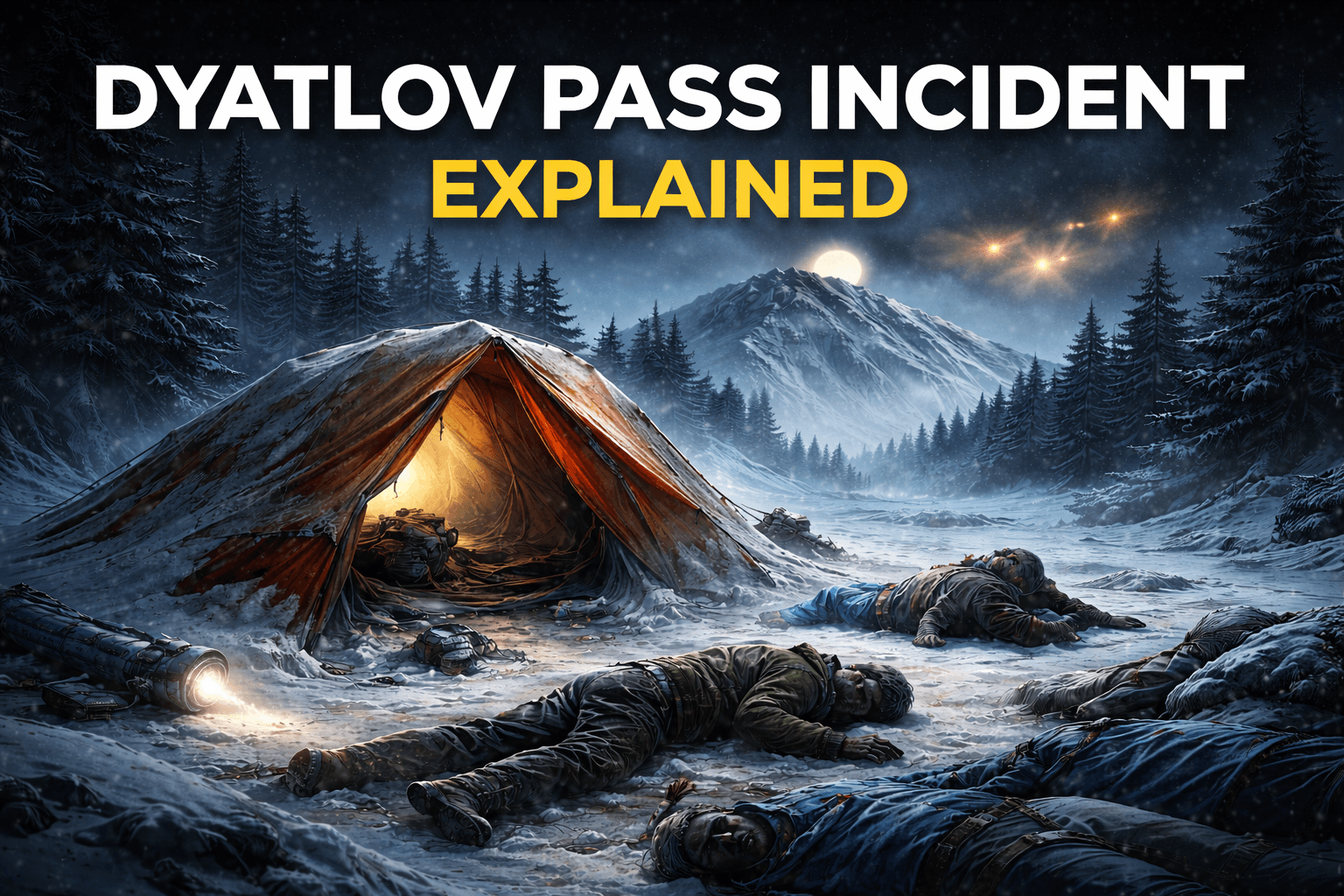
Dyatlov Pass Incident Explained: Tent Cut From Inside (2026): In February 1959, nine experienced hikers trekking through the northern Ural Mountains in the Soviet Union met a gruesome and inexplicable end. When rescuers found their tent weeks later, it had been slashed open from the inside. The hikers had fled into the sub-zero night, some barefoot and half-naked, as if escaping an immediate, terrifying threat. Their bodies were found scattered down the slope, frozen in dynamic poses.
The Impossible Injuries
The forensic examination turned the tragedy into a nightmare. While some died of hypothermia, others had sustained brutal internal injuries-skull fractures and chest trauma comparable to a car crash-yet had no external bruises. Most horrifyingly, one hiker, Lyudmila Dubinina, was missing her tongue and eyes. Traces of radiation were found on some of their clothing.
- The Avalanche Theory: Modern computer simulations suggest a “slab avalanche” could have crushed the tent, forcing them to cut their way out. However, this doesn’t fully explain the radiation or the missing soft tissues (though scavengers are a possibility).
- Soviet Military Testing: Another group of hikers miles away reported seeing strange orange spheres in the sky that night. Were the students victims of a secret weapon test or a parachute mine gone wrong?
- The Yeti / Infrasound: Fringe theories range from a Yeti attack to “infrasound” caused by the wind creating a panic-inducing frequency (the Kármán vortex street).
The Final Verdict: The Soviet investigation at the time concluded that a “compelling natural force” had caused their deaths. The file was sent to a secret archive. To this day, the Dyatlov Pass Incident remains the Mount Everest of conspiracy theories.
The Dyatlov Pass Incident: What We Actually Know
The Dyatlov Pass Incident is infamous because it combines three things that rarely appear together in a single tragedy: an extreme environment, decisions that seem irrational in hindsight, and injuries that look “too violent” to match a simple hypothermia story. In February 1959, nine experienced hikers died during a trek in the northern Ural Mountains. When the tent was discovered weeks later, it appeared to have been cut open from the inside-suggesting the group chose to escape fast instead of using the normal entrance. Their tracks led away from the tent into sub-zero darkness, some barefoot or poorly dressed, indicating an emergency so immediate that warmth and gear became secondary.
From there, the case becomes a puzzle of scattered bodies, mixed causes of death, and one haunting conclusion from Soviet investigators: a “compelling natural force.” That phrase has helped the story mutate into an endless conspiracy magnet. But a professional breakdown starts with the simplest question: what sequence of events could make trained hikers abandon shelter in the worst possible conditions?
The Tent: Why “Slashed From Inside” Matters
The tent detail is the case’s ignition point. Cutting out of your own tent is not normal behavior unless you believe the entrance is blocked or too slow to use. That implies perceived danger at the tent site itself-something that made staying put feel more dangerous than the lethal cold outside.
In practice, there are a few realistic categories of threat that can trigger a panic exit:
- Structural collapse risk: snow load, shifting slab, or tent damage making it unsafe to remain inside.
- Environmental hazard: wind-driven snow, a whiteout, or loud “impact-like” sounds suggesting an imminent avalanche or rockfall.
- Fire or smoke: a stove malfunction inside a tent can create choking smoke quickly, especially in high winds.
- Perceived external danger: an intruder, animal threat, or something interpreted as an attack.
Why They Didn’t Just Return (The Cold Logic Problem)
Many Dyatlov debates hinge on a single uncomfortable fact: if the hikers were merely startled, why didn’t they turn around quickly and retrieve clothes, boots, and supplies? The most likely answer is that the group believed the tent area remained unsafe-at least temporarily. If they thought a second slide was possible, or if visibility was too poor to navigate back safely, moving downhill to regroup could have seemed like the best immediate choice.
Another factor often underestimated is the cognitive impact of extreme cold and stress. Hypothermia can impair judgment fast. A decision that begins as “we’ll return in minutes” can collapse into fatal disorientation once people start losing dexterity, coordination, and problem-solving ability.
The “Impossible Injuries”: What Makes Them So Controversial
Some of the hikers died primarily from hypothermia. Others had severe internal trauma-chest injuries and skull fractures described as comparable to high-impact collisions-yet with limited external bruising. This combination sounds paradoxical, but it is not automatically “supernatural.” High-force injuries can occur without massive external wounds if the force is distributed (for example, compression by heavy mass) or if the person is thrown and impacted in snow or uneven terrain.
How extreme trauma can occur without obvious external damage
- Compression: a dense slab of snow can compress the torso and fracture ribs without “cutting” the skin.
- Falls onto hard features: a fall into a ravine, onto rocks, or into ice can create severe internal damage.
- Secondary impacts: being pushed or collapsing in panic can cause group members to hit each other or terrain in unpredictable ways.
Then there is the most famous detail of all: Lyudmila Dubinina’s missing tongue and eyes. It is a shocking image, but it has an unglamorous explanation that appears in many wilderness recoveries: soft tissue can be removed by scavengers and natural decomposition, especially when bodies are exposed to the elements for weeks.
Radiation and “Orange Spheres”: Why These Details Never Die
Reports of radiation traces on clothing and sightings of strange orange spheres in the sky are the fuel that keeps the military-testing theory alive. In an era defined by secrecy, any strange light becomes suspicious and any unusual measurement feels like proof of a cover-up.
The practical problem is that these points are often presented without enough context. “Radiation detected” can mean a wide range of things depending on levels, methods, and contamination sources. Likewise, distant lights in a winter sky can come from atmospheric phenomena, rocket tests, flares, or other unrelated activity. None of this clears the mystery-but it does mean these details must be handled with disciplined language rather than sensational certainty.
Leading Theories Explained (What Each One Fits-and What It Doesn’t)
1) Slab Avalanche (modern favorite)
The slab avalanche theory argues that a dense layer of snow shifted and impacted the tent area, forcing a rapid escape. This can explain why the tent was cut from the inside and why the group moved downhill fast. It can also explain high-force trauma if some hikers were compressed or thrown, and why returning to the tent may have seemed too dangerous.
Weak spots: critics argue it doesn’t fully address every data point people associate with the case (especially radiation narratives and the “orange spheres”), though those points may be separate from the core cause of death.
2) Military testing / parachute mines (classic Cold War suspicion)
This theory suggests the hikers were exposed to a secret test-parachute mines, weapons trials, or another military event. The “orange spheres” reports are often used to support it. A shockwave could theoretically produce panic and injuries.
Weak spots: the theory requires a chain of assumptions about what happened, why it happened there, and how it left so little direct trace. It also struggles to explain the specific pattern of evacuation and the physical logistics of the scene without additional evidence.
3) Infrasound / wind-induced panic (the “psychology” theory)
Infrasound theory suggests that wind interacting with terrain can generate low-frequency sound that triggers anxiety, disorientation, or panic in some people. The concept is that the hikers experienced a sudden wave of fear, fled the tent, and then the environment did the rest.
Weak spots: while panic can explain leaving the tent, it does not strongly explain the severe trauma injuries unless paired with a fall or collapse scenario.
4) Animal attack or “Yeti” (fringe)
These theories persist because they feel cinematic, but they generally conflict with the lack of clear struggle signs and the broader logistics of the scene. They can be mentioned briefly for completeness, but a credible post should treat them as low-probability.
A Coherent “Most Likely” Sequence (Without Needing a Cover-Up)
Many researchers favor a hybrid explanation because the deaths do not have to come from a single cause. A coherent sequence that fits a large portion of the evidence looks like this:
- Perceived imminent danger at the tent: snow movement, collapse risk, or a loud impact convinces the group to evacuate immediately.
- Rapid descent to safer terrain: they move downhill to reduce avalanche exposure and gain visual shelter.
- Splitting decisions under stress: some attempt to stabilize near a treeline; others move to find better shelter (ravine/forest).
- Cold + exhaustion snowball: hypothermia begins impairing judgment, making return difficult or impossible.
- Trauma occurs in secondary incident: a fall into a ravine, compression, or impact produces severe internal injuries for some hikers.
- Exposure finishes the tragedy: even minor delays become lethal in extreme cold.
Why the Soviet Verdict Sounds So Suspicious
The phrase “compelling natural force” sounds like a cover-up, but it can also reflect a practical limitation: investigators may have lacked a precise mechanism they could confidently prove. The Cold War context added opacity, and secrecy culture ensured that anything unclear would feel deliberately hidden-even when it was simply unresolved.
FAQ
Why did the hikers cut their tent from the inside?
The most likely reason is urgency-either the entrance was blocked, too slow to use, or the hikers believed the tent area was immediately unsafe.
Did an avalanche definitely happen?
Not definitively. A slab avalanche is a leading modern explanation because it fits several key details, but the case remains debated.
How could injuries be so severe with little external bruising?
High-force compression or impacts in snow and uneven terrain can cause internal trauma without the kinds of external wounds people expect from sharp or penetrating injuries.
Why was one hiker missing her tongue and eyes?
Soft tissue can be removed by scavengers and natural decomposition over weeks of exposure, especially in harsh outdoor conditions.
What about radiation on the clothing?
Radiation claims are frequently cited but require context about levels and sources. By themselves, they do not conclusively prove military involvement.
What’s the most reasonable explanation overall?
Many analyses favor a natural trigger (like a slab avalanche or collapse risk) plus secondary events (falls/trauma) combined with hypothermia and disorientation.
Closing
The Dyatlov Pass Incident remains famous because it’s a rare case where the environment itself can look like a villain. Extreme cold doesn’t just kill-it distorts decisions, breaks coordination, and turns small mistakes into fatal cascades. Whether the trigger was a slab avalanche, a structural scare, or something still unknown, the tragedy shows how quickly “experienced hikers” can become helpless when nature removes time, warmth, and clarity all at once.
Dyatlov Pass Incident Explained Tent Cut From Inside Mystery in Modern Research
The Dyatlov Pass incident explained tent cut from inside mystery has been reanalyzed using modern forensic science, computer simulations, and environmental modeling. Researchers today aim to reconstruct the sequence of events with greater accuracy by combining historical records with scientific data.
Recent studies suggest that natural forces, particularly snow dynamics and terrain interaction, may provide a more grounded explanation for the tragedy. However, no single theory fully resolves every detail, which is why the case remains widely debated.
Advancements in Avalanche Simulation
One of the most significant developments in recent years is the use of computer simulations to test avalanche scenarios. These models consider slope angle, snow layering, and environmental conditions to determine whether a slab avalanche could have occurred.
Some simulations support the possibility of a delayed slab avalanche, where a small shift in snow could create enough force to damage the tent and trigger panic without leaving obvious large-scale evidence.
- Snow layering can create unstable conditions
- Delayed avalanches may occur hours after setup
- Small shifts can produce significant pressure
- Terrain shape influences snow movement
Hypothermia and Cognitive Impairment
Hypothermia plays a critical role in understanding the hikers’ behavior. As body temperature drops, cognitive function deteriorates, leading to confusion, poor decision-making, and loss of coordination.
This can explain why the hikers did not return to the tent even after reaching a safer area. What may have started as a temporary evacuation could quickly turn into a fatal situation as their ability to think clearly diminished.
In extreme cold, even small delays can have catastrophic consequences.
Group Dynamics Under Extreme Stress
The behavior of the group must also be considered. In high-stress situations, group dynamics can influence decision-making. Leaders may make rapid choices, and others may follow without fully evaluating alternatives.
Once the group left the tent, their survival depended on coordination and communication. As conditions worsened, maintaining cohesion would become increasingly difficult.
This breakdown in group structure may have contributed to the different outcomes observed among the hikers.
The Ravine Discovery and Secondary Injuries
Some of the most severe injuries were found in hikers located in a ravine. This suggests that a secondary event, such as a fall or collapse, occurred after the initial evacuation.
The ravine environment could amplify injury severity due to uneven terrain and hidden الصخور beneath the snow. This aligns with the pattern of internal trauma without significant external wounds.
Environmental Noise and Perception
Natural sounds in mountainous regions can be disorienting, especially during extreme weather. Wind interacting with terrain can produce low-frequency sounds that may cause anxiety or fear.
While not a standalone explanation, such environmental factors could contribute to the perception of danger and influence decision-making.
Why Conspiracy Theories Persist
The Dyatlov Pass case attracts conspiracy theories because of its unusual details and lack of definitive answers. Elements such as radiation traces and reported lights in the sky create a sense of mystery that invites speculation.
However, these theories often rely on incomplete or misinterpreted data. A careful analysis shows that many details can be explained through natural or contextual factors.
Lessons from the Dyatlov Pass Incident
The tragedy offers important lessons about survival in extreme environments. Even experienced hikers can face overwhelming challenges when conditions change rapidly.
- Always assess terrain stability before setting camp
- Prepare for sudden weather changes
- Maintain clear communication within the group
- Understand the risks of hypothermia
These lessons remain relevant for modern outdoor activities and safety planning.Dyatlov Pass Incident Explained: Tent Cut From Inside (2026)
The Enduring Mystery of Dyatlov Pass
The Dyatlov Pass incident explained tent cut from inside mystery remains one of the most compelling unsolved cases in history. Its combination of environmental عوامل, human behavior, and unexplained details ensures ongoing interest.
While modern research has provided valuable insights, the absence of definitive proof means the case will likely remain open to interpretation.
As new technologies and methods emerge, future investigations may bring us closer to understanding what truly happened on that cold night in 1959. Dyatlov Pass Incident Explained: Tent Cut From Inside (2026)