

Valeriana Maya City: 13 Stunning LiDAR Revelations You Must See
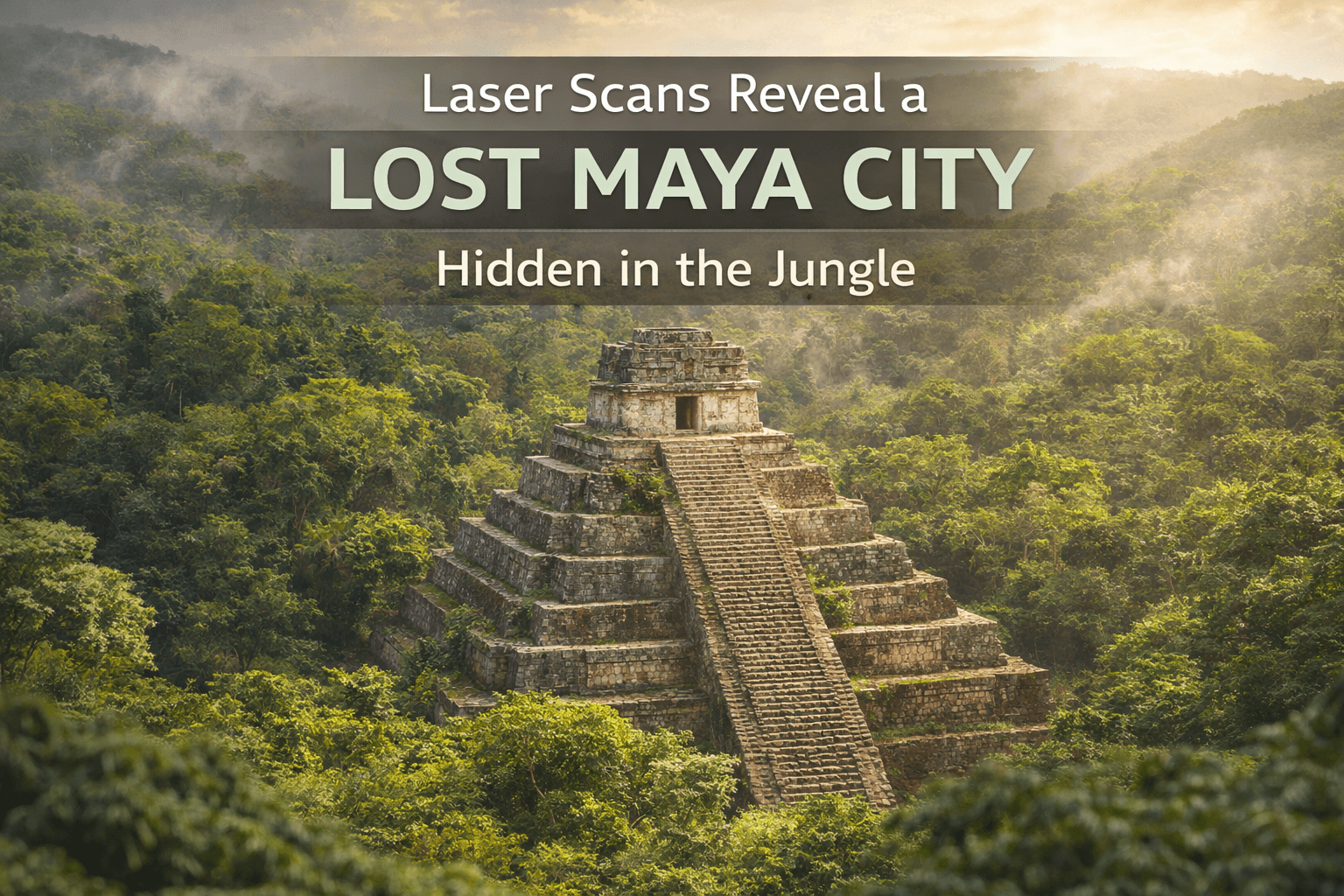
Valeriana Maya City… In the dense rainforests of Mexico, an entire ancient Maya city has been hiding in plain sight
The tale of Valeriana reads like an archaeologist’s dream. Named after a nearby freshwater lagoon, Valeriana was a Classic Period Maya city (circa 250-900 AD) buried under thick jungle canopy. Archaeologists found evidence of thousands of structures (over 6,500 by one count) . The site includes what researchers describe as “all the hallmarks of a Classic Maya political capital”: multiple temple pyramids, interconnected plazas, a ball court, and causeways linking buildings. We can imagine that when the city thrived, its stone monuments towered high above the trees. Now, thanks to LiDAR, we can see the faint outlines of those same monuments centuries later.
Key features of Valeriana include:
- Pyramidal temples and plazas: Large temple-pyramid structures with broad stairways, clustered around open plazas. These likely served religious and political purposes.
- Ball Court: A formal Maya ballgame court appears in the scans
- Reservoirs and dams: The city had an engineered water system, including at least one reservoir to capture rainy season water.
- Agricultural terraces and housing: Beyond the ceremonial core, thousands of smaller mounds reveal house platforms, terraced fields and farm plots, indicating a dense population supporting the city.
A Chance Discovery with LiDAR Technology
The story of how Valeriana was uncovered is almost as surprising as the city itself. In 2013, ecologists flying over the jungles of Campeche (in southern Mexico) collected LiDAR data to measure forest biomass and carbon. This project mapped roughly 50 square miles of canopy, saving the data for future analysis. Ten years later, graduate student Luke Auld-Thomas at Northern Arizona University had a hunch: What if scientists have already mapped more of the Maya region than archaeologists realize? Using Google and academic databases, he found the untouched LiDAR dataset. Opening the files on his computer, Auld-Thomas was “delighted, surprised, and amazed” to see an entire city laid out under the trees.
Rather than hacking through vines, archaeologists simply deleted the vegetation layer from the data to reveal the ground beneath. In minutes, outlines of walls, plazas and pyramids emerged. The discovery was literally made from a laptop in Houston, thanks to lasers that had quietly scanned the jungle a decade earlier. As Wired reports, it was like rediscovering Tikal (the famous Maya city rediscovered in 1848) without ever stepping into the forest. Even more astonishing, Valeriana lay right beside a highway
Auld-Thomas later explained that both locals and the scientific community had “never knew about it”. This underscores a striking fact: even in the 21st century, entire cities can remain hidden until we have the right tools. As archaeologist Thomas Garrison noted, wherever LiDAR is used, new settlements appear
How LiDAR Works: Scanning the Earth with Lasers
LiDAR (Light Detection and Ranging) is the high-tech key that unlocked Valeriana. Imagine an airplane or drone flying over a forest firing rapid laser pulses at the ground. Each pulse travels to the Earth and back up to a sensor, measuring distance by timing the laser’s return. Millions of these points create a detailed 3D map of the terrain. Crucially, some pulses penetrate gaps in the foliage, reaching the ground or lower canopy. By digitally filtering out vegetation, archaeologists obtain an almost surgical view of what lies beneath the trees.
The basic LiDAR process involves:
- Airborne scanning: An airplane or drone equipped with LiDAR lasers flies a systematic grid over the area.
- Emitting laser pulses: The system fires millions of pulses per second toward the ground. Each pulse reflects off objects (leaves, ground, ruins) and returns to the sensor.
- Data collection: The time it takes each pulse to return is recorded, building a point cloud of coordinate data.
- Digital processing: Specialized software removes the points representing trees and vegetation, leaving only ground and structural features visible.
- Visualization: The resulting model shows subtle elevations
In effect, LiDAR gives archaeologists X-ray vision. It is especially powerful in jungles or other areas where dense plant cover hides everything. Before LiDAR, uncovering a lost city like Valeriana would have required years of on-foot surveying and maybe still gone unnoticed. Today, an entire city emerges on the computer screen. (Even smartphones now have LiDAR sensors for augmented reality, hinting at how ubiquitous the technology may become for mapping.)
Other Ancient Cities Revealed by Laser Mapping
Valeriana is not an isolated case
These discoveries share common themes: massive population centers, engineered landscapes, and advanced infrastructure were far more widespread than written history had shown. As one archaeologist put it, the earth holds a “huge puzzle”, and each LiDAR-assisted find adds a crucial puzzle piece. For instance, Valeriana’s discovery challenges assumptions about Maya settlement density
Other highlights of LiDAR archaeology include:
- Angkor Wat and Beyond (Cambodia): LiDAR scans in 2012-2015 revealed that the Angkor empire covered much more area, with hidden cities and reservoirs in the jungle.
- Guatemalan Lowlands (Petén): Extensive LiDAR mapping uncovered tens of thousands of Maya structures and causeways, fundamentally changing estimates of Maya population and urbanization.
- Bolivia (Amazon Basin): Researchers using LiDAR found remains of pre-Columbian settlements and networks in the rainforest that had been unknown.
- UK and Europe: Even in forests and grasslands, LiDAR has revealed Iron Age forts, Roman roads, and medieval villages buried by time.
In short, wherever humans walked, LiDAR is showing us they left a lasting mark. These projects also highlight the power of reusing data. The equipment and flights are expensive, so using an existing LiDAR survey (as with Valeriana) is a cost-effective way to hunt for lost history.
What Valeriana Means for History and Archaeology
The uncovering of Valeriana is more than a cool story
Beyond Valeriana, the find sends a clear message: “We have not found everything” about ancient Mesoamerica. Even well-traveled countries like Mexico still hide secrets. The remark from lead archaeologist Luke Auld-Thomas resonates: the government and scholars “never knew” this city was there. It underscores that large swaths of the earth remain unexcavated. Each new discovery could rewrite history chapters, reveal unknown trade routes, or show that ancient populations were larger and more complex than thought. For the Maya specifically, sites like Valeriana help fill gaps between famous centers like Chichén Itzá or Palenque, showing a fuller picture of Maya civilization.
Valeriana’s discovery also has broader implications. The archaeologymag article notes that studying these diverse Maya cities provides insight into sustainable living and planning. Ancient Maya engineers managed water and land in challenging environments
The Future of Exploring Hidden Worlds
The Valeriana story demonstrates how technology can rewrite archaeology. It also hints at an exciting future: imagine archaeologists routinely scanning satellite or drone imagery with machine learning to flag potential ruins. It might become common for data science students, not just field teams, to “discover” new sites. The professor Auld-Thomas jokingly said the discovery came by searching “page 16 of Google”. Soon, advanced AI might find the right dataset pages for us, speeding up such breakthroughs.
We can expect more landscapes to be mapped and re-examined. Government projects and private companies are increasingly collecting high-resolution LiDAR over forests, deserts, and cities
Of course, technology is just a tool. Field verification will still be needed: archaeologists plan to visit Valeriana on the ground, confirm structures, and uncover artifacts. But the initial discovery opens the door. Future researchers may even use other sensors (like ground-penetrating radar, drones with multispectral cameras, or advanced satellite imagery) to complement LiDAR.
In the end, the jungle concealing Valeriana has given way to an even greater truth: our world has many hidden chapters, waiting for science to reveal them. As one Maya archaeologist put it, everywhere this tech is applied “there’s more settlement discovered every puzzle piece counts”. For curious minds in the U.S. and worldwide, the hunt for lost history has never been more thrilling. The lasers have turned into torches lighting up the ruins of the past, inviting us to explore deeper into time and see the past with fresh eyes.
What LiDAR Can Reveal That Human Eyes Can’t
On the ground, a rainforest hides everything. Even a tall pyramid can be swallowed by vines, leaf litter, and centuries of growth. LiDAR changes the rules because it captures micro-topography: tiny changes in elevation that are invisible in a living jungle. A low platform, a raised causeway, or the edges of a plaza can appear as crisp geometry once vegetation is filtered out.
This is why Valeriana is so striking. It wasn’t discovered because the ruins were small. It was discovered because the canopy was powerful. LiDAR essentially converts a green wall into a readable map-turning subtle bumps into architecture and random-looking terrain into planned urban design.
How Archaeologists Interpret a LiDAR “City”
A LiDAR scan doesn’t label buildings for you. It produces a “point cloud” that must be translated into meaning. Archaeologists look for repeating patterns that match known Maya planning: rectangular plazas, stepped mounds, straight causeways, and standardized court shapes. They also look for how features relate to each other. A political center typically has ceremonial architecture clustered tightly, while residential areas spread outward with smaller platforms.
In Valeriana, the density and organization matter as much as the monumental structures. Thousands of household platforms suggest long-term occupation and a large population base. The surrounding terraces and agricultural features imply the city wasn’t just a ritual center-it was a living, working landscape that fed and supported itself.
Why the Water System Changes the Story
In Maya lowland environments, water management often separates small settlements from major capitals. Seasonal rain can be abundant, but dry months can be severe. Reservoirs, dams, and canals were not “nice to have” features-they were survival infrastructure. They shaped where people lived, how they farmed, and how power was organized.
Valeriana’s mapped reservoirs and engineered features suggest coordinated labor and planning. Large-scale water control typically requires leadership, scheduling, and maintenance. That kind of investment hints at administration, social organization, and a city capable of mobilizing people for public works-an important clue when evaluating whether a site functioned as a regional hub.
The E-Group Complex and Maya Sky Knowledge
The mention of an “E-Group” is more than a fun detail-it points to a widespread Maya architectural tradition tied to observation of the sky and ceremonial calendars. These complexes often include a platform and aligned structures that create sightlines for sunrises at key times of year. While each site’s purpose can differ, the presence of such a complex suggests formal planning and participation in shared cultural practices across the Maya world.
If further ground work confirms the alignment and features, Valeriana could help researchers compare how different Maya cities blended astronomy, ritual, and urban design-especially in regions that have been less studied than famous centers.
Why Valeriana Stayed Hidden Near a Highway
It feels almost impossible that a major settlement could remain undocumented so close to modern roads. But the Maya region has a long history of “known unknowns”-places locals may be aware of in a general sense (“old stones in the forest”) without the site being formally mapped, studied, or protected. Dense vegetation, private land boundaries, limited field resources, and the sheer scale of the jungle all make systematic discovery difficult.
LiDAR flips that limitation. It allows researchers to prioritize where to go, rather than searching blindly. In a sense, Valeriana illustrates a new reality: the bottleneck is no longer only “finding” sites, but deciding how to verify, study, and protect them responsibly once they appear in data.
What Happens After a LiDAR Discovery
Finding a city in data is only step one. Archaeologists still need ground verification to confirm features, date occupation phases, and understand daily life. That usually involves careful walking surveys, GPS mapping, limited clearing (done responsibly), and small test excavations in key areas.
At Valeriana, early fieldwork can answer major questions:
- When was the city founded and when did it peak? Pottery styles, construction phases, and carbon dating can help.
- How was the city governed? Public architecture, monument placement, and elite compounds provide clues.
- What did people eat and grow? Soil studies, plant remains, and terrace design can reveal agricultural strategies.
- How did Valeriana connect to other cities? Causeways and routes can suggest trade, alliances, or political networks.
Why This Discovery Matters for Maya History
For decades, debates about Maya civilization included questions of population density, urban scale, and how “city-like” Maya settlements really were. LiDAR has repeatedly pushed estimates upward by revealing dense residential patterns and extensive infrastructure beyond the ceremonial core. Valeriana adds another datapoint: a large, complex center with monumental architecture and engineered landscapes in a region that still holds surprises.
That matters because history often gets written around the most famous names. New sites can fill geographic and political gaps, showing how power and culture were distributed across landscapes-especially between headline cities like Tikal, Calakmul, Palenque, and Chichén Itzá.
LiDAR’s Bigger Lesson: The Past Is Still Out There
The most exciting part of the Valeriana story may be what it implies about the future. The discovery came from repurposed ecological data-proof that valuable archaeological information can already exist inside datasets collected for other reasons. As more governments and researchers map terrain for climate science, forestry, and infrastructure, the archive of hidden history grows.
In the coming years, archaeologists will likely spend more time doing “digital fieldwork”: scanning existing LiDAR tiles, revisiting old aerial surveys, and combining terrain models with historical maps. Machine learning may help flag geometric patterns that look like plazas, roads, or platforms, but careful human interpretation will remain essential.
Protecting Sites Like Valeriana
Discovery can bring risk as well as opportunity. Once locations become widely known, looting and unregulated visitation can damage fragile sites. There is also the threat of development: clearing land without knowing what lies beneath can destroy architecture and artifacts in a single season.
That’s why mapping matters. A site can’t be protected if it isn’t documented. When governments, local communities, and researchers share information responsibly, they gain a chance to preserve heritage, plan development around sensitive areas, and encourage future research that respects both culture and environment.
Valeriana Maya City… Final Thoughts
Valeriana’s emergence from a decade-old LiDAR dataset is a perfect symbol of modern archaeology: the past is still physically there, but our ability to see it has changed. Under the rainforest canopy, an entire city waited-pyramids, plazas, ball courts, and reservoirs-until technology made the invisible visible. And if Valeriana could hide so close to the modern world, it’s a safe bet that many more chapters of lost history are still waiting in the data.