

Love Bombing: 11 Warning Signs You Should Never Ignore
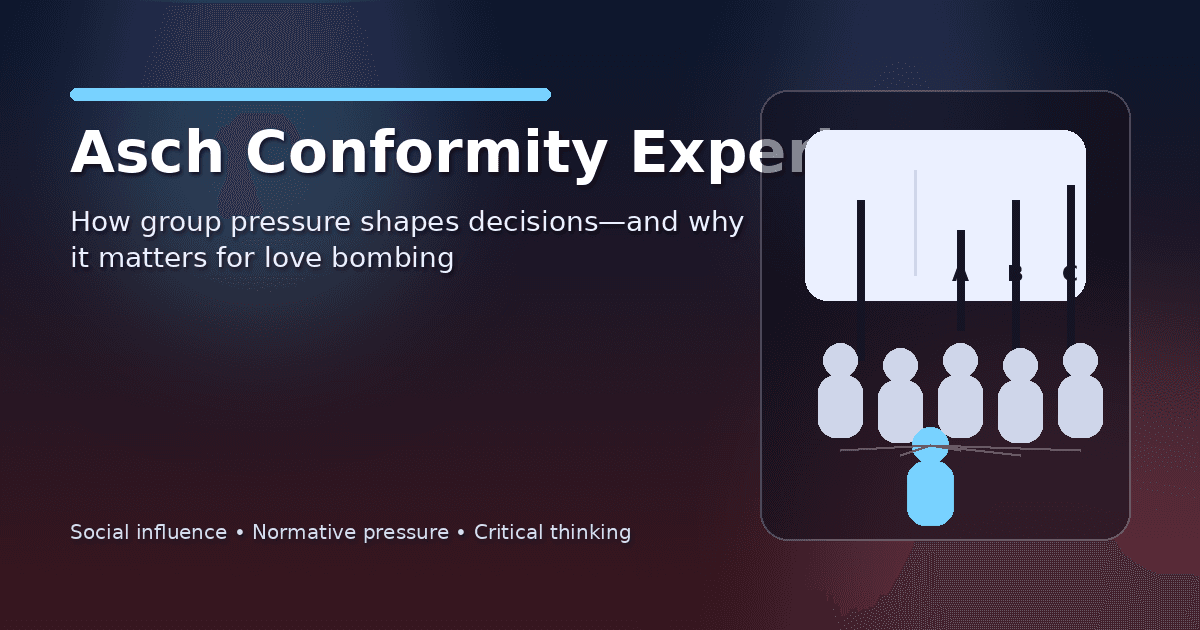
Unmasking Love Bombing. The Asch Conformity Experiment, a landmark study in social psychology, unveiled the powerful influence of group pressure on individual decision-making. While this experiment highlighted the often-overlooked tendency of people to conform, it also laid the groundwork for understanding more insidious forms of manipulation, such as ‘love bombing.’ At first glance, love bombing can appear as an overwhelming cascade of affection and admiration. However, beneath this charming façade lies a strategic manipulation tactic designed to gain control over unsuspecting individuals. In a world where connection and acceptance are highly sought after, the vulnerability to such manipulation is amplified.
Imagine entering a new relationship where your partner showers you with relentless attention, compliments, and gifts. It feels too good to be true. This is precisely the hook of love bombing, mirroring the social pressure seen in the Asch Experiment but wrapped in a deceptive package of affection. The target, much like the participants in Asch’s study who doubted their own perceptions, begins to question their instincts and judgment. The manipulator’s aim is to create dependency, subtly eroding the victim’s sense of self-worth and autonomy. As the allure of unconditional love draws them in, the individual becomes increasingly susceptible to control.
Understanding the parallels between the Asch Conformity Experiment and love bombing can empower individuals to recognize the signs of manipulation early on. By unmasking these tactics, we can foster healthier relationships and encourage a society that values genuine connection over coercive conformity. As we delve deeper into this psychological phenomenon, the importance of self-awareness and critical thinking becomes ever more apparent in safeguarding our emotional well-being.
The Asch Conformity Experiment: An Exploration into Social Influence
Background and Overview
The Asch Conformity Experiment, conducted by Solomon Asch in the 1950s, is a cornerstone study in social psychology that explores the extent to which social pressure from a majority group could influence a person to conform. This experiment provided critical insights into the mechanisms of social influence, highlighting the power of group dynamics in shaping individual beliefs and behaviors.
The Experimental Design
Asch’s experiment was ingeniously simple yet profoundly revealing. It involved a vision test where participants were asked to identify line lengths. Each participant was placed in a room with several confederates, who were in on the experiment. The group was shown a card with a line on it, followed by another card with three lines labeled A, B, and C. One of these lines matched the line on the first card in length, and the task was to accurately identify it.
- The real participant was seated such that they would provide their answer after several confederates.
- Confederates were instructed to unanimously give the incorrect answer on some trials.
- The experiment measured whether the participant would conform to the clearly incorrect majority opinion.
Findings and Outcomes
The results were striking. Approximately 75% of participants conformed to the incorrect majority at least once. On average, about one-third of the participants conformed in each trial. These findings demonstrated the powerful influence of social pressure on individual judgment, even in clear-cut situations where the correct answer was obvious.
Theoretical Implications
The Asch Conformity Experiment provided empirical evidence for several key concepts in social psychology:
- Normative Social Influence: The desire to fit in with the group often leads individuals to conform, even when it contradicts their own senses.
- Informational Social Influence: People sometimes conform because they believe the group possesses more information than they do, though this was less applicable in Asch’s clear-cut task.
- Independence and Minority Influence: Asch found that some participants remained independent despite group pressure, showcasing the potential for minority influence in group dynamics.
Case Studies and Replications
Following Asch’s initial study, numerous replications and variations have been conducted to explore the robustness of his findings across different cultures and contexts. Notably, these studies have found varying levels of conformity, often influenced by cultural norms and the specific contexts of the experiments. For instance:
- Cultural Variations: Collectivist cultures tend to show higher rates of conformity compared to individualistic cultures.
- Group Size and Unanimity: Conformity rates increase with group size up to a point, but the presence of even one ally can significantly reduce conformity.
- Task Difficulty and Ambiguity: Higher ambiguity in tasks tends to increase conformity, as individuals rely more on group input when uncertain.
Practical Applications
The findings from the Asch Conformity Experiment have significant implications across various domains:
- Education: Understanding conformity can help educators foster environments that encourage independent thinking and reduce undue peer pressure.
- Marketing and Consumer Behavior: Marketers can leverage social influence to shape consumer behavior, using tactics like testimonials and social proof.
- Organizational Behavior: Companies can design team dynamics to minimize groupthink and encourage diverse ideas and innovation.
- Public Policy and Health: Public health campaigns can utilize social norms to encourage behaviors such as vaccination and healthy lifestyle choices.
Cognitive Tools for Understanding Conformity
To better understand and navigate social influence, individuals can employ several cognitive tools:
- Critical Thinking: Encouraging a mindset of skepticism and inquiry can help individuals evaluate information critically, reducing blind conformity.
- Self-Awareness: Recognizing personal susceptibility to social influence can empower individuals to make more autonomous decisions.
- Social Skills Training: Enhancing assertiveness and communication skills can help individuals express dissenting opinions more effectively.
- Mindfulness: Practicing mindfulness can increase awareness of social pressures and enhance the ability to respond thoughtfully rather than reactively.
Limitations and Ethical Considerations
While the Asch Conformity Experiment is a foundational study in social psychology, it is not without limitations and ethical considerations:
- Ecological Validity: The artificial setting of the experiment may not fully capture the complexity of real-world social interactions.
- Deception: The use of confederates and deception raises ethical questions, although it was deemed necessary to achieve the study’s objectives.
- Participant Stress: The pressure to conform may have caused discomfort, highlighting the need for careful ethical oversight in social experiments.
Conclusion
The Asch Conformity Experiment remains a seminal study in understanding social influence. Its insights into the power of group dynamics continue to inform psychological theory and practical applications in diverse fields. By exploring the mechanisms of conformity, psychologists can better understand human behavior, ultimately contributing to the development of strategies that promote autonomy and informed decision-making in social contexts.
The Asch Conformity Experiment highlights the powerful influence of group pressure on individual judgment. It demonstrated that people often conform to group norms even when they are clearly incorrect, due to the desire to fit in or the belief that the group knows better. This experiment underscores the importance of understanding social dynamics and the potential for conformity to impact decision-making processes.
Self-Assessment Test
Love Bombing and the Psychology of Compliance
Love bombing works because it does not begin with obvious harm. It begins with intensity that feels flattering, exciting, and emotionally rare. The person on the receiving end often feels chosen in a way that is hard to resist. They may hear that they are special, different, unforgettable, or exactly what the other person has been waiting for. At first, this can feel like extraordinary chemistry. In reality, the speed and force of the attachment are part of the mechanism. The goal is not simply affection. The goal is accelerated influence.
This is where the connection to the Asch Conformity Experiment becomes useful. Asch showed that human judgment can be shaped by social pressure even when reality seems obvious. Love bombing creates a more intimate version of that pressure. Instead of a group insisting on the wrong answer, one emotionally powerful person floods the target with approval, certainty, and urgency. The target begins to reorganize their perception around the emotional environment being created for them. They may stop trusting their own discomfort because the external signal is so strong and so rewarding.
Why Love Bombing Feels So Convincing
Manipulation works best when it gives something the target genuinely wants. Most people want closeness, affirmation, safety, understanding, and emotional excitement. Love bombing offers all of these at once, often before real trust has had time to form. The speed is part of the trap. The target does not have time to assess the relationship slowly because they are being pulled into an atmosphere of emotional intensity. The manipulator may present the connection as fate, soul-level understanding, or proof that they have never felt this way before.
This can override normal caution. A person may notice small concerns such as pressure, over-texting, jealousy, or emotional inconsistency, but then dismiss those concerns because the overall experience feels so affirming. The mind begins to say, “Maybe this is just what real love feels like,” or, “Maybe I am lucky and should not overthink it.” That is often the moment when critical distance starts to weaken.
Love Bombing Versus Genuine Affection
Genuine affection can be warm, enthusiastic, generous, and emotionally expressive. The difference is not that healthy connection is unemotional. The difference is that healthy affection respects pace, boundaries, and reality. It does not need to overwhelm. It does not demand total emotional access immediately. It does not punish uncertainty. It grows alongside trust instead of trying to outrun it.
Love bombing usually feels faster, bigger, and more consuming than the actual relationship can realistically support. The person may talk about the future very early, push for exclusivity, encourage emotional dependence, or act as if the connection is already proven before enough time has passed to know each other well. What looks like romance may actually be pressure wearing a romantic mask.
Common Signs of Love Bombing
There are several patterns that appear repeatedly in love bombing. Intense contact is one of the most common. The person may text constantly, insist on long calls, or expect immediate replies. Excessive praise is another sign. Compliments move beyond natural admiration into idealization. The target is not just liked. They are elevated, often unrealistically. Rapid commitment pressure also matters. The manipulator may talk about moving in together, meeting family, or making permanent promises before the relationship has a stable foundation.
Another sign is emotional urgency. The person may imply that what is happening is rare, magical, or too important to slow down. They may frame caution as fear, distance, or self-sabotage. In some cases, gifts, surprises, or grand gestures appear very early. These are not always manipulative on their own, but when they arrive with pressure and intensity, they deserve closer attention.
How Dependency Starts to Form
Once the target becomes emotionally invested, the manipulator often begins shifting the dynamic. The same person who was once relentlessly attentive may become inconsistent. They may alternate warmth with distance, affection with criticism, or promises with confusion. This creates instability. The target begins chasing the earlier intensity, trying to get back the version of the relationship that felt perfect at the beginning.
This is a powerful point in the cycle because the target may now work harder, doubt themselves more, and become increasingly preoccupied with regaining approval. The manipulator has already established themselves as the source of emotional reward. Once that reward becomes less predictable, the attachment often becomes stronger rather than weaker. Uncertainty deepens the focus, much like intermittent reinforcement in other forms of behavioral conditioning.
Love Bombing and Self-Doubt
One of the most damaging effects of love bombing is how it erodes self-trust. In the beginning, the target may feel seen and validated. Later, they may feel confused, blamed, or emotionally off-balance. When the manipulator changes tone or begins minimizing concerns, the target often looks inward for the problem. They may ask whether they are too sensitive, too demanding, too guarded, or too suspicious. The memory of the early affection becomes evidence against their current instincts.
This is where the Asch parallel becomes even sharper. In the Asch study, people doubted their own perception because the group’s confidence was so strong. In love bombing, the target doubts their emotional perception because the manipulator’s version of the relationship was once so intoxicating and persuasive. The person may think, “If they loved me that much before, maybe I am misreading what is happening now.” That confusion keeps the cycle alive.
Why Some People Are More Vulnerable
Anyone can be vulnerable to love bombing, especially during periods of loneliness, grief, low self-worth, major transition, or unmet emotional need. But some people may be especially susceptible if they grew up around inconsistent affection, emotional unpredictability, or relationships where love had to be earned through compliance. For them, intensity may feel familiar rather than alarming. Fast attachment may feel like proof of value rather than a red flag.
People with anxious attachment patterns can also be more vulnerable because love bombing mimics the emotional highs their nervous system is already primed to respond to. That does not mean the target is weak or naive. It means the manipulation is working through deeply human needs: to belong, to matter, and to feel chosen.
Love Bombing in Dating, Friendships, and Groups
Although love bombing is often discussed in romantic relationships, it can also appear in friendships, families, workplaces, and high-control groups. A new friend may become intensely attached very quickly, demand closeness, and react badly to boundaries. A workplace leader may use exaggerated praise and “special treatment” to create loyalty before increasing pressure or control. Groups and communities may shower newcomers with attention, belonging, and certainty in ways that make later conformity easier.
This broader view matters because the core pattern is the same: intense positive attention used strategically to lower defenses and increase influence. The context changes, but the emotional mechanism remains similar.
What Love Bombing Is Not
Not every intense beginning is manipulation. Some people are naturally expressive, affectionate, and emotionally generous. Some relationships do move quickly and remain healthy. The difference lies in respect for boundaries, tolerance for pacing, and consistency over time. Healthy affection does not become hostile when you ask for space. It does not punish you for moving slower. It does not make you feel guilty for needing time to think.
If someone responds to boundaries with shame, anger, withdrawal, or accusations, that is important information. Real care can survive pacing. Manipulation usually cannot tolerate it for long.
Questions to Ask Yourself Early
If you are unsure whether you are experiencing love bombing, ask yourself a few practical questions. Do I feel free to slow this down? Can I say no without feeling punished? Does this person seem interested in who I really am, or mainly in how quickly I can attach? Are we building trust, or are we skipping over it? Do I feel more grounded with them, or more emotionally overwhelmed?
Another useful question is whether the relationship leaves room for your existing life. Healthy connection expands life. Love bombing often tries to become the center of it very quickly. If your routines, friendships, perspective, and emotional balance are shrinking while the relationship becomes more intense, pay attention.
How to Respond Without Escalating the Trap
The most effective response to love bombing is usually slowing the pace. You do not need to accuse someone immediately if you are still assessing what is happening. Instead, create space. Take longer to reply. Keep plans balanced with the rest of your life. Delay big commitments. Decline pressure politely but clearly. Notice what happens when you introduce normal boundaries. The reaction will often tell you more than the affection did.
If the person respects your pace, that is useful information. If they become irritated, guilt-inducing, wounded in a dramatic way, or suddenly cold, that is useful information too. Manipulation often reveals itself when it no longer gets instant access.
What Healing Looks Like After Love Bombing
Recovering from love bombing often involves grief and confusion because the beginning felt so good. People are not only losing a person. They are losing the fantasy of what the relationship seemed to promise. It can take time to understand that the intense affection was part of the mechanism, not proof of lasting safety. This realization can feel humiliating at first, but it should not be framed that way. Being manipulated through warmth is not a character flaw. It is a human vulnerability.
Healing often means rebuilding trust in your own pace and perception. That may involve therapy, journaling, conversations with grounded friends, and learning to notice the difference between excitement and emotional flooding. It may also involve reviewing earlier relationships to understand what patterns felt familiar and why.
Five Practical Protection Strategies
- Slow the pace on purpose. Real connection does not require instant emotional fusion.
- Watch how the person handles boundaries. Respect is more important than intensity.
- Keep your outside life active. Stay connected to friends, routines, and independent perspective.
- Notice whether affection is consistent or strategic. Sudden idealization followed by instability is a major warning sign.
- Trust discomfort even if the attention feels flattering. Unease is information, not sabotage.
Why Self-Awareness Matters More Than Perfect Detection
It is not realistic to expect yourself to detect every manipulative pattern instantly. Some love bombing is obvious, but some unfolds in subtle ways. The real goal is not perfect detection. It is maintaining enough self-awareness that you do not hand over your judgment too quickly. If you stay connected to your pace, your boundaries, and your outside perspective, it becomes much harder for manipulation to fully take hold.
This is also why critical thinking matters in relationships, not just in classrooms or public life. The Asch Conformity Experiment showed that people can doubt their own senses under pressure. Love bombing shows that emotional pressure can do the same thing. In both cases, the protection is not cynicism. It is grounded awareness.
Love Bombing and the Need for Real Connection
One of the hardest truths about love bombing is that it exploits something good: the human desire for closeness. People want to be loved, known, admired, and chosen. That desire is not the problem. The problem is when someone uses that desire as a shortcut to power. Recognizing manipulation does not mean becoming closed off to affection. It means learning to distinguish between genuine warmth and strategic overwhelm.
Healthy relationships do not need to bypass your judgment to feel meaningful. They can be exciting without being destabilizing. They can be affectionate without being coercive. They can move deeply without moving too fast. Once you learn that difference, love bombing becomes easier to recognize not because it stops looking appealing at first, but because you begin valuing steadiness more than intensity.
Final Perspective
Love bombing is powerful because it mimics the emotional shape of deep connection before trust, safety, and reciprocity have actually been built. It can leave people doubting themselves, idealizing the wrong dynamics, and chasing the return of an intensity that was never stable to begin with. But once the pattern becomes visible, it also becomes easier to resist.
The real defense is not emotional numbness. It is self-trust, pacing, and the willingness to let real connection prove itself slowly. When affection is genuine, it does not need to rush past your instincts. It can wait. Manipulation usually cannot.