

Morning Routine for Productivity: 9 Science-Backed Habits to Win Your Day
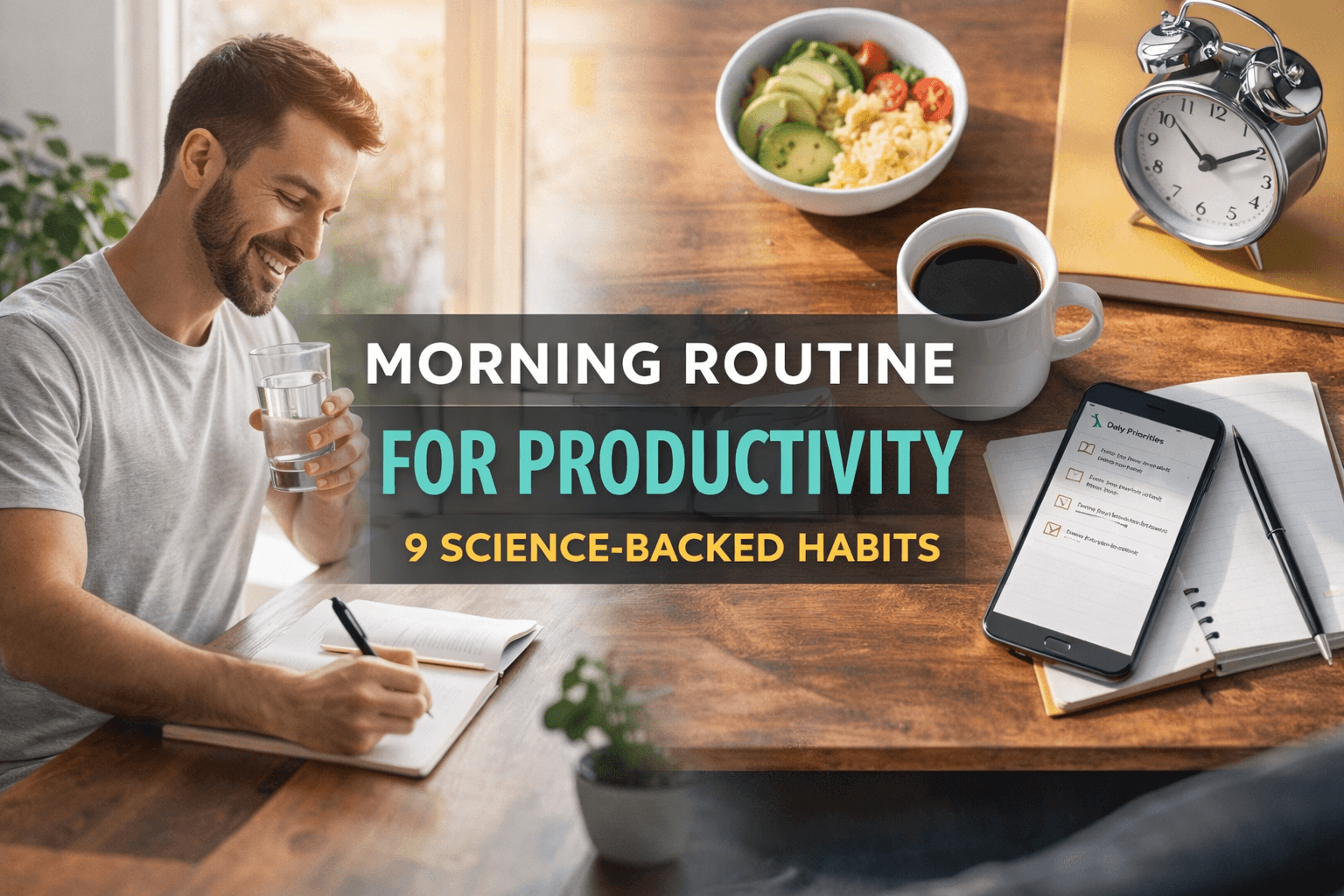
Productivity doesn’t start at work
In the U.S., millions of people search every month for ways to feel more focused, energized, and motivated throughout the day. One thing consistently shows up in high-performing individuals: a structured morning routine.
A powerful morning routine for productivity helps you:
- Reduce decision fatigue
- Improve mental clarity
- Increase energy and focus
- Set a positive tone for the entire day
The good news? You don’t need a 5 AM miracle routine or extreme habits. Science shows that small, intentional actions done consistently each morning can dramatically improve productivity.
Let’s break down the most effective habits.
Why a Morning Routine Increases Productivity
Your brain is most suggestible and focused in the first hours after waking up. According to neuroscience research, willpower and attention decline as the day goes on. That’s why successful people front-load their day with intentional habits.
A consistent morning routine:
- Reduces stress and anxiety
- Creates momentum early in the day
- Improves decision-making
- Increases long-term discipline
Instead of reacting to emails or social media, you take control of your day.

1. Wake Up at a Consistent Time
One of the most overlooked productivity habits is wake-up consistency.
Your circadian rhythm thrives on routine. Waking up at the same time every day:
- Improves sleep quality
- Reduces grogginess
- Increases morning energy
You don’t need to wake up early
Tip: Aim for a 30-minute window, even on weekends.
2. Avoid Your Phone for the First 30 Minutes
Checking your phone immediately puts your brain into reactive mode.
Notifications, news, and social media:
- Spike cortisol (stress hormone)
- Reduce focus
- Hijack attention
Instead, allow your brain to wake up naturally.
Productive alternative ideas:
- Stretching
- Journaling
- Drinking water
- Light movement
This single habit can dramatically improve daily focus.
3. Hydrate Before Caffeine
After 6-8 hours of sleep, your body is dehydrated.
Drinking water first thing in the morning:
- Improves cognitive performance
- Boosts metabolism
- Increases alertness
Many productivity experts recommend one full glass of water before coffee.
Optional upgrade: add lemon or electrolytes.
4. Get Natural Light Exposure
Morning sunlight is one of the most powerful biological signals for your brain.
Benefits include:
- Improved mood
- Better sleep at night
- Increased energy during the day
Just 5-15 minutes of sunlight helps regulate melatonin and cortisol.
If sunlight isn’t available, bright indoor lighting works as a backup.
5. Move Your Body (Light Exercise)
You don’t need an intense workout.
Light movement is enough to:
- Increase blood flow to the brain
- Improve concentration
- Reduce stress hormones
Examples:
- Walking
- Stretching
- Yoga
- Push-ups
Movement wakes up your nervous system and primes your brain for deep work.
6. Set 1-3 Daily Priorities
Highly productive people don’t create long to-do lists.
They identify 1-3 high-impact tasks.
Ask yourself:
“If I only complete three things today, what should they be?”
This approach:
- Prevents overwhelm
- Improves execution
- Increases completion rates
Write them down
7. Practice a Short Mindfulness or Reflection Habit
Mindfulness isn’t just for relaxation
Just 5 minutes of:
- Deep breathing
- Gratitude journaling
- Meditation
can:
- Improve emotional regulation
- Increase focus
- Reduce impulsive behavior
This helps you respond intentionally instead of reacting emotionally.
8. Eat a Protein-Rich Breakfast (or Fast Intentionally)
Nutrition plays a major role in productivity.
Protein-rich breakfasts:
- Stabilize blood sugar
- Improve concentration
- Reduce mid-morning crashes
If you practice intermittent fasting, that’s fine too
The key is intentionality, not perfection.
9. Start with a “Quick Win” Task
Begin your workday with a task you can finish quickly.
This creates:
- Dopamine release
- Motivation
- A sense of progress
Examples:
- Organizing your desk
- Responding to one important email
- Completing a short task
Momentum is a productivity multiplier.
Sample Morning Routine for Productivity (30-60 Minutes)
Here’s a realistic example:
- Wake up (same time daily)
- Drink water
- Light stretching or walk (10 min)
- No phone for 30 minutes
- Write top 3 priorities
- Start first task
Simple. Sustainable. Effective.
Common Mistakes to Avoid
- Trying to copy influencer routines
- Overloading your mornings
- Being inconsistent
- Skipping sleep
Your routine should support your life, not control it.
Why a Morning Routine for Productivity Works (The Science in Plain English)
A consistent morning routine for productivity works because it reduces friction. Your brain spends a surprising amount of energy making small choices: what to wear, what to eat, what to do first, whether to check notifications, whether to work out, whether to plan. When those decisions are repeated daily, they create decision fatigue-a subtle mental drain that lowers focus and willpower later.
Morning routines help by turning key actions into defaults. Instead of negotiating with yourself every day, you follow a script. That script supports your biology (sleep-wake rhythm, hydration, light exposure), your psychology (momentum, self-trust), and your attention (less reactivity, more intentional focus). The result is not perfection-it’s consistency. And consistency is what compounds.
Start Here: Build Your Routine Around “Keystone Habits”
Not all habits are equal. Some habits create a ripple effect that makes other habits easier. These are called keystone habits. In most morning routines, the biggest keystone habits are:
- Consistent wake time (stabilizes energy, mood, and sleep quality)
- Light exposure (signals your brain to become alert at the right time)
- Movement (boosts blood flow, reduces stress, improves attention)
- Planning priorities (prevents overwhelm and aimless task switching)
If your routine feels too big, keep the keystone habits and shrink everything else.
How Early Should You Wake Up for Better Productivity?
You do not need to wake up at 5 a.m. to be productive. The idea that “early equals elite” is popular online, but your productivity depends more on sleep quality and consistency than on the exact hour. Some people naturally function better later due to chronotype (a preference for earlier or later sleep-wake timing).
The practical goal: wake up at a consistent time that fits your life and allows you to get enough sleep. If you wake up early but feel exhausted, your routine is not helping-you are borrowing energy from the rest of the day.
Quick Chronotype Check
- Morning-leaning: you feel most alert within 1-2 hours of waking.
- Evening-leaning: you feel sluggish early and peak later in the day.
- Mixed: your peak shifts depending on sleep and stress.
Build your morning routine for productivity around your real energy pattern, not a trend.
Upgrade the 9 Habits with Practical Details
Your list already covers the essentials. The difference between “knowing” and “doing” comes down to small upgrades that make each habit easier to execute.
1) Consistent Wake Time: The 2-Minute Rule
If waking up consistently is hard, focus on what happens before bed. Most morning struggles start the night before. Try these small changes:
- Set a “bedtime alarm” 60 minutes before sleep to start winding down.
- Keep your phone out of reach (or across the room) to reduce late scrolling.
- Prepare one thing the night before (clothes, water bottle, notes) to reduce morning friction.
If you miss a day, do not reset the entire plan. Return to consistency the next morning. Your routine is a direction, not a verdict.
2) Avoid Your Phone: Replace, Don’t Remove
It’s easier to avoid your phone when you have a replacement behavior ready. Choose one “first 10 minutes” ritual:
- Water + window light: drink a glass of water and stand near natural light.
- 3-minute journal: write one sentence: “Today I want to feel…” and one sentence: “Today I will focus on…”
- Mobility reset: neck rolls, shoulder circles, hip opening, gentle stretching.
The goal is to start your day in proactive mode. Phones pull you into other people’s priorities. Your routine should protect your attention.
3) Hydrate Before Caffeine: The “Two Glass” Strategy
One glass of water is great. Two glasses can be even better if you wake up dehydrated. A simple approach:
- Drink 1 glass immediately after waking.
- Drink a second glass after light movement or after your shower.
If you feel headaches or fatigue in the morning, dehydration is often part of the issue. Hydration is one of the fastest “low effort, high return” productivity upgrades.
4) Morning Light: Make It Automatic
Light exposure is most effective when it happens early and consistently. You don’t need perfect conditions. Try one of these:
- Open curtains immediately after waking.
- Step outside for 5-10 minutes while drinking water.
- Walk around the block for quick light + movement.
- If it’s dark, use bright indoor lighting and get outside later.
Think of morning light as your brain’s “start button.” It tells your body clock: it’s daytime now.
5) Light Exercise: The “Minimum Effective Dose”
Movement does not have to be long. For many people, 5-10 minutes is enough to noticeably improve focus. A simple menu:
- 2 minutes: brisk walk around your home + deep breaths
- 5 minutes: stretching + a few squats or push-ups
- 10 minutes: walk outside or short yoga flow
The goal is not to “burn calories.” The goal is to wake up your nervous system and make your mind feel clearer.
6) 1-3 Priorities: Use the “Outcome Sentence”
Many people write tasks but not outcomes. A stronger approach is to define success in one sentence:
- Outcome: “By noon, I will have a draft of the report ready for review.”
- Outcome: “Today, I will finish the first version of the presentation slides.”
- Outcome: “I will complete my workout and schedule my appointments.”
Outcome thinking reduces busywork and increases clarity. It also makes your day feel measurable, which boosts motivation.
7) Mindfulness: Keep It Functional
Mindfulness for productivity is not about being calm all day. It’s about improving your ability to notice distractions and return to your task. Try a 4-step reset:
- Breathe in slowly for 4 seconds.
- Hold for 2 seconds.
- Exhale for 6 seconds.
- Ask: “What is the next right step?”
This short routine is powerful because it interrupts impulsive behavior and makes your next action intentional.
8) Protein Breakfast or Intentional Fasting: Choose One Strategy
Nutrition affects attention because it affects blood sugar stability and energy levels. The best routine is the one you can repeat. Two common approaches work well:
- Protein-rich breakfast: improves steadier energy for many people (eggs, yogurt, tofu, lean meat, protein smoothie).
- Intentional fasting: can work if it does not lead to energy crashes or overeating later.
Whichever you choose, make it consistent for at least 2 weeks before judging results. Frequent switching can create unpredictable energy.
9) Quick Win: Create Momentum Without Procrastination
Quick wins are valuable, but they should not become a way to avoid your real priorities. Choose a quick win that supports your main tasks:
- Open your project file and write the first paragraph.
- Outline your next steps in bullet points.
- Clear your desk for 2 minutes to reduce visual clutter.
A quick win should create forward movement, not a detour.
The 30-60 Minute Morning Routine for Productivity (Flexible Templates)
Here are a few realistic templates you can copy. Choose one that matches your life.
Template A: 30 Minutes (Busy Morning)
- Wake up + drink water (2 minutes)
- Open curtains or step outside (5 minutes)
- Light movement (5-8 minutes)
- Write top 3 priorities (5 minutes)
- Start the first task (10 minutes)
Template B: 45 Minutes (Balanced)
- Wake up + water (2 minutes)
- Phone-free reset: stretching or journaling (8 minutes)
- Light exposure (5-10 minutes)
- Movement (10 minutes)
- Protein breakfast or intentional fasting plan (5 minutes)
- Top 3 priorities + first action (10 minutes)
Template C: 60 Minutes (High Focus Day)
- Wake up + water + light exposure (10 minutes)
- Movement (15 minutes)
- Mindfulness reset (5 minutes)
- Plan 1-3 priorities + time blocks (10 minutes)
- Quick win that starts your main project (10 minutes)
- Breakfast or prep + transition into deep work (10 minutes)
Make It Stick: Habit Stacking and Environment Design
Most routines fail because they rely on motivation. Motivation is unreliable in the morning. Instead, rely on design.
Habit Stacking
Habit stacking means attaching a new habit to an existing habit. Example:
- After I drink water, I will open the curtains.
- After I open the curtains, I will do 10 slow breaths.
- After I brush my teeth, I will write my top 3 priorities.
This works because your brain already recognizes the anchor behavior. You are not building a new routine from scratch-you are extending one that already exists.
Environment Design
- Put your water bottle next to your bed.
- Keep workout clothes visible (or prepped the night before).
- Charge your phone outside the bedroom.
- Keep a notebook and pen on your desk for planning.
The best routine feels “inevitable” because your environment nudges you into the next step.
Common Morning Routine Mistakes (And What to Do Instead)
Mistake 1: Copying Influencer Routines
Many online routines are optimized for content, not for real life. Your routine should fit your schedule, responsibilities, and energy patterns. Start smaller than you think you need.
Mistake 2: Overloading the Routine
If your routine has 12 steps and takes 2 hours, it’s fragile. Fragile routines break when life gets busy. Build a routine that still works when you slept poorly, have kids to manage, or need to be out the door quickly.
Mistake 3: Treating a Bad Morning Like a Failed Plan
One off day does not erase progress. The best productivity routines recover quickly. If your morning goes off track, do a “reset”:
- Drink water.
- Pick one priority.
- Start for 10 minutes.
That is enough to rebuild momentum.
Mistake 4: Ignoring Sleep
No morning routine can outwork chronic sleep deprivation. If you want real productivity, protect your sleep. Consistency plus adequate sleep is the foundation under everything else.
How to Customize Your Morning Routine for Productivity by Lifestyle
If You Have Kids or a Chaotic House
- Use a micro-routine (10-15 minutes) before the household wakes up.
- Do movement in short bursts (2-5 minutes).
- Plan priorities the night before to reduce morning friction.
In busy homes, the goal is consistency, not length. Even 10 minutes can change the day.
If You Work From Home
- Create a “start work” boundary (walk outside, change clothes, or a short checklist).
- Keep your phone out of the workspace during the first focus block.
- Start with your most important task before email.
Remote work blurs boundaries. A morning routine restores structure and prevents drifting into reactive mode.
If You Work Night Shifts or Irregular Hours
Shift work changes the meaning of “morning.” Your productivity routine should begin when you wake, not when the sun rises. Keep the same principles:
- Hydrate immediately.
- Get bright light exposure when possible.
- Move your body gently.
- Set priorities before you open notifications.
Simple Tracking: Measure What Matters Without Obsessing
Tracking helps you stay consistent, but it should be lightweight. Track only a few behaviors:
- Wake time (yes/no)
- Phone-free first 30 minutes (yes/no)
- Light + movement (yes/no)
- Top priorities written (yes/no)
If you hit 3 out of 4 most days, your routine is working. The goal is not a perfect streak-it’s a stable pattern.
FAQ: Morning Routine for Productivity
How long should a morning routine be?
As long as you can repeat it. For many people, 20-60 minutes is ideal. If you are busy, a 10-minute routine is still powerful if it includes hydration, light, and one clear priority.
Should I exercise in the morning?
Exercise can boost focus and mood, but it is not mandatory. Light movement is often enough. If morning workouts make you consistent, great. If they make you quit, reduce intensity and keep it simple.
Is checking email in the morning bad for productivity?
It often is, because it shifts you into reactive mode. If possible, do at least one meaningful work block before email. If you must check email early, set a timer and avoid responding to everything immediately.
What if I’m not a morning person?
You can still build a routine. Start with the smallest steps: consistent wake time, water, light exposure, and one priority. You don’t need high enthusiasm-you need a repeatable structure.
Final Thoughts
A morning routine for productivity is not about strict discipline. It is about designing your mornings so your best habits happen by default. If you keep wake time consistent, protect your attention from your phone, hydrate, get light, move gently, and choose 1-3 priorities, you will feel a noticeable shift in focus and energy.
Start small. Build momentum. Let consistency do the heavy lifting. In a few weeks, your routine will feel less like effort and more like identity: “This is just how I start my day.”