

Octopuses Have Three Hearts and Blue Blood: 9 Incredible Facts About Their Alien Biology
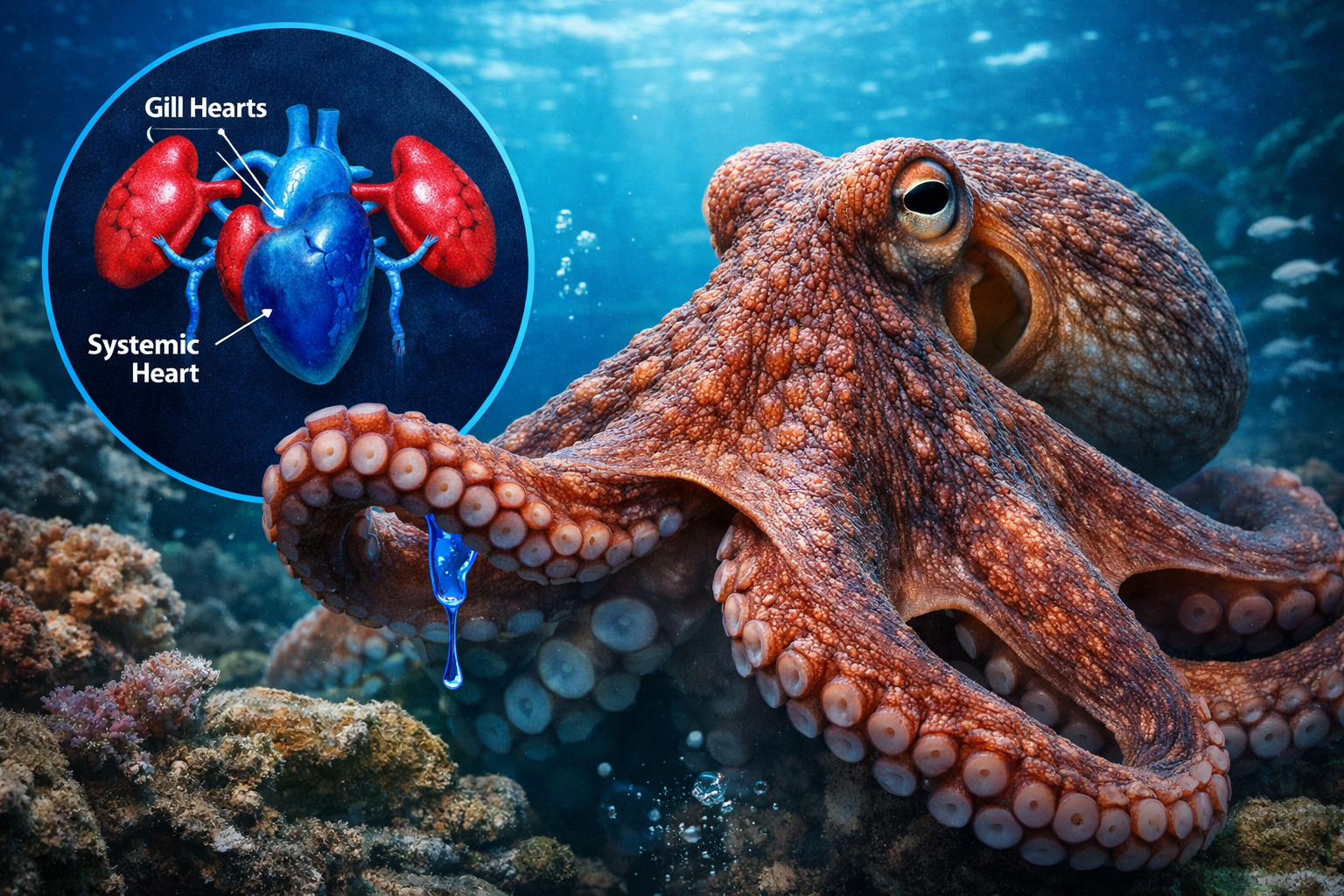
Octopuses Have Three Hearts and Blue Blood… Did you know that octopuses have not one, not two, but three hearts pumping their uniquely blue blood? These enigmatic creatures, masters of disguise and intelligence, defy our understanding of life in the ocean. Their extraordinary anatomy not only keeps them alive in the depths of the sea but also reveals the astonishing adaptations that allow them to thrive in environments that would overwhelm most other creatures. Dive into the fascinating world of octopuses, where biology meets mystery, and discover how these remarkable beings challenge our perceptions of what it means to be alive.
Octopuses Have Three Hearts and Blue BloodOctopuses are fascinating creatures that have captured the imagination of many due to their unusual anatomy and behavior. Among their most notable features are their three hearts and blue blood, which set them apart from most other animals. In this blog post, we’ll explore the science behind these remarkable traits and what they mean for the octopus’s survival in the ocean depths.
The Anatomy of an Octopus HeartOctopuses possess three hearts, a unique adaptation that helps them thrive in their aquatic environment. Here’s how they work:
#
Why Three Hearts?Having three hearts allows octopuses to efficiently manage their oxygen supply, which is critical given the oxygen-poor environments they often inhabit. The design of the octopus circulatory system is particularly beneficial when they are active. Here’s why:
In addition to their three hearts, octopuses have blue blood, which is a rare trait among animals. The reason for this coloration lies in the molecule that carries oxygen in their blood.
#
Comparison Table: Heart and Blood Features| Feature | Octopus | Human | |
| Number of Hearts | 3 | 1 | |
| Blood Color | Blue | Red | |
| Oxygen Transport Molecule | Hemocyanin | Hemoglobin | |
| Habitat | Marine | Terrestrial | |
| Adaptation to Environment | Cold, low-oxygen waters | Warm, oxygen-rich air |
The octopus is an extraordinary example of evolution’s creativity, showcasing adaptations that allow it to survive and thrive in diverse marine environments. With three hearts and blue blood, these creatures embody the complexity of life beneath the sea. Whether you’re a marine biologist or just a curious reader, understanding these traits can deepen your appreciation for the natural world and the incredible diversity of life it holds. Next time you encounter an octopus, remember the remarkable biology that allows it to be the enigmatic and captivating creature that it is!
In conclusion, the fascinating biology of octopuses, characterized by their three hearts and blue blood, highlights the unique adaptations these creatures have developed to thrive in their underwater environments. Their circulatory system efficiently supports their active lifestyles, making them remarkable among marine animals. What other intriguing adaptations do you think other sea creatures possess? Share your thoughts in the comments!
Octopuses Have Three Hearts and Blue Blood in Order to Survive a Harsh Ocean World
The more closely scientists study octopuses, the more these animals seem to belong to a different biological imagination altogether. They are not just clever sea creatures with flexible arms and strange eyes. They are organisms built with a body plan that feels almost alien when compared to most animals people know well. Three hearts and blue blood are only the beginning. Once you understand why they have these features, the octopus becomes one of the most extraordinary examples of how evolution tailors life to extreme environments.
Life in the ocean can be brutally demanding. Temperature, depth, oxygen levels, and pressure vary in ways that can challenge ordinary circulatory systems. An octopus cannot afford inefficiency. It needs a blood chemistry and pumping system capable of keeping oxygen moving through a soft, active, highly intelligent body. That is where the three hearts come in. Two help push blood through the gills to load it with oxygen, while the third sends that oxygen-rich blood to the rest of the body. It is a specialized setup for an animal that must be both delicate and powerful at the same time.
The blue blood matters just as much. Instead of relying on iron-based hemoglobin like humans do, octopuses use a copper-based molecule called hemocyanin. This molecule is especially useful in cold and low-oxygen environments, making it ideal for many marine settings. So what seems bizarre at first is actually a brilliant solution. Octopus biology looks strange because it has been shaped by the sea, and the sea rewards only what works.
Why Three Hearts Make Sense
At first glance, three hearts may sound excessive, but for an octopus they are practical. The circulatory system is doing difficult work in a body that is both muscular and oxygen-hungry. The two branchial hearts are dedicated to pushing blood through the gills. The gills are where oxygen is absorbed from the water, so these two hearts make sure the blood reaches that exchange site efficiently. The third heart, called the systemic heart, then sends the oxygenated blood to the rest of the animal.
This division of labor matters because octopuses are active predators. They squeeze through cracks, lunge at prey, manipulate shells, jet through water, and constantly use their arms in coordinated ways. All of that requires energy. A single pumping organ might not serve them as effectively under the demands of their environment. With three hearts, they can keep oxygen moving in a way that supports both survival and complex behavior.
There is also a fascinating cost built into this system. When an octopus swims, the systemic heart actually stops beating for a time, which helps explain why many octopuses prefer crawling to long-distance swimming. Swimming is simply more exhausting for them. This detail makes their biology feel even more unusual. Their body is wonderfully adapted, but it still comes with trade-offs.
Blue Blood Is More Than a Color
Blue blood sounds like the kind of phrase people use poetically, but in octopuses it is a literal biological fact. The blood looks blue because it contains hemocyanin, a copper-based protein that binds to oxygen. In vertebrates like humans, the oxygen-carrying molecule is hemoglobin, which contains iron and gives blood its red color. Octopuses and some other invertebrates took a different evolutionary route.
Hemocyanin is especially effective in cold water and environments where oxygen is limited. That makes it a good fit for many cephalopods, including octopuses that inhabit deep or relatively low-oxygen marine zones. In such settings, a molecule that can pick up and deliver oxygen efficiently becomes crucial. This is why blue blood is not just a curiosity. It is part of a survival strategy.
The drawback is that hemocyanin is generally less efficient than hemoglobin under some conditions, which means the octopus body compensates in other ways, including its three-heart system. Once again, octopus anatomy reveals a network of linked adaptations rather than isolated oddities. The hearts and the blood work together. One makes more sense because of the other.
How Octopuses Move Oxygen Through a Soft Body
Unlike vertebrates, octopuses do not have bones. Their bodies are soft, flexible, and capable of astonishing movement. That flexibility is one of their greatest strengths, allowing them to compress themselves into narrow spaces and escape predators or chase prey through crevices. But a soft body also presents challenges. It needs efficient internal transport to keep muscles and organs supplied with oxygen.
This is where the circulatory system becomes especially important. Oxygen has to move through a body that is constantly changing shape. The octopus may stretch an arm into a crack, coil its limbs around prey, flatten itself against the seafloor, or pulse through water with a sudden jet of motion. Its circulation must remain functional under all of these conditions.
That makes the three-heart system feel even more impressive. It supports a body that behaves almost like liquid muscle. An octopus is not rigid and predictable. It is fluid, reactive, and constantly in motion. The circulatory design helps make that possible.
Octopuses Have Three Hearts and Blue Blood, but Their Brain Is Just as Astonishing
If the hearts and blood make octopuses seem alien, their nervous system makes them even more extraordinary. Octopuses are widely regarded as some of the most intelligent invertebrates on Earth. They can solve problems, open containers, escape enclosures, learn patterns, and interact with objects in ways that suggest curiosity and adaptability. Their intelligence feels especially striking because it evolved along a very different path from vertebrate intelligence.
One of the most remarkable features of octopus biology is that a large portion of their neurons are not concentrated only in the central brain. Many are distributed through the arms. This means the arms are not merely obedient tools waiting for commands from the head. They have a degree of local processing power that allows them to explore and respond to the environment with surprising autonomy.
That creates an animal that is both centralized and decentralized at once. The octopus thinks with a brain, but it also experiences the world through arms that are far more capable than ordinary limbs. This distributed intelligence adds another layer to why their circulatory system matters so much. A body this neurologically active and behaviorally complex needs reliable oxygen delivery to support its astonishing responsiveness.
The Arms of an Octopus Are Almost a World of Their Own
Each octopus arm is lined with suckers that can taste and touch at the same time. Imagine having limbs that can not only grasp but also chemically explore the world. This gives octopuses an extraordinary way of interacting with their surroundings. They do not just see prey or feel surfaces. They sample them directly through contact.
The arms can move with incredible precision. They can pry open shells, manipulate stones, explore tiny openings, and coordinate in complex sequences. This is one reason octopuses are so effective as hunters. Their intelligence is not abstract. It is embodied in every movement. Their body is a thinking, sensing machine built for exploration.
This makes their blood and hearts even more interesting. The arms are muscular, active, and constantly in use. A creature with such distributed sensory and motor capability depends heavily on circulation. The octopus is not merely alive in a passive sense. It is actively processing, reaching, tasting, problem-solving, and reacting. Its unusual anatomy supports an unusually rich way of being in the world.
Camouflage Takes Their Biology to Another Level
Octopuses are famous for their camouflage, and deservedly so. Their skin can rapidly change color and pattern thanks to specialized pigment cells called chromatophores, along with other structures that affect light reflection. Some species can also alter the texture of their skin, making themselves appear smoother, rockier, or more sponge-like depending on what they are trying to imitate.
This ability is not just for beauty. It is survival in action. Camouflage helps octopuses evade predators, sneak up on prey, and communicate in certain situations. A motionless octopus against coral or stone can seem almost invisible. The transformation can happen in seconds, which is part of what makes it so mesmerizing.
When people think of octopuses as mysterious, camouflage is a big part of the reason. They do not just live in the sea. They vanish into it. Combined with their three hearts and blue blood, this gives them an almost mythical quality. They seem designed to challenge every simple idea we have about animal bodies.
Why So Many Octopuses Prefer Crawling to Swimming
Most people imagine octopuses gliding dramatically through the water, and they can indeed move by jet propulsion. But many octopuses prefer crawling along the seafloor. This is not because they are incapable swimmers. It is because swimming is costly. As mentioned earlier, the systemic heart stops beating while the animal swims, making prolonged swimming especially tiring.
Crawling is more energy-efficient and better suited to the kind of life many octopuses lead. They hunt in reefs, rocky seafloors, crevices, and complex underwater landscapes. Moving along surfaces gives them control, stealth, and stability. They can use their arms to probe the environment, hide quickly, and remain less conspicuous than when pulsing through open water.
This detail is a good reminder that impressive biological features do not make an animal invincible. Octopus anatomy is brilliant, but it is also full of compromises. Evolution shaped them to thrive in very specific ways, and part of thriving means avoiding unnecessary costs when possible.
Short Lives, Intense Lives
One of the saddest and most surprising facts about octopuses is that many species live only a few years, and some live much less. For animals so intelligent and so biologically sophisticated, their lifespan can seem unfairly short. Yet within that short life, they pack in a remarkable amount of growth, learning, hunting, escaping, and reproduction.
This brief lifespan makes their intelligence even more intriguing. Octopuses do not have many years to accumulate experience compared with longer-lived mammals or birds. They must develop quickly, adapt fast, and survive in dangerous environments without the long social learning periods seen in some other intelligent animals.
Their short lives give them a strange emotional resonance. They feel brilliant, expressive, and temporary all at once. Perhaps that is part of why humans are so fascinated by them. They seem like creatures from another world, living vividly and disappearing quickly, leaving behind questions about consciousness, evolution, and what intelligence can look like outside our familiar models.
Octopuses and the Limits of Human Imagination
Octopuses challenge human imagination because they show that complex life does not have to resemble us in order to be remarkable. They are soft-bodied, blue-blooded, multi-hearted, highly intelligent, distributed in their nervous system, and capable of camouflage that seems almost technological. They are close enough to us to feel familiar as animals, yet different enough to feel almost alien.
This matters scientifically and philosophically. Studying octopuses expands our understanding of what evolution can produce. It shows that intelligence, perception, and problem-solving can arise in bodies built along entirely different lines from vertebrates. It also reminds us not to confuse familiarity with superiority. Octopuses are not failed versions of something more advanced. They are their own extraordinary achievement.
When we look at an octopus, we are seeing one of evolution’s boldest experiments. It is an animal that solves problems through flexibility, sensation, camouflage, distributed control, and unusual chemistry. No wonder it continues to captivate scientists and the public alike.
The Ocean Made Them This Way
Everything unusual about octopuses becomes more understandable when you think about the ocean as a shaping force. The sea is not just a backdrop. It is the environment that selected for these traits over immense spans of time. Cold water, variable oxygen levels, predators, hidden prey, and complex underwater terrain all helped shape the octopus body into what it is now.
The three hearts are a response to oxygen demands. The blue blood is a response to the chemistry of marine life. The flexible body is a response to hiding and hunting in narrow spaces. The camouflage is a response to both danger and opportunity. The arms became tools of intelligence because the world rewarded animals that could interact with it in fine detail.
Seen this way, the octopus is not random at all. It is a masterpiece of environmental adaptation. Its weirdness is the visible record of the ocean’s pressures written into flesh.
What Octopuses Teach Us About Life
There is something deeply humbling about animals like octopuses. They remind us that life is more inventive than our expectations. We often build our sense of biology around familiar mammals, birds, and fish, but the natural world contains beings that stretch those categories almost to breaking point. Octopuses show that complexity can be silent, flexible, solitary, and ocean-bound. They show that intelligence can live in a body unlike ours. They show that survival can be engineered through blue blood and extra hearts.
This is one reason octopuses inspire such wonder. They are not only interesting facts. They are arguments against narrow thinking. They remind us that being alive can take forms more varied and more beautiful than human intuition usually anticipates.
And perhaps that is the greatest gift of studying them. They make the world larger. They force us to admit that nature still contains bodies, minds, and solutions that feel almost impossible until we see them clearly.
Final Thoughts
Octopuses Have Three Hearts and Blue Blood, and those two facts alone would be enough to make them unforgettable. But once you understand why they have these features, the octopus becomes even more extraordinary. Its three-heart system keeps oxygen moving efficiently through a soft, active body, while its copper-based blue blood helps it survive in cold and low-oxygen marine environments.
These traits are not isolated oddities. They are part of a whole design shaped by the ocean: intelligence spread through the arms, camouflage that borders on magic, movement defined by both power and cost, and a body that can do things no vertebrate body can easily imitate. The octopus is strange because it is perfectly adapted to a strange world.
The next time you think about the most remarkable animals on Earth, the octopus deserves a place near the very top. It is a reminder that life in the sea has evolved solutions so astonishing that they continue to challenge human imagination, even now.