

On-Device AI in Everyday Life: 1 How Local Intelligence Is Changing Digital Experiences
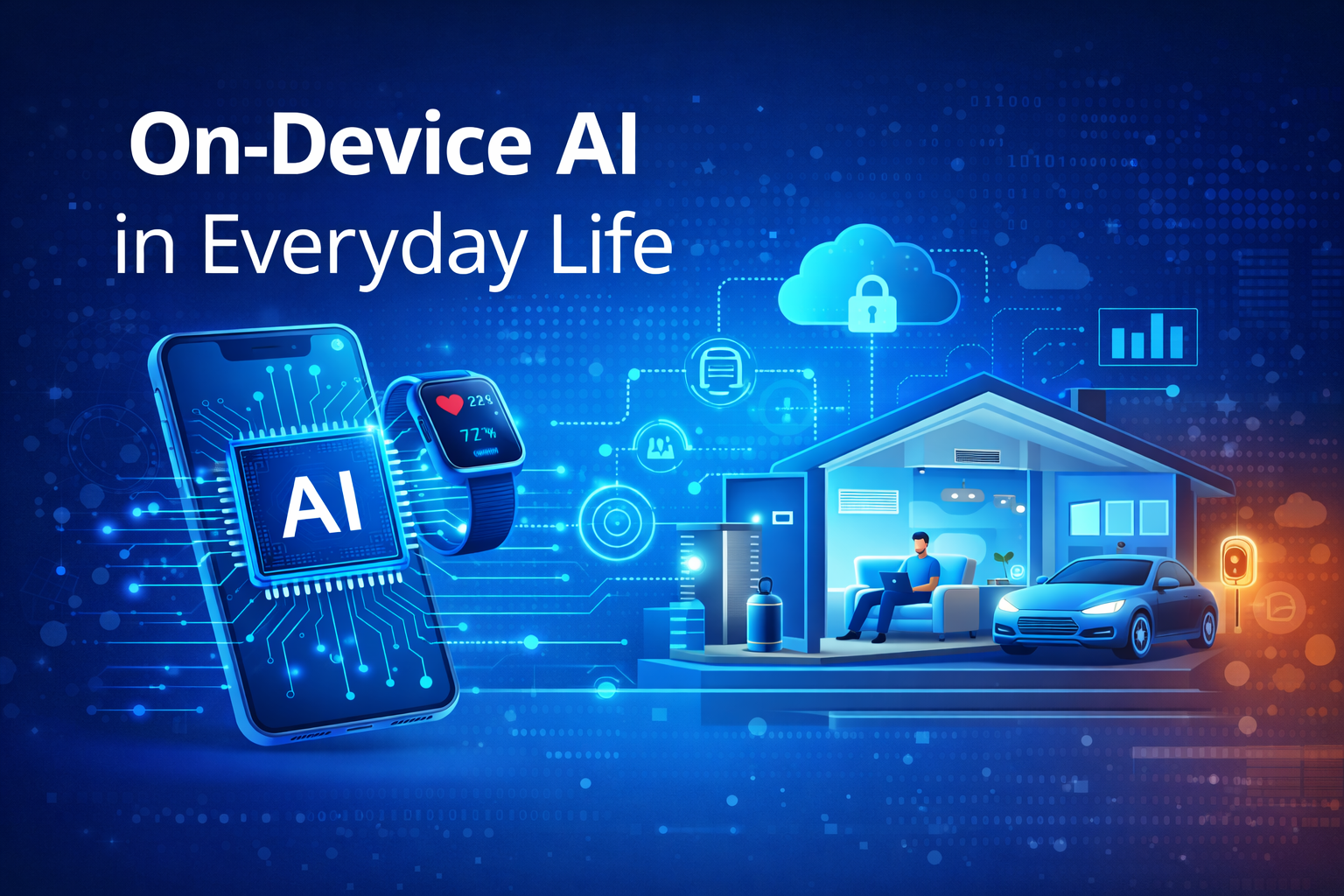
On-device AI in everyday life is becoming one of the most important shifts in modern technology, even though many people use it without realizing it. For years, artificial intelligence was largely associated with massive cloud systems, remote servers, and enterprise-scale computing. Most users imagined AI as something that lived far away in data centers, responding to commands only after information traveled across the internet. That model still matters, but it is no longer the whole picture. Increasingly, intelligence is moving closer to the user, closer to the device, and closer to the moment where decisions actually need to happen.
This change matters because people now expect technology to be fast, responsive, private, and reliable. They do not want every interaction to depend on perfect connectivity. They do not want every photo, voice command, typing habit, or movement pattern sent elsewhere just to receive a useful result. They want devices to feel smarter in real time. That expectation is pushing manufacturers, software developers, and platform providers to design systems that can process more information locally. The result is a growing wave of on-device AI that quietly powers features people use every day, from camera enhancements and live transcription to predictive typing, health tracking, language translation, adaptive battery management, and intelligent accessibility tools.
At its core, on-device AI refers to artificial intelligence models that run directly on a user’s device rather than relying entirely on remote cloud infrastructure for inference. That device could be a smartphone, tablet, smartwatch, laptop, smart speaker, car system, security camera, or wearable health monitor. In practical terms, the local hardware interprets patterns, makes predictions, or performs classifications without always sending raw data to an external server. This architecture can improve speed, reduce latency, support privacy, and make intelligent features usable even when internet access is weak or unavailable.
The implications are much bigger than convenience. On-device AI is changing the relationship between people and digital tools. It is making devices more context-aware, more personal, and more capable of supporting daily routines without constant friction. It is also changing product design itself. Companies are no longer asking only how much computing power they can centralize in the cloud. They are also asking which forms of intelligence should live directly in the hardware a person carries, wears, or interacts with throughout the day.
On-Device AI in Everyday Life: Why It Matters Now
The rise of on-device AI is not happening by accident. It is being driven by a convergence of consumer expectations, hardware advances, privacy concerns, and software efficiency improvements. Modern users expect technology to respond immediately. Delays that once felt acceptable now feel broken. Whether someone is unlocking a phone with facial recognition, dictating a message, adjusting a photo, or getting turn-by-turn navigation, they want the result to happen almost instantly. Local AI supports that expectation because it removes or reduces the delay caused by sending data to a remote server and waiting for a reply.
Privacy is another major reason this shift matters. People are increasingly aware that digital services collect large amounts of personal information. Photos, voice samples, location history, search intent, health metrics, and daily habits can reveal more than users often realize. When AI tasks run locally, more of that raw data can stay on the device instead of being transmitted elsewhere. That does not solve every privacy issue, but it can reduce exposure and help build trust in ways that cloud-only systems often struggle to match.
Reliability is equally important. Not every environment offers stable connectivity. People travel, commute, move through buildings with weak signals, and live in areas where network performance varies. A feature that works only when the cloud responds is inherently fragile. On-device AI makes intelligent features more resilient because they remain available even when connectivity is limited. That matters for everyday tasks such as language translation, voice commands, accessibility support, navigation, and content organization.
Hardware has also evolved rapidly. Smartphones and consumer devices now contain specialized chips designed to accelerate machine learning workloads. Neural processing units, AI accelerators, advanced GPUs, and optimized mobile processors allow devices to run increasingly sophisticated models locally. At the same time, machine learning models have become more compact and efficient. Developers can now deliver useful AI features without requiring the device to function like a data center in miniature.
Together, these changes are creating a new normal. Instead of asking whether a device can support local intelligence, manufacturers are increasingly asking how much intelligence should be local by default. That change is quietly redefining everyday technology.
What On-Device AI Actually Means
To understand the impact of on-device AI, it helps to separate it from the broader and often vague way the term AI is used in marketing. On-device AI does not simply mean that a product includes some kind of smart feature. It specifically refers to machine learning or AI inference happening directly on the device itself. Inference is the stage where a trained model applies what it has learned to new inputs. A phone camera detecting a face, a keyboard predicting the next word, a smartwatch identifying a workout, or a laptop generating live captions may all rely on local inference.
Training, by contrast, often still happens elsewhere. Many on-device AI features are based on models that were developed, trained, or refined using large-scale infrastructure. Once trained, those models are compressed, optimized, and deployed to devices where they can perform useful tasks locally. This hybrid structure is common because it balances the strengths of cloud-scale development with the practical benefits of edge execution.
The local nature of on-device AI makes it distinct from cloud-first assistants and services that depend on continuous remote processing. In a cloud-heavy model, the device is mainly a gateway. In an on-device model, the device becomes an active decision-making environment. That distinction influences speed, privacy, power usage, and overall user experience.
Importantly, on-device AI is not all or nothing. Many products now use a blended approach. A device may handle simple or time-sensitive tasks locally while escalating more complex requests to the cloud. For example, a smartphone might handle wake-word detection, voice cleanup, and basic command routing locally, while sending broader conversational requests to remote servers when needed. This layered design is often the most practical because it combines local responsiveness with the broader capabilities of centralized systems.
How Smartphones Use On-Device AI Every Day
Smartphones are the clearest example of how on-device AI in everyday life has already become mainstream. Many of the most useful mobile features rely on local intelligence operating silently in the background. Camera systems use AI to identify scenes, balance exposure, improve portraits, reduce blur, isolate subjects, and enhance low-light images in real time. These tasks feel immediate to the user because much of the analysis happens directly on the device during capture or processing.
Keyboards also rely heavily on local AI. Predictive text, autocorrect, grammar support, and personalized suggestions work best when they adapt to how a person writes while protecting sensitive input. Running these models locally can make typing feel smoother and more private, especially when users are entering personal messages, notes, or work-related content.
Voice features are another major category. Wake-word detection, local speech recognition, voice isolation, and live transcription increasingly run on-device. This allows users to dictate messages, search settings, or activate assistants without waiting for a cloud round trip every time. In noisy or mobile environments, speed matters as much as accuracy, and local inference often provides a more fluid experience.
Battery management is a less visible but highly practical use case. Smartphones now analyze usage patterns to understand which apps are used most often, when charging usually happens, how performance should be balanced against heat, and which background processes deserve priority. These decisions are often powered by local models that learn usage habits over time. The result is not just a smarter phone, but a device that feels better tuned to the person carrying it.
Photo organization, spam filtering, fraud detection, live translation, accessibility features, and app recommendations also benefit from on-device intelligence. Users may not describe these experiences as AI, but they feel the effects every day through features that seem more immediate, more personalized, and more context-aware.
Wearables, Health Devices, and the Rise of Personal Context
Wearables provide a powerful example of why local intelligence matters. A smartwatch or fitness tracker is constantly collecting signals such as movement, heart rate, sleep rhythm, oxygen levels, workout intensity, and recovery indicators. Sending all of this raw information continuously to the cloud would be inefficient and potentially invasive. On-device AI allows many forms of interpretation to happen locally, which helps preserve battery life, improve responsiveness, and reduce unnecessary data transmission.
Activity recognition is one of the most common examples. A wearable can determine whether someone is walking, running, cycling, sleeping, or remaining sedentary based on sensor patterns. It can do this continuously because the inference process is optimized for local hardware. The same principle applies to irregular heart rhythm alerts, stress estimation, fall detection, sleep scoring, and workout classification.
What makes this especially important is that health-related signals are highly personal. Users are more comfortable when at least part of the interpretation happens close to them rather than being handled entirely off-device. Local processing can also help ensure that important functions remain active even when a device is temporarily offline or disconnected from a phone.
As wearables become more capable, on-device AI is likely to deepen the idea of personal context. Devices will increasingly understand routine, detect deviations, offer proactive guidance, and support well-being in more subtle ways. The challenge will be balancing usefulness with transparency so users understand what their devices are observing and why certain recommendations appear.
Smart Homes and Ambient Intelligence
Smart home technology becomes significantly more useful when intelligence moves closer to the device. In a basic connected home, devices are reactive. A sensor reports a status change, a hub sends a command, and an action occurs. In a more intelligent home, devices begin to recognize patterns and respond in ways that feel adaptive rather than merely automated. On-device AI helps make that possible without requiring every interaction to be routed through external systems.
Smart speakers can use local processing for wake-word detection and selected voice commands. Security cameras can identify motion types, distinguish people from vehicles, and reduce false alerts by interpreting video locally. Thermostats can learn routines, occupancy trends, and environmental behavior to make energy use more efficient. Lighting systems can adapt to time, activity, and presence more intelligently when they understand local context.
This matters because homes are deeply personal environments. Devices in these spaces may observe speech, movement, habits, and daily rhythms. The more of that processing that can happen locally, the more comfortable users may feel adopting advanced features. Local intelligence also makes the home more reliable. A smart lock, camera, or alert system should not become useless just because the network is unstable for a few minutes.
Ambient intelligence is the broader vision behind this trend. Instead of forcing people to actively command every device, systems learn to respond more naturally to context. On-device AI is a foundational part of that shift because it allows intelligence to exist at the edge of daily life, embedded within the spaces people actually live in.
Cars, Mobility, and Real-Time Local Decisions
Vehicles are another environment where on-device AI plays a central role. Driving is full of time-sensitive decisions, which makes local processing essential. A car cannot wait for a cloud response to detect lane drift, monitor driver attention, recognize road signs, or interpret nearby hazards. Many modern driver assistance systems rely on local AI to analyze camera feeds, radar inputs, and vehicle behavior in real time.
Even outside advanced safety features, on-device intelligence shapes everyday mobility. Navigation systems can adapt to driver habits, infotainment systems can personalize recommendations, voice interfaces can process commands more quickly, and maintenance systems can detect abnormal patterns before they become serious mechanical problems. In electric vehicles, local AI can also support route-aware battery estimation, thermal optimization, and charging recommendations.
The broader point is that mobility environments demand immediate interpretation. Latency is not just inconvenient in a vehicle. It can be dangerous. That is why local AI is likely to remain fundamental to how cars, scooters, delivery fleets, and transport systems evolve.
Privacy Advantages of On-Device AI
One of the strongest arguments for on-device AI in everyday life is privacy. When a system processes information locally, it can reduce the amount of sensitive raw data sent to external infrastructure. That matters for voice, images, health metrics, typing behavior, location signals, and daily routines. While metadata and service-level interactions may still exist, local inference allows many useful tasks to happen without transmitting everything that produced them.
This approach supports a more privacy-conscious model of technology design. Instead of assuming that every useful feature requires centralized data collection, developers can ask whether the desired outcome can be achieved locally. In many cases, the answer is yes for at least part of the workflow. That design decision can reduce risk exposure, strengthen user trust, and help align products with growing expectations around data minimization.
Privacy is not only about regulation. It is also about psychology. People are more willing to engage with intelligent tools when they feel that their devices are working for them rather than watching them for someone else. On-device AI does not eliminate every concern, but it can make the relationship between the user and the product feel more respectful and more balanced.
Speed, Reliability, and Better User Experience
Speed is one of the most immediately visible advantages of local intelligence. Users may not know why a feature feels smoother, but they quickly notice when it does. When a phone unlocks instantly, a keyboard predicts accurately without lag, captions appear live, or a smart device reacts without delay, local AI often plays a central role. Reduced latency improves not just performance metrics, but the emotional feel of the product.
Reliability adds another layer of value. Many everyday situations involve poor or inconsistent connectivity. Travelers may be on airplanes or trains. Drivers may move through tunnels or low-signal routes. Students may work in environments with limited access. Emergency situations may disrupt networks. In all of these cases, technology that continues to function intelligently has a clear advantage over systems that become passive the moment the cloud disappears.
Better user experience also comes from personalization. Devices that learn patterns locally can adapt in ways that feel useful rather than intrusive. They can prioritize the apps a person actually uses, surface the photos they are likely to search for, identify routines, and support accessibility based on individual needs. When this happens without excessive friction, the technology fades into the background and becomes more genuinely helpful.
The Limits and Challenges of Local AI
Despite its advantages, on-device AI is not a perfect solution. Devices still have limits in storage, memory, power consumption, and thermal performance. Running AI models locally requires careful optimization. Developers must compress models, manage inference efficiency, and balance performance against battery life. A model that is powerful but drains a device too quickly may fail in real-world use no matter how accurate it is.
Another challenge is model complexity. Some tasks remain too large or too computationally demanding for fully local execution on consumer hardware. This is why hybrid systems are common. Local AI handles immediate, private, or routine tasks, while the cloud supports heavier reasoning, broader search, or large-scale generative outputs when needed.
There is also the issue of update cycles. If a model lives on the device, product teams need reliable ways to update it securely, test performance across hardware generations, and ensure consistency across a fragmented ecosystem. This becomes especially difficult in device categories where users keep hardware for many years.
Transparency remains another challenge. On-device AI is often invisible by design, which makes it feel seamless but can also make it harder for users to understand what is happening. Companies must be careful not to hide behind convenience. People should know when local intelligence is being used, what kinds of signals are being interpreted, and how those features can be adjusted or disabled when appropriate.
How On-Device AI Will Shape the Future of Consumer Technology
The future of consumer technology will likely depend heavily on the balance between local and cloud intelligence. Devices will become more capable of acting as personal computing environments rather than simple endpoints connected to remote systems. This shift will influence everything from hardware design and chip architecture to software interfaces and platform strategy.
One major trend will be more personalized computing. Devices will increasingly adapt to individual habits, preferences, schedules, and communication styles while keeping more of that understanding local. Instead of requiring users to explicitly configure every setting, systems will learn from patterns and offer support more proactively. This could improve productivity, health awareness, accessibility, and media experiences in ways that feel deeply integrated into daily life.
Another likely trend is broader offline capability. As local models improve, more features that once required connectivity will become usable anywhere. Translation, summarization, photo editing, assistance tools, and contextual recommendations will continue to move closer to the user. This will be especially valuable in travel, education, field work, and mobile-first regions where connectivity may be inconsistent or expensive.
Trust will become a competitive advantage. Companies that design local intelligence well may be able to offer products that feel both smarter and more respectful. In markets where users are increasingly skeptical about data collection, that combination could matter just as much as raw feature count.
There is also a broader social implication. As AI becomes embedded in personal devices, it will shape how people experience autonomy. A device that can assist without constant surveillance feels very different from one that depends on continuous external observation. On-device AI supports a more distributed model of intelligence, where usefulness does not always require centralization. That could have long-term effects on digital culture, product regulation, and public expectations about responsible technology.
Why On-Device AI in Everyday Life Is More Than a Trend
It is easy to treat AI as a marketing layer placed on top of existing products, but on-device AI represents something more structural. It changes where intelligence lives, how products behave, and what users expect from their technology. It makes devices faster, more private, more reliable, and more closely aligned with the rhythms of everyday life. It turns ordinary tools into adaptive environments that understand context with less friction than before.
Most importantly, it brings AI out of the abstract. Instead of existing only as a remote service, intelligence becomes part of the object in a person’s hand, on their wrist, in their home, and around their daily movement. That creates a different kind of relationship between people and technology. The device is no longer just a portal. It becomes an active participant in how work gets done, how communication happens, how health is monitored, and how daily choices are supported.
That is why on-device AI in everyday life matters so much. It is not just about making devices more impressive. It is about making digital experiences more immediate, more personal, and more dependable in the moments where people actually need them. As local hardware improves and software becomes more efficient, this form of intelligence will likely become one of the defining foundations of modern consumer technology.