

Phantom Vibration Syndrome: Why You Feel Your Phone Buzz When It Did Not
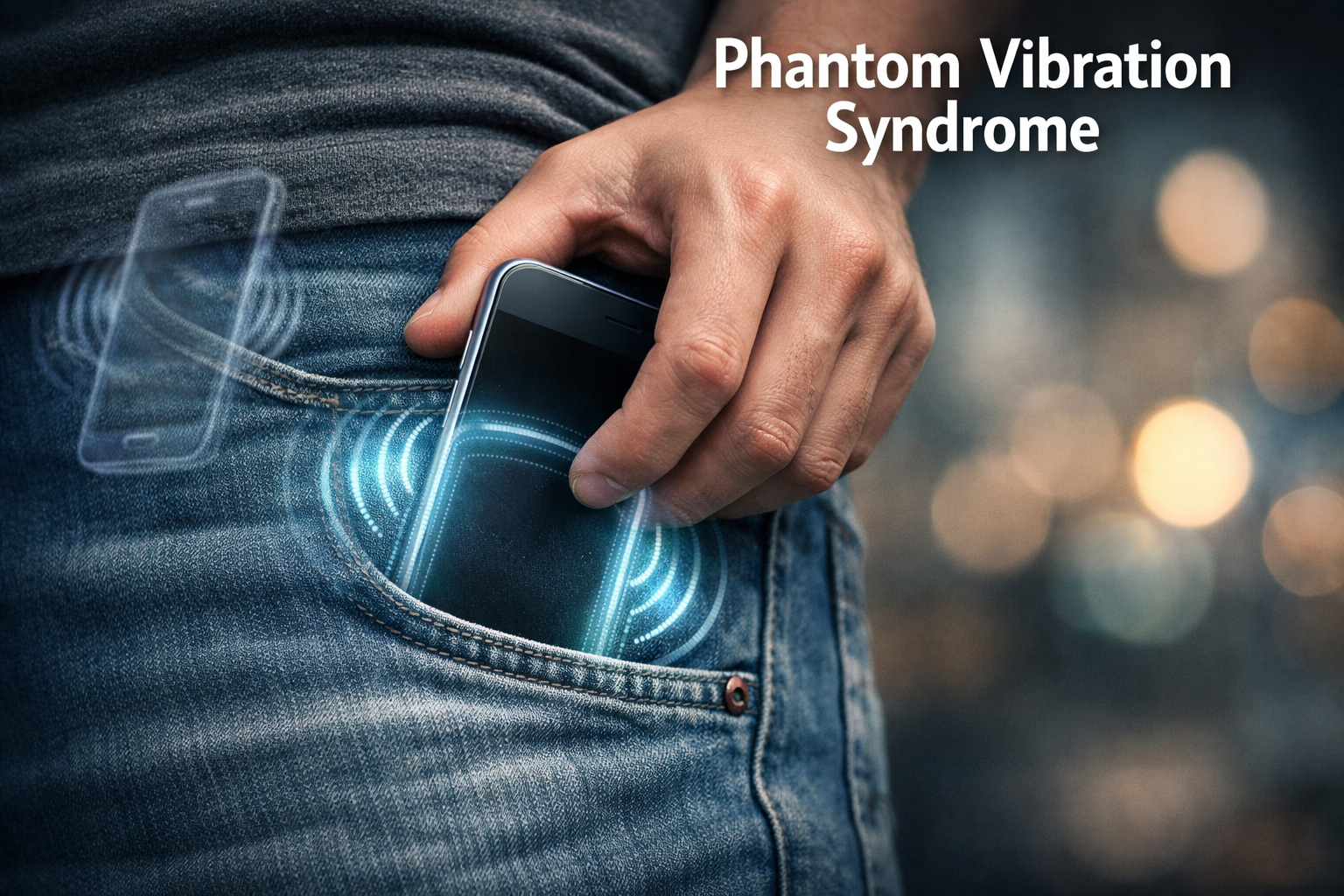
There is a strange modern experience that almost everyone recognizes the moment it is described. You are walking to work, standing in a grocery line, finishing a task at your desk, or trying to fall asleep. Suddenly, you feel your phone vibrate. The sensation seems unmistakable. You reach for your pocket, check your hand, or glance at the table beside you, only to discover that nothing happened at all. No call. No text. No alert. No vibration. Just a powerful impression that your body insists was real.
This experience is commonly called phantom vibration syndrome. The term sounds dramatic, but the phenomenon itself is surprisingly ordinary. It happens to students, parents, doctors, office workers, gamers, freelancers, drivers, and people who barely think of themselves as “phone addicted.” It can happen during busy periods, stressful weeks, emotionally loaded situations, or seemingly at random. Sometimes it appears alongside phantom notification sounds. Sometimes it fades for months and then returns the minute life becomes hectic again.
Because the sensation feels so vivid, many people worry that something is wrong with them. They wonder whether they are too dependent on their devices, whether their nervous system is becoming overstimulated, or whether their attention span is breaking down. Others laugh it off but keep noticing it often enough that the joke becomes uncomfortable. Why does a nonexistent signal feel physically real? Why does the body create a message that the phone never sent?
The answer sits at the intersection of attention, expectation, habit, memory, and the way the brain learns to prioritize possible rewards. Human perception is not a camera passively recording reality. It is an active prediction system. Your brain constantly guesses what matters, filters out what does not, and fills in missing information at astonishing speed. When a phone becomes one of the most behaviorally important objects in your daily life, the brain starts treating possible notifications as meaningful events worth detecting immediately. That is where the illusion begins.
This article explores phantom vibration syndrome in full depth: what it is, why it happens, what it says about the modern mind, how stress and anticipation make it worse, why it is usually harmless, and what practical steps actually reduce it. More importantly, it explains why this phenomenon is not just about phones. It is a clue about how the brain builds reality from expectation long before conscious thought catches up.
What Is Phantom Vibration Syndrome?
Phantom vibration syndrome refers to the false perception that your phone is vibrating when it is not. The experience usually occurs in the place where you normally carry your phone: a front pocket, back pocket, jacket pocket, bra, waistband, hand, or even a nearby surface if your brain has become accustomed to monitoring that location. Some people feel a brief buzz. Others describe a pulsing sensation, a tiny shiver, or a patterned vibration that seems exactly like a real alert.
Despite the word “syndrome,” this is not generally treated as a dangerous medical disorder. It is better understood as a perceptual misfire shaped by routine and repeated expectation. Your nervous system receives ambiguous sensory information all the time. Clothing shifts. Muscles twitch. Skin brushes against fabric. Nerves fire. Movement produces micro-sensations. Most of these signals are ignored. But when the brain is primed to look for one specific outcome, it can interpret an ordinary body sensation as a phone alert.
That is why phantom vibrations often feel convincing. You are not inventing them in a theatrical or conscious sense. You really do feel something. The misunderstanding happens in interpretation. The sensation is real; the source you assign to it is not. In other words, the body whispers and the brain labels the whisper as “notification.”
Some people experience the auditory version instead: they hear a ding, ring, or vibration-like hum that never occurred. Others experience both. Together, these false alerts reveal a powerful fact about human awareness: we do not merely react to the world. We actively predict it, and sometimes prediction outruns reality.
Why the Brain Creates False Alerts
To understand phantom vibration syndrome, it helps to stop thinking of perception as a one-way street. Your brain does not wait patiently for perfect information before deciding what is happening. It uses past experience, current goals, emotional context, and learned patterns to make rapid best guesses. This is efficient. Without prediction, daily life would be painfully slow.
Imagine walking through a crowded street while carrying a phone in your pocket. Your brain already “knows” that messages often arrive during movement, work, commuting, or social downtime. It also knows that alerts may matter. A message could be from a partner, a boss, a delivery service, a client, a friend, a school, a bank, or a ride-share app. Each alert might contain reward, urgency, or threat. That makes the signal psychologically important.
When something matters, the brain lowers the threshold for detecting it. This is useful when accuracy is life-saving. It is less useful when the signal is a smartphone buzz. In such cases, the detection system becomes hypersensitive. Small sensory inputs that would normally be ignored can get pulled into the “possible notification” category. The result is a false positive: better to think you got a message and check than to miss one that could matter.
From the brain’s perspective, this makes sense. False alarms are tolerated when the cost of missing something feels high. Modern communication platforms quietly train this logic every day. Messages arrive unpredictably. Some are boring, but some are rewarding, socially significant, or time-sensitive. That unpredictable reward schedule makes attention sticky. The mind learns to stay ready.
This is one reason phantom vibrations can persist even when you dislike being overly connected. The phenomenon is not simply about loving your phone. It is about learned vigilance. The brain adapts to what appears behaviorally important, even when that importance is exhausting.
The Role of Habit and Body Memory
Phones are not just tools we use. For many people, they become extensions of body routine. You carry the device in the same place for weeks, months, or years. You check it in the same gestures. You respond to it with the same speed. You may reach for it dozens or hundreds of times a day without conscious deliberation. Over time, this builds a form of body memory.
Body memory means the body learns patterns before reflective thought gets involved. Consider how you can sometimes unlock your phone, open an app, and begin checking something before you can even explain why you picked it up. That is not accidental. It is a learned action chain. Phantom vibration syndrome grows out of similar conditioning.
If your phone usually vibrates against the same area of skin or fabric, your nervous system becomes especially tuned to changes in that location. The brain creates a template for what “incoming alert” feels like. Once the template exists, nearby sensations can be matched to it. A wrinkle in denim, a shifting seam, the rebound of a step while walking, or a subtle muscle contraction may be close enough for the brain to declare, “That was it.”
This is why phantom vibrations can feel more common in people who keep their devices on their body for long stretches. The sensation map becomes overlearned. The body keeps expecting the familiar buzz even in silence, much like you can feel the ghost of a watch on your wrist after removing it or briefly think you still have glasses on your face after taking them off.
Stress, Anxiety, and Hypervigilance
Phantom vibration syndrome tends to become more noticeable during stressful periods, and that is not a coincidence. Stress changes attention. It narrows the mind toward possible demands, interruptions, and threats. If you are waiting for a job update, a medical message, a relationship text, a school result, or an urgent work request, your brain starts scanning for cues that the awaited event has arrived.
Anxious anticipation amplifies the effect even further. Anxiety does not only make people worry; it changes how ambiguous information is interpreted. Under calm conditions, a tiny sensation in your pocket may stay meaningless. Under anxious conditions, the same sensation becomes suspicious. The mind asks, “Was that the message?” before evidence is available.
This is a form of hypervigilance. Hypervigilance is heightened scanning for relevant signals, especially when the brain believes something important could happen at any moment. In ancient survival contexts, hypervigilance helped people notice danger. In modern device culture, the same machinery gets recruited for texts, notifications, and digital interruptions.
That is why phantom vibrations may spike during emotionally charged situations. Waiting for a reply after conflict. Expecting a deadline message. Anticipating a dating app response. Monitoring family emergencies. Tracking a package that matters too much. Stress gives the phone more psychological weight, and the heavier that weight becomes, the more aggressively the brain searches for signs of contact.
Reward Loops and the Psychology of Uncertainty
One of the most important ingredients behind phantom vibration syndrome is uncertainty. If phones notified us on a perfectly predictable schedule, they would be less mentally intrusive. But notifications arrive irregularly. Sometimes the next buzz changes nothing. Sometimes it changes your whole mood. That unpredictability is exactly what keeps the brain engaged.
Intermittent rewards are especially powerful in shaping behavior. When a signal might bring something meaningful, the mind becomes attentive in a way that steady rewards do not produce. Social approval, novelty, relief, urgency, opportunity, gossip, danger, and validation can all ride inside the same buzzing device. The brain learns that checking may pay off, even if many checks do not.
This creates an attention loop. You expect alerts because alerts have mattered before. You monitor for them because they are unpredictable. You feel relief or stimulation when they arrive. Over time, the expectation itself becomes embodied. The nervous system starts leaning toward detection.
Phantom vibration syndrome is therefore not simply a quirky side effect of technology. It is an understandable consequence of how human brains respond to uncertain rewards. The mind hates missing important signals. It would rather over-detect than under-detect when the stakes feel socially or emotionally relevant.
Why It Feels So Real
Many people are disturbed not just by the existence of phantom vibrations, but by how convincing they are. The sensation does not always feel vague. Sometimes it feels exact, down to the rhythm and location. That realism can be unsettling, but it makes sense once you understand how perception works.
The brain is constantly combining raw sensory data with expectations. When the expectation is strong, it can shape the final experience dramatically. This does not mean the brain is “lying” in a simple sense. It means perception is interpretive. You do not experience the world as untouched data; you experience the brain’s best model of what the data likely means.
Suppose fabric rubs lightly against your leg while you walk. That sensation alone is ambiguous. It could mean almost nothing. But if your brain is primed to detect a phone buzz, it may assign the vibration label to that ambiguous input instantly. Once the label is attached, the experience feels coherent and real. By the time you check your phone, the interpretation has already happened.
This same mechanism explains other everyday illusions. You think someone called your name in a noisy room. You see movement in your peripheral vision that turns out to be shadows. You hear your baby cry in the shower even though the house is quiet. The brain errs toward meaningful interpretation when ambiguity meets expectation. Phantom vibrations are the smartphone-age version of that ancient cognitive habit.
Who Experiences Phantom Vibration Syndrome?
The short answer is: almost anyone who uses a phone regularly can experience it. You do not need to be severely dependent on your device. You do not need a mental health diagnosis. You do not need to work in tech. This phenomenon appears across age groups and lifestyles, though it may be more common among people whose work, relationships, or routines require frequent digital responsiveness.
Students may notice it during exam periods when messages feel loaded with social and academic meaning. Professionals may notice it when they are on call, waiting for clients, or carrying too much responsibility. Parents may notice it when they are expecting updates from school or family. People in new relationships may notice it when anticipation and uncertainty are high. Creators, freelancers, traders, managers, and remote workers may experience it because so much of their real-world activity is routed through one device.
In some cases, people who feel lonely or overstretched may also become more attentive to notifications because messages carry emotional relief. In other cases, highly disciplined people experience phantom vibrations precisely because they feel obligated to stay reachable. The common thread is not personality type alone. It is repeated relevance. The phone becomes a portal to things that matter, and the brain adapts accordingly.
Does It Mean You Are Addicted to Your Phone?
Not automatically. Phantom vibration syndrome can appear in people with heavy screen habits, but it should not be treated as a standalone diagnosis of addiction. It is better seen as a clue that your attention system has become sensitized to phone-related cues. That sensitization might reflect overuse, stress, obligation, emotional anticipation, or all of the above.
It can, however, be a useful signal to pause and look at your relationship with your device. If phantom vibrations are frequent and you also find yourself compulsively checking your phone, feeling restless when separated from it, interrupting conversations to monitor notifications, or using it to regulate every uncomfortable emotion, then the experience may be part of a larger pattern of digital overattachment.
Still, it is important not to overpathologize yourself. The modern world is designed to pull attention toward devices. Many jobs demand responsiveness. Many social circles operate through fast messaging. Many services depend on real-time alerts. Your brain adapting to those conditions does not mean you are weak or broken. It means you are human in an environment optimized for attention capture.
When Phantom Vibrations Are Usually Harmless
In most cases, phantom vibration syndrome is harmless. It is common, episodic, and responsive to behavioral changes. If it happens occasionally or during stressful periods and does not interfere significantly with your life, it is generally better understood as a normal byproduct of modern attentional conditioning than as a serious health problem.
Many people notice that the sensation fades when they go on vacation, reduce work pressure, move their phone to a bag, turn off nonessential notifications, or simply spend more time away from constant monitoring. That pattern strongly suggests a situational, habit-linked mechanism rather than a dangerous one.
Harmless does not mean meaningless, though. Even minor phantom alerts can reveal how loaded your internal environment has become. They can be one of the first hints that your body is operating in a low-grade state of expectation long before your conscious mind admits you feel overloaded.
When It Might Be Worth Paying Attention
Although phantom vibration syndrome is usually not serious, context matters. If false alerts are accompanied by overwhelming anxiety, severe sleep disruption, panic symptoms, escalating distress, or other sensory experiences unrelated to phone use, it may be worth discussing them with a qualified healthcare professional. The same is true if you are experiencing broad changes in perception, concentration, or emotional stability that go far beyond the occasional false buzz.
The key question is not whether you have ever felt a phantom vibration. The key question is whether the experience is isolated and understandable within your phone habits, or whether it is part of a larger pattern that is causing substantial impairment. For most people, it is the former. But being observant about your own baseline is always wise.
Why Phantom Vibrations Happen More in Silence
Paradoxically, phantom vibrations often become more noticeable in quiet moments rather than in constant chaos. This happens because the mind fills silence with monitoring. When external demands briefly drop, internal scanning can become louder. You finally notice the micro-sensations that were always there, and the brain assigns meaning to them.
This is why people report phantom alerts while trying to sleep, resting after work, or waiting between tasks. Stillness gives expectation room to echo. The body becomes a stage for faint signals, and the brain-already trained to treat possible notifications as important-turns ordinary bodily noise into a digital message.
In this sense, phantom vibration syndrome also tells a story about rest. Many people are no longer fully resting, even when they appear to be. They are pausing in posture while remaining alert in mind. The phone may be silent, but the expectation of interruption stays active. The body does not know the shift is over.
How to Reduce Phantom Vibration Syndrome
The good news is that phantom vibration syndrome often improves with practical behavioral changes. Because it is driven by learned expectation and attention patterns, small adjustments can have outsized effects over time.
1. Change where you carry your phone. If the false buzz usually occurs in one pocket or one part of the body, move the device somewhere else for a while. Put it in a bag, on a desk, or in a coat instead of against the same skin area every day. This disrupts the body map that the brain has learned.
2. Reduce nonessential notifications. Not every app deserves direct access to your nervous system. Disable alerts that do not truly matter. Fewer real notifications reduce anticipatory monitoring, which lowers the chance of false ones.
3. Use scheduled checking windows. Instead of living in constant readiness, create moments when you intentionally check messages. This teaches the brain that responsiveness can be deliberate rather than reflexive.
4. Turn vibration off for certain periods. If possible, switch to visual notifications during work blocks, evenings, or weekends. When the body is no longer trained by repeated physical buzzing, phantom sensations often decrease.
5. Notice your emotional context. Ask yourself what you are waiting for. A message from whom? About what? Phantom alerts often intensify when unspoken anticipation is high. Naming the source of tension can reduce its power.
6. Rebuild tolerance for disconnection. Leave the phone in another room for short intervals. Walk without it occasionally if that is safe and practical. Practice being unreachable for controlled periods. This retrains the brain away from constant alertness.
7. Lower background stress. Sleep deprivation, anxiety, overwork, and emotional overload all make false positives more likely. Sometimes the best “phone fix” is not a phone fix at all. It is a nervous system reset.
A Deeper Lesson About the Modern Mind
Phantom vibration syndrome may look trivial, but it reveals something profound. Human attention is trainable at the level of sensation itself. Repetition does not merely change habits; it changes what seems real enough to deserve action. The more tightly technology wraps around urgency, identity, connection, and reward, the more deeply the body participates in digital life.
That matters because phones are not neutral objects anymore. They are social lifelines, workstations, entertainment systems, navigation tools, cameras, wallets, memory archives, and anxiety containers. When one object becomes all of these things at once, the brain assigns it unusual priority. Phantom vibrations are one visible side effect of that priority.
But there is another lesson too: perception can be retrained. The same plasticity that creates false alerts can also reduce them. If the brain learned to expect constant buzzing, it can learn calmer rules. That is hopeful. It means overstimulated attention is not destiny. It is often adaptation, and adaptation can be updated.
How to Tell Whether Your Phone Is Running You
If phantom vibration syndrome keeps returning, treat it as an invitation to audit your digital environment. You do not need to panic or swing into extreme detox rhetoric. Instead, ask a few honest questions. How often are you checking your phone without purpose? How uncomfortable do you feel when you cannot access it? How many notifications are truly useful? How many moments of boredom, uncertainty, or discomfort do you automatically fill by reaching for the screen? How often does your body feel on standby for incoming contact?
These questions matter more than the occasional false buzz itself. The buzz is a symptom, not the whole story. It may be telling you that your attention has become fragmented, your nervous system over-available, or your emotional life too tied to unpredictable digital reinforcement. The goal is not to become anti-phone. The goal is to become less governable by alerts.
Phantom Vibration Syndrome and the Future of Attention
As wearable devices, smart assistants, AI messaging tools, haptic feedback systems, and ambient notifications continue to expand, phantom alert experiences may become even more common. The body is being integrated into communication loops more directly than ever. Watches tap the wrist. Rings pulse. Earbuds chime. Cars speak. Home devices blink. The future of technology is not only visual. It is sensory, intimate, and constant.
That means the line between signal and expectation may blur further unless people actively design boundaries. Phantom vibration syndrome is an early warning from the age of always-on feedback. It shows what happens when the body becomes too accustomed to interruption. The nervous system starts generating its own previews.
If there is a healthy path forward, it will require more than better self-control. It will require deliberate design choices, personal rituals of disconnection, and a cultural shift away from treating instant availability as the default definition of responsibility. Otherwise, the body will keep learning that silence is temporary and interruption is always about to arrive.
Final Thoughts
Phantom vibration syndrome is strange, but it is not mysterious in the supernatural sense. It is the natural outcome of a predictive brain living in a world where tiny alerts can carry outsized psychological value. The body feels something. The brain fills in the most probable cause. You check the phone. Nothing is there. The moment passes, but the lesson remains.
That lesson is not merely that phones are distracting. It is that attention shapes sensation. Expectation shapes perception. Repetition shapes reality more than most people realize. When the mind is trained to wait for interruption, even silence can begin to vibrate.
If you experience phantom vibrations, you do not need to feel ashamed or alarmed. Instead, treat the phenomenon as useful feedback. It may be showing you where anticipation has taken root, where stress is hiding, or where your digital habits have become more bodily than you knew. Once you see that clearly, the false buzz loses some of its power. It becomes what it really is: not a message from your phone, but a message from your attention.