Prompt Chaining: 10 Practical Ways to Get Better AI Results
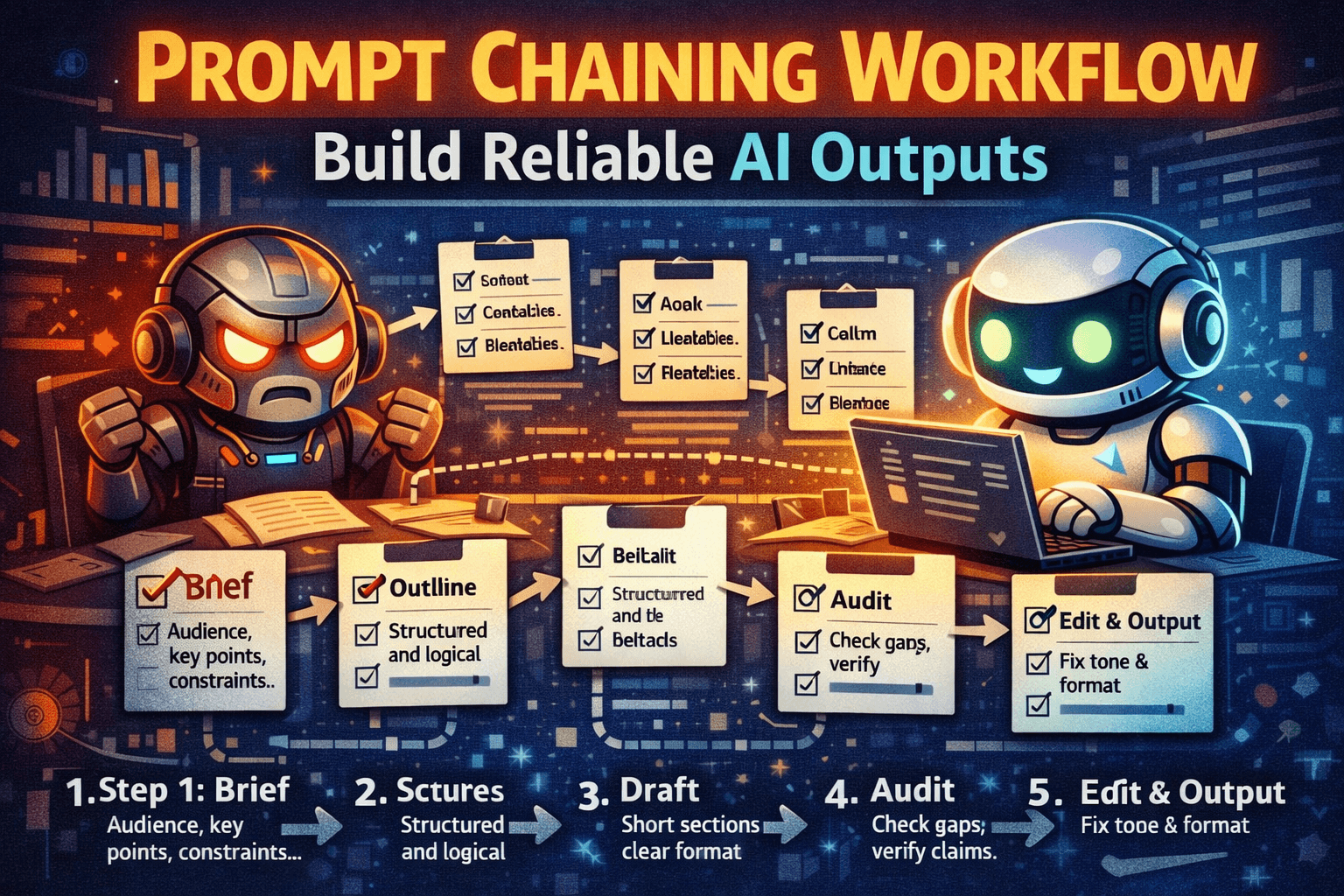
Prompt chaining is a simple way to get better results from AI without repeating yourself. Instead of writing one massive prompt and hoping the output is perfect, you break the work into a short sequence of prompts. Each step produces a clear artifact that becomes the input for the next step.
This approach is practical because most real tasks are multi-stage: you clarify the goal, choose constraints, draft, revise, and polish. Prompt chaining matches how professionals work. It also reduces errors, because the AI has fewer opportunities to guess what you meant.
In this guide, you’ll learn what prompt chaining is, why it works, and how to run a clean workflow. You’ll also get real examples, common mistakes to avoid, and a copy-paste template library you can save and reuse.
Why It Matters / Benefits
- More consistent quality: Each step has a single purpose, so outputs stay focused.
- Less rework: You catch gaps early (before you invest time polishing a flawed draft).
- Lower hallucination risk: You can force assumptions, verify claims, and keep the model inside your constraints.
- Better control of tone and format: You can dedicate a step to structure, then a step to editing.
- Reusable workflows: Once you have a chain for “blog post,” “SOP,” or “support reply,” you can repeat it fast.
Key Concepts
What “Prompt Chaining” Means
Prompt chaining is a method where you run prompts in a planned sequence. Each prompt produces an output artifact (brief, outline, draft, checklist, final copy). You then feed that artifact into the next prompt.
Mini example: Brief → Outline → Draft → Edit pass → Final.
Artifacts
An artifact is the thing you want from each step. Examples: a one-paragraph brief, a list of headings, a draft under 1,200 words, or a checklist of fixes.
Artifacts keep the chain stable. If you only say “make it better,” the model can change anything. If you ask for a specific artifact, you control the result.
Constraints
Constraints are rules that define “good.” Length, tone, audience, platform, must-includes, and must-avoids are the most important. Constraints should be repeated across steps, so the chain stays aligned.
Handoff Format
A handoff format is how you pass information from one step to the next. If the output is structured (headings, bullets, labeled sections), it becomes easy to reuse and edit.
Verification vs. Creation
Creation steps generate new content. Verification steps check for errors, gaps, and weak assumptions. A good chain includes both, even if verification is short.
Step-by-Step Guide
- Step 1: Define the deliverable and success criteria. Decide exactly what “done” looks like before you ask the AI to create anything. Action: Write a one-sentence goal and 5-10 constraints (tone, length, audience, format).
- Step 2: Create a short brief. The brief becomes your control center. It should include purpose, audience, key points, and what to avoid. Action: Ask for a brief in a fixed format (bullets). Do not ask for the full draft yet.
- Step 3: Generate an outline based on the brief. Make the outline scannable and logical. Ensure it matches search intent if you’re writing for SEO. Action: Ask for headings and subheadings plus what each section should cover.
- Step 4: Expand to a draft in sections. Draft section-by-section if the topic is complex. That reduces drift and keeps style consistent. Action: Ask for the introduction + 2-3 sections at a time, then continue.
- Step 5: Run a “gap and logic” audit. Ask the AI to find missing subtopics, unclear steps, and places where it made assumptions. Action: Require a list of issues first, then specific fixes.
- Step 6: Run a “style and clarity” edit. This step removes fluff and improves readability. Action: Ask for short sentences, active voice, and consistent terminology.
- Step 7: Produce the final deliverable in your required format. Only at the end do you request the final output formatting (HTML, email format, checklist layout, etc.). Action: Provide the final formatting rules and ask the model to output only that.
Real Examples
Example 1: SEO Blog Post Chain (Reliable, Scannable)
Goal: Write an SEO guide without fluff, using consistent structure.
- Brief prompt: My goal is to write a practical blog post about: [TOPIC].Context:
- Outline prompt: Using the brief below, create a detailed outline.Constraints:
- Draft prompt (sectioned): Write the Introduction and the first two H2 sections from this outline.Constraints:
- Audit prompt: Audit the draft below for missing steps, unclear definitions, or sections that feel generic.Output format:1) Top issues (ranked)
2) Specific fixes (bullet list)
3) Suggested additions (only if necessary)Draft: [PASTE DRAFT] - Final formatting prompt (HTML): Convert the final draft into valid HTML for WordPress.Rules:
Example 2: Support Reply Chain (Fast, On-Policy)
Goal: A reply that is calm, firm, and consistent with policy.
Step 1 (Policy extraction): Summarize the policy and allowed options from this text: [PASTE POLICY]. Output bullets only.
Step 2 (Draft): Draft a reply under 130 words. Must offer two options. Must end with a question. Customer message: [PASTE]. Policy bullets: [PASTE].
Step 3 (Tone edit): Make it warmer without weakening the boundary. Keep length under 130 words. Output the final email only.
Example 3: Research Summary Chain (No Invented Claims)
Goal: Summarize a source you provide without adding unsupported facts.
Step 1: Extract key points from the text below. Output 8-12 bullets. Do not add new claims. Text: [PASTE].
Step 2: Turn those bullets into a short summary (150-220 words). Keep the same meaning. Bullets: [PASTE].
Step 3: List anything uncertain or unsupported. Output “Uncertain items” bullets only.
Example 4: SOP Chain (Clear Steps + QA)
Goal: Create a standard process people can follow.
Step 1: Ask up to 3 questions that affect the SOP the most. Then list assumptions and proceed.
Step 2: Draft the SOP with: purpose, scope, prerequisites, numbered steps, QA checklist, escalation path.
Step 3: Review for missing edge cases and reorder steps for clarity. Output the improved SOP only.
Example 5: Idea-to-Execution Chain (Turn Ideas into Actions)
Goal: Convert rough ideas into a concrete plan.
Step 1: Turn this idea into a one-paragraph brief with goal, audience, and constraints. Idea: [PASTE].
Step 2: Produce a 10-step execution plan with deliverables per step and approximate time ranges.
Step 3: Identify the top 5 risks and propose mitigations.
Common Mistakes (and how to avoid them)
- Trying to do everything in one prompt: Split the task. One goal per step.
- Not saving the brief: If you don’t keep a stable brief, the chain drifts.
- Changing constraints mid-chain: If you change tone or scope halfway, outputs become inconsistent.
- Skipping the audit step: A short audit prevents long rewrites later.
- Letting the AI add facts: Add a rule: “Do not invent statistics or quotes.”
- Over-revising: Limit revisions to one “logic” pass and one “style” pass unless necessary.
Pro Tips / Advanced Tactics
Use a fixed “chain header”
Start each step with the same header: goal, audience, tone, and format. This keeps the model aligned across the chain.
Require “assumptions” up front
If information is missing, ask the model to list assumptions first. Then you can correct them before drafting.
Use “stop rules”
Prevent endless lists by limiting outputs: “Top 5 only,” “3 options max,” or “one recommendation.”
Separate structure from writing
Make one step for structure (outline), one step for drafting, and one step for editing. Mixing them often causes messy results.
Add a “compliance” check when needed
If you have rules (policy, style guide, formatting), include a final step: “Check compliance and list violations.” Then fix violations.
FAQ
What is prompt chaining?
Prompt chaining is using a planned sequence of prompts where each output becomes the input for the next step.
Is prompt chaining only for long tasks?
No. Even two steps (brief → draft) can improve clarity and reduce rework.
How many steps should a chain have?
Use the minimum that produces reliable output. For most tasks, 3-6 steps is enough.
What’s the most important step?
The brief. If the brief is clear, the outline and draft become much easier and more consistent.
How do I keep the chain from drifting?
Repeat the same constraints in each step and use structured outputs (labeled sections and bullets).
Can prompt chaining reduce hallucinations?
It can help by forcing assumptions, verifying claims, and preventing the AI from filling gaps silently.
Should I always add an audit step?
For important work, yes. A quick audit catches missing steps and generic sections before you publish or send.
How do I chain prompts for SEO content?
Use brief → outline → draft → gap audit → style edit → final HTML. Keep the structure stable and avoid invented claims.
What if the AI output is too long?
Add a hard word limit and request a shorter version. You can also draft section-by-section to control length.
Can I reuse chains across different topics?
Yes. Save the chain as a template with placeholders like [TOPIC], [AUDIENCE], and [CONSTRAINTS].
Copy-Paste Templates / Library
1) Chain Step 1: Brief Generator
My goal is: [DELIVERABLE].
Context:
Topic: [TOPIC]
Audience: [AUDIENCE]
Intent: [INTENT]
Constraints:
Tone: helpful, practical, confident (not hypey)
No invented statistics or named quotes
Keep it simple and specific
Output format:
Purpose (1-2 sentences)
Audience pains (5 bullets)
Key takeaways (5 bullets)
Must-include points (5 bullets)
Must-avoid points (5 bullets)
2) Chain Step 2: Outline Builder
Create a detailed outline using the brief below.
Constraints:
Use H2 for main sections and H3 for subsections
For each H2, add 3-6 bullets explaining what to cover
Keep it practical and beginner-friendly
Brief: [PASTE BRIEF]
3) Chain Step 3: Draft in Sections
Write the next section(s) from the outline below.
Constraints:
2-4 sentences per paragraph
Use lists where helpful
Do not add new sections
If a detail is missing, mark it as [NEEDS INPUT]
Outline: [PASTE OUTLINE]
Sections to write: [NAME SECTIONS]
4) Chain Step 4: Gap and Logic Audit
Audit the draft below for gaps and weak logic.
Output format:
1) Missing subtopics (bullets)
2) Places that feel generic (bullets)
3) Unclear steps (bullets)
4) Suggested fixes (bullets)Draft: [PASTE DRAFT]
5) Chain Step 5: Style and Clarity Edit
Edit the draft below for clarity and readability.
Constraints:
Grade 7-9 readability
Use active voice
Remove fluff and repetition
Keep terminology consistent
Draft: [PASTE DRAFT]
6) Chain Step 6: Final Output Formatter (HTML)
Convert the content below into valid WordPress HTML.
Rules:
Output ONLY the HTML inside <article>…</article>
Use h1, h2, h3, p, ul, ol, li, strong, em, blockquote
No inline CSS or scripts
Content: [PASTE FINAL CONTENT]
7) Chain Header (Reuse in Every Step)
Goal: [DELIVERABLE]
Audience: [AUDIENCE]
Tone: helpful, practical, confident
Constraints: [LENGTH], no invented stats/quotes, simple US English
Format: [REQUIRED STRUCTURE]
8) “Assumptions First” Safety Block
If any key info is missing, list your assumptions in 3-6 bullets before writing. Do not invent facts. If assumptions would change the result, ask up to 2 questions.
9) “Make It Shorter” Compression Prompt
Compress the text below by 25-35% while keeping the meaning. Remove repetition and examples that don’t add value. Output the revised text only. Text: [PASTE]
10) “Make It More Practical” Upgrade Prompt
Rewrite the section below to be more actionable.
Constraints:
Add a step-by-step list
Add a checklist
Replace vague phrases with specific actions
Keep it concise
Section: [PASTE]
Related Reads
Conclusion
Prompt chaining is a reliability system. Instead of asking the AI to do everything at once, you guide it through a short sequence: brief, outline, draft, audit, edit, and final formatting. Each step has a clear artifact, so you stay in control.
Start simple: run a 3-step chain (brief → outline → draft) for your next task. Then add an audit step when quality matters. Over time, save your best chains as templates so you can produce consistent results in minutes.
When Prompt Chaining Works Best
Prompt chaining is most useful when the task has multiple decision points. If you are writing a long guide, building a process document, preparing sales messaging, or summarizing source material, a chain gives you checkpoints before the final output. That means you do not have to discover major problems at the end. You can correct direction at the brief stage, improve structure at the outline stage, and tighten logic before formatting. The longer or more important the work is, the more valuable these checkpoints become.
It is also useful when reviewers are involved. A manager can approve the brief, a subject matter expert can review the outline, and an editor can comment on the draft. Because each step creates a separate artifact, feedback becomes easier to apply. Instead of rewriting everything from scratch, you fix the exact stage that went off track. That saves time for teams.
Prompt Chaining for Different Types of Work
Although prompt chaining is often explained with writing examples, it also works well for research, operations, customer support, product planning, and internal documentation. A researcher can chain source extraction, summary, comparison, and risk review. An operations manager can chain requirements, SOP draft, exception handling, and QA checklist. A support lead can chain policy extraction, first reply, tone adjustment, and final approval. The pattern stays the same even when the task changes: define the goal, generate one artifact at a time, and verify before moving on.
This is why prompt chaining becomes more valuable over time. Once you build a few reliable chains, you stop starting from zero. You are no longer asking, “What should I prompt?” for every task. Instead, you choose the closest chain, replace the placeholders, and run the workflow. That turns prompting from a creative gamble into a repeatable workflow.
Prompt Chaining Mistakes That Quietly Ruin Results
Some mistakes do not look serious at first, but they weaken the whole chain. One common problem is vague outputs. If you ask for “a better version,” the model has too much freedom. It may improve tone but break structure. It may shorten the piece but remove useful detail. A better request is to ask for a named artifact such as a revised outline, a ranked issue list, or a final HTML version. Clear artifacts protect quality.
Another mistake is skipping source control. If you are working from notes, source text, or policy documents, keep that material attached to the right step. Do not assume the model will remember everything correctly across a long conversation. Paste the exact input needed for that step. Anchor important claims directly to the relevant source.
Prompt Chaining Checklist Before You Start
- Define the final deliverable in one sentence.
- List the audience, tone, length, and must-include points.
- Decide the artifacts you want from each step.
- Separate creation steps from verification steps.
- Set stop rules so outputs do not become bloated.
- Reuse the same core constraints across the chain.
- Keep source material available for the steps that need it.
- Save the successful version as a reusable template.
Prompt Chaining Example Workflow You Can Use Today
If you want a simple starting point, use this five-step workflow for any content task. First, create a brief with purpose, audience, constraints, and must-include points. Second, turn that brief into a structured outline with clear section coverage. Third, draft the content section by section instead of in one shot. Fourth, run an audit for logic, missing steps, repetition, and unsupported claims. Fifth, format the approved draft into the final structure you need, such as HTML, email copy, or a checklist.
This workflow is simple enough to use immediately but strong enough to improve quality fast. It is also flexible. If the task is small, you can collapse it into three steps: brief, draft, and edit. If the task is high stakes, you can add more reviews such as compliance, fact checking, or stakeholder approval. The point is not to create the longest chain possible. The point is to create the shortest chain that still gives reliable output.
Final Thoughts on Building Better AI Workflows
Prompt chaining works because it reduces ambiguity at every stage. Instead of asking the model to guess your goal, your structure, your tone, and your final format all at once, you guide it through a controlled sequence. You become more precise about what you want, what counts as success, and where errors usually enter the process.
In practice, that is the real advantage. Prompt chaining is not just a prompting trick. It is a workflow design habit. Once you adopt it, your AI work becomes easier to review, easier to reuse, and easier to improve. Start with one chain for a task you do often. Run it a few times, save the best version, and refine only what actually breaks. That is how a simple method turns into a reliable system you can use every day.