

Psychological Tricks to Stay Calm Under Pressure: 12 Fast Techniques
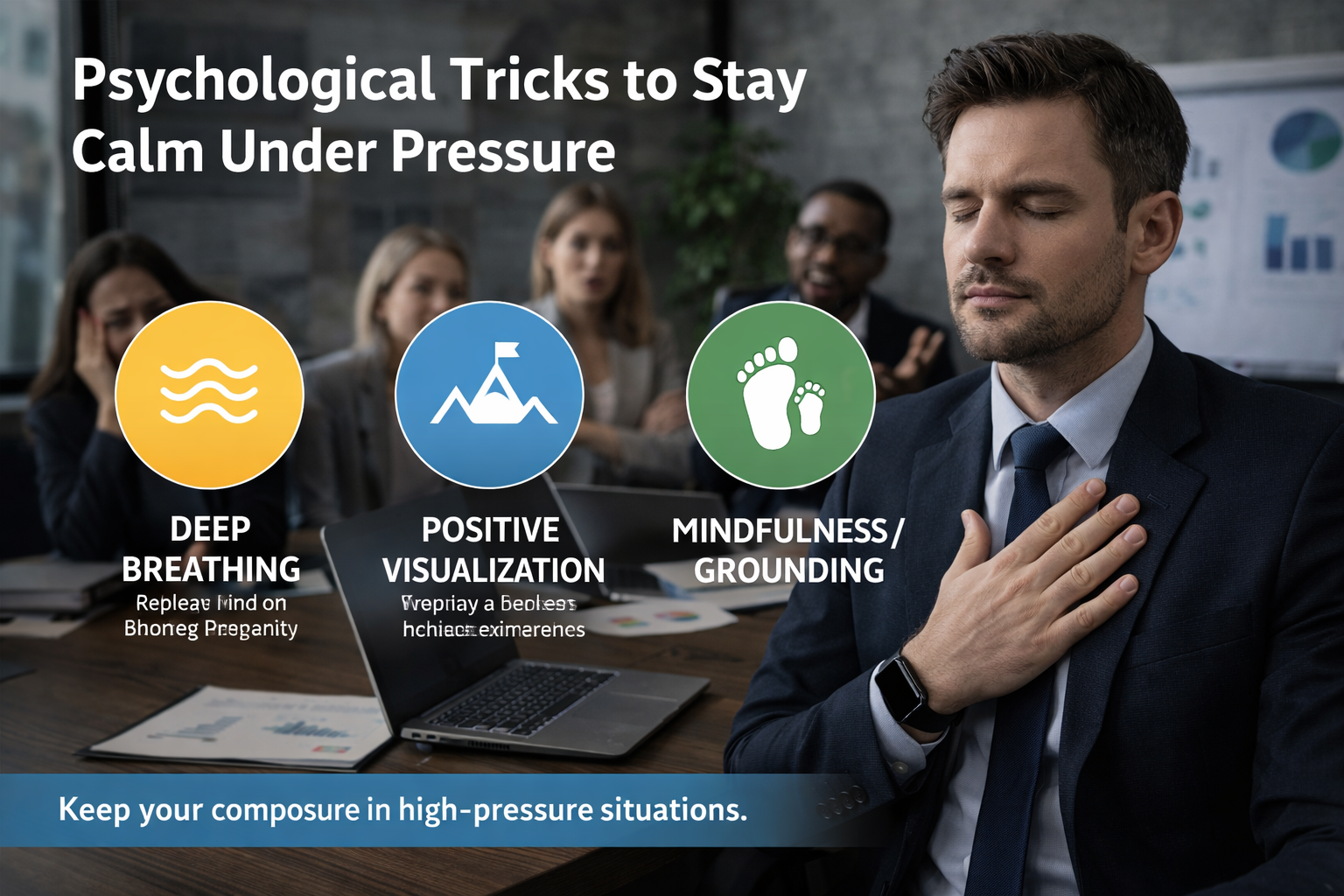
Psychological Tricks to Stay Calm Under Pressure… Did you know that nearly 75% of people experience overwhelming anxiety in high-pressure situations? Whether it’s a job interview, a critical presentation, or a tense conversation, the ability to stay calm can be the difference between success and failure. But what if you could train your mind to remain composed, regardless of the circumstances? In this guide, we’ll explore powerful psychological tricks that will empower you to harness your inner strength, conquer stress, and maintain your cool when it matters most. Prepare to transform your approach to pressure and unlock your true potential!
Psychological Tricks to Stay Calm Under PressureIn our fast-paced world, pressure is a common part of our daily lives. Whether it’s meeting deadlines, handling difficult conversations, or facing high-stakes situations, learning to stay calm can significantly impact our performance and well-being. Fortunately, there are several psychological tricks you can employ to maintain your composure when the heat is on. Let’s explore these techniques in an informative and fun way!
Understanding PressureBefore we dive into the tricks, it’s essential to understand what happens when we’re under pressure. Our body enters a state of heightened alertness, often referred to as the “fight or flight” response. While this reaction can be beneficial in some situations, it can also lead to anxiety and hinder our ability to think clearly. Here are some interesting facts about pressure:
Here are some effective psychological strategies to help you maintain your calm when pressure builds.
#
1. Deep BreathingDeep breathing is one of the simplest yet most effective techniques to calm your nerves. By focusing on your breath, you can activate your body’s relaxation response.
Use this technique whenever you feel overwhelmed, and you’ll notice a quick reduction in anxiety.
#
2. Positive VisualizationVisualization is a powerful tool that athletes and performers often use. Picture yourself succeeding in the high-pressure situation you are facing.
Spend a few minutes each day visualizing success, and your brain will start to believe it!
#
3. Reframe Your MindsetChanging your perspective on pressure can significantly affect your response to it. Instead of viewing pressure as a threat, see it as a challenge and an opportunity to grow.
This shift can transform your experience from fear to excitement.
#
4. Mindfulness and Grounding TechniquesPracticing mindfulness helps you stay present and focused, reducing feelings of anxiety and panic.
This method helps anchor you in the moment, preventing your mind from spiraling into worry.
Comparison of TechniquesHere’s a quick comparison table to summarize the techniques:
| Technique | Description | When to Use | |
| Deep Breathing | Focus on breath to reduce stress | Anytime you feel anxious | |
| Positive Visualization | Imagine a successful outcome | Before a performance or big event | |
| Reframing Mindset | Shift perspective on pressure | When feeling overwhelmed or scared | |
| Mindfulness/Grounding | Stay present through sensory awareness | During high-stress moments |
Staying calm under pressure is a skill that can be developed with practice. By incorporating these psychological tricks into your routine, you can enhance your ability to face challenges with confidence and poise. Remember, the next time you find yourself in a stressful situation, just take a deep breath, visualize your success, and embrace the challenge. With these tools in your toolkit, you’ll be well-equipped to handle whatever life throws your way!
In conclusion, mastering psychological tricks to stay calm under pressure can significantly enhance your performance and overall well-being. Techniques such as deep breathing, positive visualization, and reframing negative thoughts equip you to handle stressful situations with greater ease and confidence. By incorporating these strategies into your routine, you can cultivate a more resilient mindset. What methods do you find most effective for staying calm under pressure? Share your thoughts in the comments!
Why Calmness Is a Skill (Not a Personality Trait)
Some people look naturally calm under pressure, but most of what you’re seeing is trained regulation. Calmness is the ability to keep your nervous system from hijacking your thinking. Under stress, your body tries to protect you by speeding up your heart rate, tightening muscles, and narrowing attention. That response can be helpful in a true emergency, but it can sabotage you during modern “pressure moments” like interviews, presentations, tests, and difficult conversations.
The good news is that you can train calm like any other skill. The trick is to work with your biology, not against it. When you control your breath, posture, attention, and inner narrative, you change the signals your brain receives. Those signals determine whether your mind feels safe enough to think clearly.
The Calm Under Pressure Toolkit: 12 Psychological Tricks
Use these techniques like tools. You don’t need all of them. Pick a few that fit your situation and practice them until they become automatic.
1) Extend Your Exhale (Fastest Nervous System Reset)
Longer exhales signal safety to your body. When you’re anxious, your breathing becomes shallow and quick. Flip that pattern.
- Inhale for 4 seconds.
- Exhale for 6-8 seconds.
- Repeat for 60-90 seconds.
This works especially well right before you speak or respond to a tough question.
2) Label the Emotion (Name It to Tame It)
When you name what you feel-“I’m nervous,” “I’m overwhelmed,” “I’m angry”-you reduce emotional intensity. Labeling creates psychological distance. It turns the feeling into information instead of a threat.
Try: “This is anxiety.” Or: “My body is in high alert.”
3) Reframe Stress as Energy
Your body’s stress response can look like excitement: faster heart rate, higher alertness, more energy. The difference is the story you attach to it. Instead of “I’m going to fail,” try: “My body is preparing me.”
This simple reframe often improves performance because it reduces fear and increases focus.
4) Use the “Next Tiny Step” Question
Pressure gets worse when you think about the entire situation at once. Shrink the problem.
- Ask: “What is the next tiny step?”
- Then do only that step.
In an interview, the next step might be: “Answer the question in one clear sentence.” In a presentation: “Say the next line slowly.” In conflict: “Reflect what they said before responding.”
5) Ground Through Your Senses (5-4-3-2-1)
This technique interrupts spiraling thoughts by anchoring you in the present.
- 5 things you can see
- 4 things you can touch
- 3 things you can hear
- 2 things you can smell
- 1 thing you can taste
It’s especially useful during panic-like moments or when your mind feels “blank.”
6) Lower the Stakes on Purpose
Pressure rises when your brain believes everything depends on this one moment. Remind yourself: “This is important, but it’s not everything.”
A calmer internal script: “I’m going to do my best with the information I have.” This reduces perfectionism, which is a major driver of anxiety.
7) Use a Physical “Reset Posture”
Your body posture sends emotional signals. Under pressure, people often collapse: shoulders forward, chin down, shallow breathing. Reset with a neutral, open posture:
- Feet grounded
- Shoulders relaxed
- Jaw unclenched
- Hands open or resting calmly
Even a small posture change can reduce the feeling of threat.
8) Practice Micro-Exposure
Confidence under pressure is built through exposure. Train in small doses.
- Practice your talk out loud once daily for 3 minutes.
- Do a “mini interview” with a friend for 5 questions.
- Rehearse a difficult conversation by writing 3 key lines.
Repeated exposure teaches your brain: “This is survivable.”
9) Visualization With Sensory Detail
Instead of only visualizing success, visualize the moment you feel pressure and then see yourself handling it well. Add sensory detail: the room, your voice, your calm breath, the slow pace. Your brain learns the pathway before you live it.
10) Use a Short Mantra to Block Mental Noise
Pressure creates chaotic thoughts. A short phrase gives your mind one clean track to follow:
- “Slow is smooth.”
- “One breath, one step.”
- “Calm and clear.”
Repeat it silently as you breathe out.
11) Pre-Commit to a Simple Structure
Structure reduces cognitive load. Decide your format in advance so you don’t improvise under stress.
- Answer structure: Point → reason → example → close.
- Conflict structure: Reflect → validate → request.
- Presentation structure: Problem → insight → solution → next step.
When pressure hits, you just follow the template.
12) Stop Fighting the Feeling
Trying to “force calm” can increase anxiety because it creates resistance. A better approach is acceptance: “My heart is racing, and I can still perform.” Acceptance reduces secondary stress (stress about being stressed).
Use These Tricks in Real Situations
Before a Job Interview (5-Minute Routine)
- 60 seconds: extended exhales (4 in / 6-8 out).
- 30 seconds: reset posture and relax jaw.
- 60 seconds: label the emotion (“This is nervous energy”).
- 60 seconds: visualize the first question going well.
- 60 seconds: repeat a mantra (“Calm and clear”).
Before Public Speaking (2-Minute Reset)
- Exhale longer than you inhale for 60 seconds.
- Pick one person to speak to at a time.
- Start slower than you think you should.
During a Tense Conversation
- Pause, exhale, and soften your face.
- Reflect what you heard: “So you’re saying…”
- Make one clear request: “What I need is…”
Common Mistakes That Increase Pressure
- Catastrophizing: treating one moment as life-defining.
- Speeding up: rushing speech increases anxiety and mistakes.
- Over-rehearsing last-minute: cramming can spike stress and reduce sleep.
- Too much caffeine: can mimic anxiety symptoms and amplify panic.
FAQ
Can I train calmness long-term?
Yes. Consistent sleep, movement, mindfulness, and repeated exposure to stressful tasks build nervous system resilience. The more your brain learns that pressure is manageable, the calmer you become.
What if my mind goes blank?
Use grounding (5-4-3-2-1), then ask “What’s the next tiny step?” If needed, buy time with a calm phrase: “That’s a great question-let me think for a moment.”
How long do these techniques take to work?
Breath and posture shifts can help in under two minutes. Deeper resilience comes from practice over days and weeks.
Conclusion
Psychological tricks to stay calm under pressure work best when they’re practiced before you need them. Start with the fastest tools-extended exhales, emotion labeling, grounding, and a simple structure for responses. With repetition, your body learns that pressure is not danger, and your mind stays clearer when it matters most.
The Science of Pressure: What Your Body Is Actually Doing
When pressure hits, your brain is trying to help you survive. The amygdala (threat detector) scans for danger, and if it decides something is risky-like being judged, failing publicly, or losing status-it triggers stress chemistry. Adrenaline increases heart rate and energy. Cortisol mobilizes fuel. Your attention narrows to what feels urgent. That’s great if you need to sprint away from danger, but not great if you need to explain an idea clearly or think through a complex question.
The key insight: your body’s stress response is not “wrong.” It’s just mismatched to the modern situation. Your job is to signal safety to your nervous system so your thinking brain can come back online. That’s why breath, posture, and attention control work so quickly-they communicate safety without needing logic.
The “Pressure Loop” and How to Break It
Many people get stuck in a loop: you feel stress → you notice stress → you worry about stress → stress increases. This is called secondary anxiety, and it’s one of the biggest performance killers. The way out is to treat stress like weather: it can be uncomfortable, but it doesn’t have to control you.
- Step 1: Notice the sensation (“heart racing,” “tight chest,” “shaky hands”).
- Step 2: Name it (“This is stress activation”).
- Step 3: Normalize it (“My body is preparing me”).
- Step 4: Redirect (“Next tiny step”).
This breaks the loop because you stop treating the sensation as a problem that must be eliminated before you can perform.
Advanced Psychological Tricks to Stay Calm Under Pressure
These techniques go beyond basic breathing and grounding. They’re designed for moments when pressure is intense: high-stakes meetings, difficult conversations, exams, negotiations, or conflict.
13) The Physiological Sigh (Quick Reset in 10 Seconds)
This is one of the fastest ways to reduce arousal. Take a normal inhale, then top it up with a second short inhale, then exhale slowly. Repeat 1-3 times. It helps release carbon dioxide efficiently, which can calm the body quickly when you feel panicky.
14) “External Focus” to Reduce Self-Consciousness
Pressure often makes you self-monitor: “How do I look?” “Am I shaking?” “Do they think I’m dumb?” That self-focus increases anxiety. Switch to an external focus: the message, the audience’s needs, the problem you’re solving. Ask yourself: “What is the most helpful thing I can deliver right now?” This turns performance into service, which reduces fear.
15) The 3-Second Rule for Slowing Speech
When nervous, people talk faster. Fast speech makes you feel more anxious and makes others perceive you as less calm. Use a simple rule: pause for three seconds after important points. The pause feels long to you, but it feels confident to others. It also gives your brain time to organize the next thought.
16) “If-Then” Scripts (Preloaded Responses Under Stress)
Under pressure, your brain struggles to improvise. If-then scripts remove decision load.
- If I get a tough question, then I will say: “Great question-let me think for a moment.”
- If I feel my voice shake, then I will slow down and extend my exhale.
- If conflict escalates, then I will reflect and ask one clarifying question.
These scripts keep you steady because you’ve already chosen your response before stress hits.
17) The “Pressure Rehearsal” Technique
Most people rehearse success, but they don’t rehearse disruption. Practice the stressful part on purpose: imagine forgetting a line, getting challenged, or receiving criticism-and then imagine yourself recovering calmly. Recovery confidence is what makes you feel safe. When your brain believes you can recover, it stops treating mistakes as disasters.
18) Cognitive Defusion (Distance From Thoughts)
Under pressure, thoughts can become loud: “I’m going to mess this up.” Defusion means seeing thoughts as mental events, not truths. Try one of these:
- “I’m having the thought that I’m going to fail.”
- “My mind is telling a scary story.”
- “That’s an anxiety prediction, not a fact.”
This reduces the power of the thought without needing to argue with it.
19) The “Two Wins” Mindset
Pressure often comes from needing a perfect outcome. Replace it with a two-win goal:
- Win #1: Do the task.
- Win #2: Practice staying regulated while doing it.
Even if the result isn’t perfect, you still succeed at training calmness. This reduces fear and increases long-term resilience.
Calm Under Pressure in Specific Scenarios
Scenario A: You’re Put on the Spot in a Meeting
When someone asks a question unexpectedly, your brain may blank. Use a simple sequence:
- Buy time calmly: “Let me think about that for a second.”
- Exhale slowly once: longer exhale than inhale.
- Answer with structure: point → reason → example.
- If unsure: “I want to be accurate-can I follow up after I confirm?”
This looks composed because you’re not rushing to fill silence with panic.
Scenario B: High-Stakes Presentation
Presentations trigger fear because they involve judgment. The goal is to switch from “being evaluated” to “delivering value.”
- Before you start, relax your jaw and drop your shoulders.
- Speak 15% slower than normal for the first minute.
- Focus on one person at a time, not the entire room.
- If you lose your place, pause, breathe out, and continue. Pauses read as confidence.
Scenario C: A Tense Conversation With Someone Emotional
Other people’s emotions can spike your nervous system. Use the “calm container” approach:
- Lower your volume and slow your pace.
- Reflect first: “I hear that you’re frustrated about…”
- Validate without surrendering: “That makes sense. I still need…”
- One clear request: “Can we focus on one issue at a time?”
Calmness here is less about perfect wording and more about nervous-system leadership.
Scenario D: Exams and Performance Tests
Test anxiety often comes from catastrophic thinking and time pressure. Use this approach:
- Before starting: 3 physiological sighs.
- Scan the whole test quickly to reduce uncertainty.
- Start with a “warm-up” question to build momentum.
- If panic hits: 5-4-3-2-1 grounding, then return to the next tiny step.
Build Long-Term Calm: Training Outside the Pressure Moment
In-the-moment tricks work, but long-term calm comes from baseline regulation. If your daily stress level is high, you’ll hit pressure moments with less capacity. These habits make pressure easier to handle:
- Sleep consistency: poor sleep increases reactivity and reduces focus.
- Regular movement: exercise teaches your body that high heart rate is safe.
- Mindfulness practice: trains attention control and reduces rumination.
- Exposure practice: small weekly challenges build confidence.
Think of these as “calm deposits.” The more you build your baseline, the less pressure spikes you.
The 30-Second Emergency Reset (Use Anywhere)
If you only remember one tool, use this:
- Drop shoulders and unclench jaw (5 seconds).
- Inhale 4, exhale 8 (10 seconds).
- Name the emotion: “This is stress energy” (5 seconds).
- Ask: “Next tiny step?” and do it (10 seconds).
This reset is powerful because it addresses body, mind, and action in under a minute.
Final Reinforcement
Staying calm under pressure is not about eliminating stress. It’s about staying functional while stress is present. When you train your breath, your attention, and your self-talk, you teach your nervous system that pressure is manageable. Over time, your body stops treating high-stakes moments as threats and starts treating them as challenges you can handle.