

Shocking Nazca Lines Mystery: Drawings Only G0ds Can See
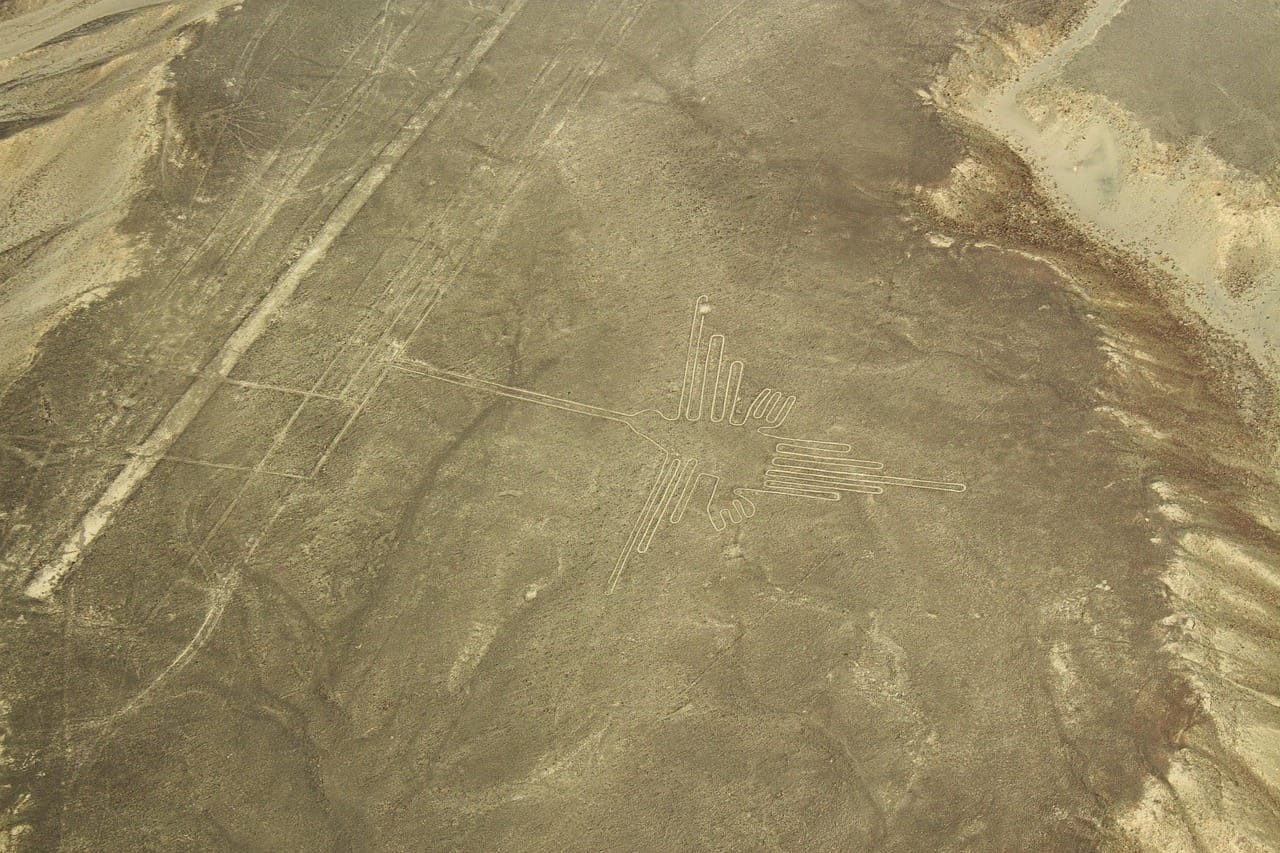
Drawings Only Gods Can See
Nazca Lines… Etched into the arid desert floor of southern Peru are hundreds of massive geoglyphs known as the Nazca Lines. Created between 500 BC and 500 AD, these lines depict animals, plants, and geometric shapes. They are so large-some measuring over 1,200 feet across-that their full forms can only be appreciated from the sky. This raises the impossible question: How did an ancient civilization design artwork that they themselves could never see?
Theories of Purpose
The lines were made by removing the reddish-brown iron oxide-coated pebbles to reveal the light-colored earth underneath. Because of the dry, windless climate, they have survived for two millennia.
- The Alien Theory: Popularized by Erich von Däniken in “Chariots of the Gods,” this theory suggests the long, flat geometric lines were landing strips for extraterrestrial spacecraft. While scientifically dismissed, it remains a favorite in pop culture.
- Water Rituals: Modern archaeologists believe the lines were walking paths for religious processions. In one of the driest places on Earth, these rituals were likely pleas to the gods for rain. The shapes correspond to constellations or sacred animals associated with water and fertility.
- Astronomical Calendar: Maria Reiche, a mathematician who dedicated her life to the lines, argued they acted as a giant astronomical calendar, pointing to the rising and setting of the sun and stars during solstices.
The Spider and the Monkey: The precision is baffling. The famous “Nazca Spider” is anatomically correct to a genus of spider found only in the Amazon rainforest, hundreds of miles away. How did the Nazca people know of it, and why did they draw it for the sky?
How Do You Draw for the Sky Without Being in the Sky
The “impossible question” at the heart of the Nazca Lines is really two questions fused together. First: how could the Nazca plan and execute figures so large that their full forms read best from above? Second: why would they invest extraordinary labor into art that seems aimed at a viewer no human could naturally become? The first question is a problem of technique. The second is a problem of purpose. The mystery survives because neither can be fully solved without touching the other.
Technically, the Nazca did not need flight to build large, accurate designs. They needed coordination, measurement, and a way to preserve proportion across distance. Ancient cultures solved similar problems in architecture long before cranes and lasers: by using grids, ropes, stakes, and repeated checks. A geoglyph is a drawing stretched across land, and land can be measured as reliably as a wall-often more reliably, because the desert is a stable canvas.
The key is scaling. A small design can be enlarged if you can keep proportions consistent. One method is a grid system: draw the figure on a small surface in squares, then replicate that grid on the ground at a larger scale. Another method is triangulation: define anchor points with stakes, then use ropes of fixed lengths to create straight segments and curves by controlling distance from a center line. Even today, surveyors create precision on open terrain by establishing reference points, not by hovering overhead.
It also matters that “only visible from the sky” is partly a modern perspective shaped by aircraft. From ground level, you can still perceive long straight lines and large geometric forms. And from nearby foothills or natural rises, a person can gain partial aerial-like views that help confirm layout. The Nazca would not need to see the entire spider at once to keep it accurate. They only needed to see enough at each stage to verify that the proportions were holding as the lines extended outward.
What feels impossible to us is less about engineering and more about imagination. We assume a giant image requires a giant viewpoint. The Nazca may have worked the other way around: build the image precisely on the ground, knowing it belongs to a viewer above-whether that viewer is a deity, an ancestor, the sky itself, or the ritual community that brings the design to life through movement.
The Desert as a Permanent Medium
The Nazca desert behaves like a memory. In wetter climates, a line scratched into the earth is a temporary mark. In this region, the ground can preserve a gesture for centuries. The process described-removing dark, iron-oxide-coated stones to expose lighter soil-creates a high-contrast line that is surprisingly durable when wind is minimal and rain is rare. In other words, the Nazca were not just drawing; they were selecting a medium with built-in longevity.
That longevity changes the stakes of the act. If a line can last for generations, then drawing becomes a form of long-term communication. It can be a message to gods, to future communities, or to the landscape itself. It can also become a ritual infrastructure: a path that is walked again and again, reinforcing meaning through repeated use.
The desert’s stability also makes precision plausible. Soft, shifting dunes would swallow lines and distort measurement. But a stony plain is cooperative. Stakes can be driven. Ropes stay taut. Straight lines remain straight because the canvas resists deformation. What looks like supernatural accuracy may be the outcome of choosing a place where accuracy is easy to maintain.
There is an additional subtlety: the act of clearing stones does not require continuous carving. It is more like unveiling. The line is created by moving surface material aside, which can be done incrementally and corrected as needed. If a segment drifts, the Nazca could adjust by expanding the cleared area or correcting the next segment’s direction. Over long distances, minor corrections accumulate into a final form that appears deliberate.
Blueprints, Stakes, and the “Invisible Drawing” Problem
If you try to draw a monkey the size of a city block, the main difficulty is not drawing-it is maintaining the plan while you work inside it. You can’t step back far enough to see the whole, so you must trust your method more than your eyes. That is where physical reference systems become the real artistry.
Imagine the desert mapped with a set of anchor stakes. Each stake is a coordinate. Between coordinates, ropes define line segments. A curve becomes a sequence of small straight steps, each set at a slightly different angle, producing the illusion of a smooth arc when viewed from a distance. This is how large-scale drafting works even in modern settings: you approximate curves with many controlled segments.
The Nazca could also have used a “string compass” approach for certain shapes: fix a point, tie a rope to it, and sweep an arc at a constant radius. Geometric figures-trapezoids, spirals, long runways of straightness-are especially compatible with such techniques. And that is exactly what makes the alien “landing strip” theory seductive: the long straight lines feel like they were made by someone obsessed with geometry. But geometry is also the most natural language of measurement. A culture capable of organizing labor can produce astonishing straight lines without needing anything extraterrestrial-only consistency.
Once you accept that the Nazca could create large designs with small-scale planning, the “impossible question” evolves. It becomes less about whether they could do it and more about what kind of social system could sustain it. Large projects imply leadership, shared belief, and continuity across time. Geoglyphs are not doodles. They are communal statements.
The Ritual Path Theory, Deepened
The idea that the lines were walking paths for processions is compelling because it explains two things at once: why the lines are on the ground and why they are so extensive. A procession is not about looking; it is about moving. The meaning is created through action-through footsteps, chanting, offerings, and the embodied experience of traversing the design.
In the driest regions, water becomes more than a resource. It becomes a spiritual relationship. A community’s survival depends on rainfall patterns, underground aquifers, seasonal streams, and the fragile timing of agriculture. In such a world, a ritual that “asks” for water is not symbolic in the casual sense. It is existential. The lines can be seen as an attempt to negotiate with the forces that decide whether life thrives or fails.
If the geoglyphs functioned as paths, then their scale makes sense. A large path can accommodate many participants. It can support repeated ceremonies. It can transform a barren plain into a sacred stage. The figures-animals, plants, and geometric shapes-may have served as ritual scripts. Each design could correspond to a season, a deity, a myth, or a specific plea. The act of walking becomes the act of writing a request into the earth.
Geometric lines also fit a processional function. A long straight line creates a sense of direction and purpose, a physical enactment of reaching outward. Trapezoids create platforms or corridors that feel like ceremonial “rooms” without walls. Spirals create a bodily experience of circling inward and outward, like a dance that imitates cycles of drought and rain.
From this perspective, the lines being best appreciated from the sky is not a flaw. It is the point. Humans are not the only audience. The ceremony is performed on earth, but it is meant to be recognized by the sky. The desert becomes a tablet on which a community inscribes a relationship with rain, stars, and gods.
Astronomy: Calendar, Compass, or Myth Map
Maria Reiche’s astronomical interpretation remains influential because it offers a satisfying order: the lines are not random; they are functional, pointing to solstices, equinoxes, and celestial events. A calendar carved into the desert would be a tool of power in an agricultural society. If you can anticipate seasonal shifts, you can plan planting and ceremonies with greater confidence.
The challenge is that “astronomical” can mean multiple things. It can mean precise alignments that operate like a measuring instrument. It can also mean symbolic alignments that connect the landscape to the sky in a mythic way. A line that points roughly toward a significant sunrise may matter even if it is not accurate to a fraction of a degree. In ritual contexts, precision and symbolism often coexist, and meaning does not require mathematical perfection.
The Nazca could have used the lines as a kind of seasonal reminder: a set of cues that certain times are approaching. Or the lines could have functioned as ceremonial axes that link earthly offerings to celestial cycles. When drought threatens, the sky becomes a clock you cannot ignore. The sun’s position, the appearance of certain stars, and the progression of seasons would feel like messages. The lines could be the Nazca’s response, turning celestial observation into terrestrial devotion.
There is also a third possibility: the lines may encode a cosmology rather than a calendar. In many traditions, constellations are not merely markers of time. They are stories. Animals in the sky are not just patterns; they are characters. If the Nazca created animal geoglyphs that correspond to constellations or sacred creatures, they might have been weaving a myth map-an earthly mirror of a sky narrative tied to fertility and water.
The Spider and the Monkey: Precision as Cultural Memory
The spider and monkey geoglyphs are where the mystery becomes personal. Geometric lines can be explained as measurement. But a spider with recognizable anatomical detail feels like knowledge rendered into art. It raises the question: how did desert people know of an Amazonian spider, and why elevate it to a figure worthy of monumental scale?
One answer lies in networks. Ancient societies were rarely isolated. Trade routes carried goods, stories, and symbols across long distances. A community in an arid region could still have contact-direct or indirect-with rainforest zones through exchange networks. Even if the Nazca never traveled deep into the Amazon, they could have encountered artifacts, textiles, or myths carrying rainforest imagery. A spider might represent more than a species; it might represent water-rich worlds beyond the desert, or the idea of life thriving where moisture is abundant.
Another answer lies in symbolic amplification. A spider is not only an animal; it is a weaver. In many cultures, weaving is a sacred metaphor-threads becoming order, chaos becoming pattern. The Nazca Lines themselves are a kind of weaving across the desert: long strands forming a coherent image. The spider might be a self-referential emblem, a way of saying, “We too weave.”
The monkey, likewise, can symbolize fertility, abundance, and the untamed vitality of wetter climates. Drawing a monkey in a desert may be an act of longing: a giant prayer for the world of water to return. If these animals are associated with environments richer than the Nazca’s own, their presence on the desert floor could be intentional contrast-an invocation of life against dryness.
Precision, then, becomes less baffling and more meaningful. The Nazca may have chosen forms that carried potent associations, and they replicated them accurately because accuracy was part of the offering. A sloppy image would not honor the symbol. A precise image would.
Why the Alien Theory Refuses to Die
The alien theory thrives not because it is the most likely, but because it is the most cinematic. It offers a single, dramatic solution: the lines were made for visitors from above. The long flat lines become runways. The desert becomes a landing field. The “impossible question” becomes proof of extraterrestrial influence.
But the alien interpretation often collapses under its own simplicity. A “runway” in the modern sense implies a surface designed to bear weight, resist erosion, and provide guidance. The Nazca Lines are shallow surface clearings, not paved structures. Their value is visual, not mechanical. If an advanced craft needed a runway, it would not need a fragile drawing made of displaced pebbles. And if it did need a marker, it could be something far simpler than a giant hummingbird or spider.
Yet the alien theory persists because it captures an emotional truth: the lines feel like a message to the sky. And to many people, “message to the sky” sounds like “message to someone up there.” The human imagination leaps from “gods” to “aliens” when the sacred is translated into science fiction. The theory is less a historical claim than a modern myth built on the same foundation as the ancient one: the idea that the sky is inhabited and attentive.
Competing Theories Can All Be Partly True
One reason the Nazca Lines resist a single explanation is that they may not have had a single function. Complex cultural projects often accumulate meanings over time. A line might begin as a path and later gain astronomical associations. A figure might begin as a symbol of fertility and later become part of a ceremonial calendar. As generations add new lines, the landscape becomes a layered text.
This layering can also explain why the site includes both animal figures and vast geometric forms. The animals might be tied to myths, deities, or ritual identities. The geometric lines might be the infrastructural skeleton that organizes movement, orientation, and ceremonial space. Together, they create a sacred geography: a place where walking is worship and where visibility from above is a feature, not a puzzle.
Instead of asking, “Which theory is correct?” a better question may be, “What combination of needs could produce this?” In a dry environment, ritual for water makes sense. In an agricultural environment, seasonal tracking makes sense. In a society with mythic symbolism, animal icons make sense. In a community capable of organization, large-scale land art makes sense. The Nazca Lines may be the intersection of all of these.
A Timeline of Effort, Not a Single Event
The lines were created over centuries, and that matters. A project spanning hundreds of years is not a single design executed once. It is a tradition. It implies that the act of making lines was itself culturally meaningful, regardless of the specific image produced. Some lines may have been renewed, re-traced, or expanded. Some may have been created to mark specific events-drought years, leadership changes, or ceremonial reforms.
Long timelines also mean that knowledge could be refined. The earliest line-makers may have developed basic techniques that later builders improved. Over time, a community can become extraordinarily skilled at a practice that outsiders perceive as miraculous. The Nazca did not need to invent perfect methods on day one. They could evolve them.
Viewed this way, the Nazca Lines become less like a single enigma and more like a cultural technology: a method for turning landscape into meaning. That technology combines surveying skill, ritual life, and environmental pressure. And like any technology, it becomes more impressive the longer it is used.
The Landscape as a Contract
The most haunting possibility is that the Nazca Lines are a contract between humans and forces beyond human control. In drought-prone regions, the relationship with water can feel personal, almost moral: rain arrives when the gods are pleased, or when the rituals are correct, or when the community is aligned. This is not “primitive thinking.” It is a psychological adaptation to living under relentless uncertainty.
The Nazca Lines may have been a way of making that contract visible. To clear a line is to commit labor. To commit labor is to prove devotion. The sheer scale becomes an argument: Look what we have done. Look what we have given. Answer us. The desert becomes a witness, preserving the pledge across time.
That interpretation also explains why the figures might be intended for the sky. If the recipient of the contract is above-rain-bringing deities, ancestral spirits, or celestial powers-then the message must be legible from above. The lines are not “art” in the modern sense. They are an offering with a built-in audience.
Practical Takeaways: Reading the Nazca Lines Without Losing the Mystery
- Separate technique from purpose. The Nazca could have built the lines with stakes, ropes, and grids; the harder question is why they chose to.
- Assume multiple meanings. Processional paths, water rituals, and sky symbolism can coexist in a single landscape tradition.
- Respect environmental context. In extreme dryness, water is theology, not just weather.
- Expect layered timelines. A site built over centuries can reflect changing beliefs and practices, not one fixed plan.
- Notice which theories satisfy emotion. Alien theories often satisfy the feeling of “message to the sky,” even when they fail as engineering explanations.
- Don’t underestimate ancient planning. Large-scale accuracy does not require flight; it requires repeatable measurement and communal coordination.
Why the Lines Still Feel Like They Don’t Belong to Us
Even after you strip away the sensational theories, something remains unsettling. The lines are quiet, enormous, and patient. They make modern viewers feel like intruders because they were never designed for casual human attention. They were designed for repetition, for ritual, for a gaze that feels elevated-whether that gaze is literal or symbolic.
That is why the Nazca Lines keep being described as “drawings only gods can see.” It is not a claim about capability. It is a claim about intention. The Nazca were not trying to impress other humans in the way monuments usually do. They were creating a dialogue with something beyond the immediate community: the sky, the seasons, the forces that decide whether crops grow or fail.
And the spider and monkey sharpen that message. These are not random shapes. They are chosen symbols, placed where they can last, made at a size that demands humility. The lines turn the desert into a sacred page. The Nazca wrote on it with the confidence that the right audience would read it.
FAQ
How were the Nazca Lines made so precisely without aerial views
Large designs can be scaled from small plans using grids, stakes, ropes, and measured reference points. The Nazca could build segments accurately and verify proportions step by step without needing to see the entire figure at once.
What is the most accepted purpose of the Nazca Lines
Many researchers favor a ritual function, including processional pathways and ceremonies tied to water and fertility in an extremely dry environment, possibly linked to sacred animals and seasonal concerns.
Did the Nazca Lines function as an astronomical calendar
Some interpretations argue certain lines align with celestial events, but “astronomical” may include symbolic sky connections as well as practical seasonal markers, rather than a single precise calendar system.
Why do people think aliens built the Nazca Lines
The lines look most dramatic from above, and some long straight shapes resemble runways to modern imagination. However, the lines are shallow clearings meant to be seen, not surfaces built to support vehicles.
Why are animals like the spider and monkey included
They may represent sacred symbols tied to fertility, water, or mythic stories, possibly influenced by long-distance cultural networks. Their accuracy could reflect the importance of making the offering visually “correct.”
How have the Nazca Lines survived for so long
The dry, relatively windless desert climate preserves the high-contrast exposed soil after stones are cleared away, allowing the lines to remain visible for centuries.
Could the Nazca Lines have had multiple purposes over time
Yes. Because the site developed over centuries, different generations could have added lines for new ceremonies, new meanings, or new interpretations, creating a layered sacred landscape.
Can the Nazca people have seen any of the designs at all
They likely couldn’t view the full figures the way a modern aerial photo does, but partial elevated viewpoints and ground-based measurement would still allow them to plan and confirm the designs during construction.