

9 Signs Your Smart Home Setup Is Making Life Harder, Not Easier
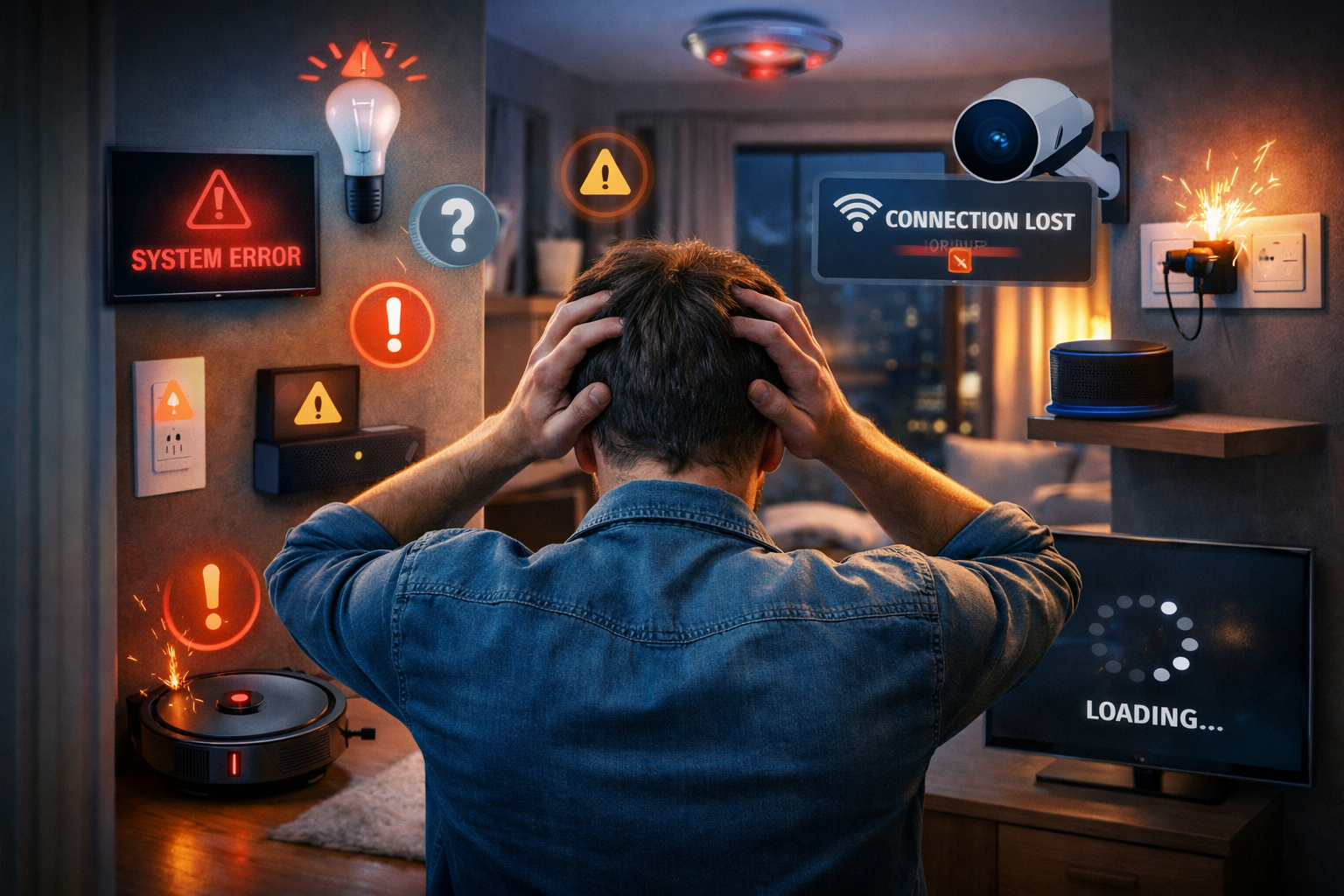
Smart home technology is usually sold with a simple promise: more convenience, less friction, better control. In theory, that promise makes perfect sense. A connected home should save time, reduce repetitive tasks, improve comfort, and help people manage everyday life with less effort. Lights turn on automatically, thermostats learn preferences, cameras improve peace of mind, speakers respond to voice commands, and routines combine multiple actions into one tap. It sounds efficient, modern, and obvious.
But daily life inside a connected home does not always feel as smooth as the marketing suggests. In many households, smart home setups begin as practical upgrades and slowly evolve into something more complicated. A single smart bulb turns into three ecosystems. One speaker becomes several devices connected to different accounts. A routine works perfectly for two weeks and then breaks without explanation. A light switch starts behaving differently from room to room. The family stops knowing whether to use the app, the wall switch, the voice assistant, or the manual override. The home becomes “smart” on paper but strangely exhausting in practice.
This is the hidden side of smart living that many people experience but rarely describe clearly. The problem is not always bad hardware. It is often the accumulation of small cognitive burdens. When too many connected products compete for attention, demand maintenance, or create inconsistent rules, the home stops feeling effortless. Instead of removing decisions, it creates more of them. Instead of reducing friction, it redistributes friction into troubleshooting, remembering, updating, syncing, and adapting to invisible system behavior.
The irony is that smart home technology usually fails in the exact area it claims to improve: everyday ease. A home can be technically advanced and experientially inefficient at the same time. That distinction matters. Most people do not want a futuristic house as an abstract concept. They want mornings that run smoothly, evenings that feel calm, and systems that help without becoming another source of low-grade stress.
This article explores a question that more homeowners, renters, and tech enthusiasts are starting to ask: what happens when a smart home starts making life harder instead of easier? The answer is rarely dramatic. It usually shows up through subtle signs that accumulate over time. You stop trusting automations. You repeat commands. You explain the house to guests. You need workarounds for products that were supposed to eliminate workarounds. You buy new devices not because you need new capabilities, but because your existing setup no longer behaves predictably.
These are not just annoying details. They reveal a deeper truth about modern home technology: convenience is not created by features alone. It is created by clarity, consistency, reliability, and the feeling that the home works with you rather than around you. If a smart setup weakens those things, it may be increasing technical sophistication while reducing actual quality of life.
Below are nine strong signs that your smart home setup may be doing the opposite of what it was meant to do, along with practical ways to fix the underlying problems without throwing everything away.
1. You Have to Remember Too Many Rules Just to Use Your Own Home
A truly helpful home system should reduce the number of things you need to remember. If your setup requires you to memorize which app controls which room, which assistant understands which command, which bulbs cannot be turned off physically, which routines only work at certain times, and which devices need to stay powered at the wall, then your smart home may already be creating cognitive overload.
This is one of the clearest signs that a connected setup has crossed from useful to mentally expensive. The average person does not want to maintain an internal map of technical logic just to turn on lights, adjust temperature, or listen to music. Once the home starts demanding rule management, it begins competing with the attention that daily life already needs for work, family, errands, planning, and rest.
The burden becomes even more obvious in shared households. One person understands the system because they built it. Everyone else uses the home cautiously, asks for help, or avoids certain features completely. That is not real convenience. It is a private hobby hidden inside a common living space. If only one person can operate the house with confidence, the setup is not intuitive enough.
The fix is usually not adding more automation. The fix is simplification. Reduce the number of control paths. Choose one primary way to perform routine actions. Standardize naming across rooms and devices. Eliminate duplicate functions that force people to guess whether they should use a voice command, an app, a switch, or a routine. Smart homes feel better when they behave like well-organized environments rather than puzzle systems.
If a device or automation requires explanation every time it is used, it is not saving mental energy. It is consuming it. The smartest home is often the one that makes the fewest demands on memory.
2. Your Automations Work Just Often Enough to Be Dangerous
Many smart home owners accept partial reliability for far too long. A routine that works eighty percent of the time may sound acceptable in a product review, but in daily life it creates distrust. When lights fail to trigger at sunset two or three times a week, when motion sensors miss the moment you need them, or when a “good night” routine behaves differently depending on the day, the issue is no longer small. Inconsistent convenience is not convenience. It is uncertainty.
Humans adapt quickly to systems they trust and reject systems they do not. Once your household starts wondering whether an automation will actually happen, people begin compensating manually. They check more often, prepare backup actions, or stop relying on the system altogether. At that point, the automation still exists, but its value has collapsed because it no longer reduces effort with confidence.
This unpredictability is especially frustrating because it creates invisible labor. You may not be walking around doing everything manually all the time, but you are carrying a background question: “Will this work?” That small question adds friction to ordinary routines. It weakens the calm feeling that smart technology is supposed to support.
To fix this, review every automation with ruthless honesty. Do not keep routines just because they feel advanced. Keep only the automations that are highly reliable and genuinely useful. A smaller set of dependable routines is far better than a large system full of clever but unstable behavior. Make each automation pass a simple test: does it save effort every week without introducing doubt? If not, simplify it, rebuild it, or remove it.
Reliability matters more than novelty. A boring automation that works every single day is more valuable than a sophisticated routine that behaves like a prototype.
3. Manual Control Has Become Weirdly Difficult
One of the most common smart home mistakes is designing around the assumption that digital control will always be available and preferable. In real homes, that assumption fails constantly. People use switches with wet hands. Guests do not know voice commands. Children press physical buttons. Wi-Fi drops. Apps lag. Phones die. A partner does not want to open an app just to dim a lamp. If the manual experience gets worse after smart upgrades, the system is not respecting how homes are actually lived in.
This problem often appears when smart bulbs depend on wall switches staying permanently on, when touch panels replace obvious controls, or when multiple devices conflict with one another. Suddenly, something as basic as turning on a light becomes conditional. It works differently depending on how the room was left, whether the network is stable, or whether someone unknowingly cut power to the device earlier.
A good smart home should always preserve a simple, understandable fallback. Manual control should never feel like a second-class option. In fact, the best setups are often the ones where the “dumb” interaction remains excellent. You can still use the house comfortably without apps, voice assistants, or troubleshooting. Smart features enhance the baseline instead of replacing it with fragility.
If manual control in your home has become awkward, slow, or inconsistent, re-evaluate the design from a non-technical point of view. Ask what happens when someone walks into a room and wants immediate results without explanation. If the answer involves multiple steps, dependency chains, or special knowledge, your smart system is overbuilt in the wrong direction.
Convenience should survive internet outages, tired evenings, guests, and people who do not care about smart home culture. If it does not, the home may be optimized for the system instead of the people living inside it.
4. Guests and Family Members Keep Getting Confused
A home that only makes sense to its primary builder is not truly user-friendly. One of the fastest ways to judge whether a smart setup is helping or hurting is to watch how other people interact with it. Do guests hesitate when trying to switch on a bathroom light? Does your partner ask which speaker belongs to which room group? Do children trigger scenes accidentally because controls are too abstract? Do visiting relatives feel like they need a tutorial before they can make coffee, adjust lighting, or lower the temperature?
These moments are revealing because they expose assumptions hidden inside the system. Many smart home enthusiasts unconsciously design around their own habits and tolerance for complexity. They know the workarounds, the routines, the naming logic, and the app layout. Everyone else experiences the home fresh, without that private mental map. Their confusion is useful data.
Homes should not feel like software platforms that require onboarding. They should feel legible. A person should be able to understand the major functions of a room within seconds. If connected products interfere with that legibility, then the home is losing usability even while gaining technical depth.
To improve this, prioritize visible simplicity over hidden complexity. Label key controls if needed. Use intuitive room names. Make the most common actions available physically. Remove automations that surprise people. Avoid “magic” behavior unless it is consistently delightful and predictable. Guests do not need to admire the sophistication of your setup. They need to feel comfortable inside it.
When family members repeatedly choose the non-smart fallback or avoid certain devices altogether, they are telling you something important. They are not rejecting technology in principle. They are rejecting friction.
5. You Spend More Time Managing the System Than Enjoying the Results
There is a point in some smart home journeys where ownership starts to resemble maintenance work. Apps need updates. Firmware changes break routines. New products need account linking. Voice assistants lose connections. Hubs require reboots. Devices drop off the network and return later. Permissions shift. A subscription changes features. A platform update alters how scenes behave. The setup keeps functioning, but only because someone is constantly tending to it behind the scenes.
This ongoing attention is often normalized by enthusiasts, yet it should not be ignored. A system that demands regular babysitting may still be enjoyable as a hobby, but that does not mean it is improving household life overall. If you are spending hours each month fixing, adjusting, reconnecting, renaming, relocating, or optimizing devices, the total convenience equation may already be negative.
This is especially important because maintenance time is rarely counted honestly. People remember the thrill of automating a room, but they do not always account for the minutes lost troubleshooting edge cases. Over time, those minutes become the hidden cost of ownership. The home is not just using electricity and bandwidth. It is using attention.
A better approach is to treat smart home complexity like any other household cost. Ask whether the system earns the time it consumes. Which products quietly work month after month? Which ones keep demanding intervention? Which automations produce real daily value, and which mostly create work disguised as customization?
Once you identify the maintenance-heavy weak points, simplify aggressively. Replace unstable products with more reliable ones only if the function truly matters. Retire devices that sounded exciting but never became essential. Do not preserve technical clutter out of sunk-cost guilt. A smart home should feel more like a helpful environment than a side job.
6. You Keep Buying New Devices to Fix Problems Created by Old Devices
Another major warning sign is when the smart home enters a repair-through-expansion cycle. A motion sensor misses coverage, so you buy another. Voice pickup is inconsistent, so you add more speakers. One platform does not integrate cleanly, so you add a bridge. Lighting feels uneven, so you buy more bulbs. A camera system lacks the right trigger, so you add third-party automation software. Eventually, the setup becomes a stack of compensations rather than a coherent design.
This happens because connected products often promise modular improvement. The next device seems like a small upgrade, not a structural decision. But over time, each small fix adds new dependencies, new power requirements, new apps, and new failure points. The home does not necessarily become more elegant as it becomes more capable.
In many cases, the real issue is not missing hardware. It is poor system architecture. Too many people optimize locally instead of globally. They solve one room, one annoyance, or one edge case at a time without asking whether the overall experience is becoming clearer or more chaotic. The result is a patchwork smart home that contains a lot of equipment but not enough coherence.
If you keep feeling that one more purchase will finally make everything smooth, pause before buying anything else. Step back and map the full environment. How many ecosystems are you using? Which products overlap? Where are the bottlenecks? Are you adding hardware to solve a design problem that should really be solved by simplification, standardization, or removing low-value features?
The most expensive smart homes are not always the best ones. Often, the best ones are the most intentional. They have fewer devices, stronger compatibility, and clearer purpose. They are designed around daily life, not around endless upgrade momentum.
7. Your Home Interrupts You More Than It Helps You
Not every smart home problem looks like failure. Sometimes the system technically works, but it increases interruption. Doorbell alerts, motion notifications, package updates, camera pings, appliance reminders, security warnings, maintenance messages, and app prompts all compete for attention. What begins as “awareness” can slowly turn into domestic noise.
This matters because homes are not just operational spaces. They are also recovery spaces. People need environments that support concentration, rest, intimacy, and mental decompression. If your connected setup constantly announces itself, demands responses, or generates low-level monitoring behavior, it may be undermining the emotional function of the home even while improving information access.
Many people tolerate this because each alert seems individually reasonable. Of course you want to know when someone is at the door. Of course motion detection matters. Of course device health is useful. But the cumulative effect is what matters. A home full of notifications can train its residents into a surveillance mindset where every event seems potentially urgent. Instead of feeling supported, people feel watched, pinged, and subtly on duty.
The solution is not abandoning smart technology altogether. It is becoming much more selective about what deserves interruption. Ask which alerts truly require immediate awareness and which can wait in an app until checked intentionally. Most homes do not need real-time notification for every detectable event. They need calm defaults and meaningful exceptions.
A smart home should fade into the background when nothing important is happening. If it continually pushes itself into the foreground, it is not serving peace of mind. It is consuming it.
8. You No Longer Trust What the House Will Do Next
Trust is one of the least discussed but most essential qualities in home technology. People do not merely want connected products to function. They want them to behave in understandable ways. When the house begins acting unpredictably-lights turning on at odd times, speakers responding from the wrong room, thermostats shifting unexpectedly, sensors triggering scenes no one meant to activate-the emotional effect is larger than the technical glitch itself.
Unpredictability changes how people move through space. They become cautious. They stop assuming the environment will cooperate. They second-guess automations. They brace for odd behavior in front of visitors. Even if the incidents are minor, the home starts feeling less stable. And stability is one of the most important psychological qualities of a living space.
This is why trust should be treated as a design goal from the start. Smart homes should be boring in the best possible way. Their behavior should feel legible, deliberate, and easy to anticipate. If you cannot explain why a room behaves the way it does, or if automations overlap in ways that create accidental consequences, the system has become too opaque.
To restore trust, reduce hidden logic. Make routines time-bound only when necessary. Avoid stacking too many triggers on the same outcome. Test changes before expanding them across multiple rooms. Keep a simple record of what each automation does and why. Most importantly, remove anything that creates surprise without strong value. Surprise may feel clever in demos, but reliability is what makes people relax.
A home should not feel like it has moods. If yours does, the setup needs pruning.
9. The Setup Looks Impressive but Solves Very Few Real Problems
The final sign is the hardest to admit because it touches identity. Many smart homes become elaborate because building them feels rewarding. There is nothing wrong with that. Tinkering can be enjoyable, and home technology can absolutely be a legitimate hobby. Problems begin when the setup is justified as practical convenience even though most of its complexity exists for the satisfaction of building and owning it.
There is a difference between a home that contains interesting technology and a home whose technology meaningfully improves daily life. Sometimes those overlap beautifully. Sometimes they do not. A highly connected environment may look advanced, impress visitors, and offer endless configuration options while still failing to solve the basic frustrations people actually care about: poor sleep, rushed mornings, wasted energy, forgotten tasks, comfort issues, weak security habits, and household coordination.
That mismatch matters because it traps people in a misleading narrative. They keep optimizing the setup because it feels like progress, even when the real quality-of-life gains are small. The house becomes more technical without becoming more supportive. It gains dashboards, scenes, assistants, and accessories, but the day still feels cluttered.
The antidote is to return to first principles. Ask what problems your household truly has. Do you need better lighting timing in the evenings? Easier climate control? Simpler bedtime routines? Better entryway security? Energy savings? Accessible controls for older relatives? Fewer repeated tasks? Once the real needs are clear, evaluate every device against them. If a product exists mainly because it is possible rather than because it is useful, it may belong in the hobby category, not the household necessity category.
This distinction is freeing. You do not have to pretend every gadget is essential. Some devices can simply be fun. But when building for actual convenience, honesty matters more than ambition. A modest system that solves real problems is far more valuable than a dazzling one that mostly creates extra layers.
How to Make a Smart Home Feel Simpler Again
If several of these signs feel familiar, that does not mean your setup is a failure. It means the system needs a reset in philosophy. The goal is not maximum automation. The goal is dependable ease. That shift alone changes what you keep, what you remove, and how you judge success.
Start by identifying the moments in a normal day where the home genuinely helps. Maybe porch lighting at sunset is perfect. Maybe a thermostat schedule saves energy without being noticed. Maybe one bedtime routine works beautifully. These are anchors. They show what successful smart living actually looks like: invisible, reliable, and supportive.
Then identify the opposite moments. Which devices make you hesitate? Which features require explanation? Which automations fail often enough that you do not trust them? Which alerts pull you out of focus? Which products exist because of historical layering rather than present value? Be ruthless. Anything that repeatedly adds friction should lose its protected status just because it was expensive or exciting once.
Next, unify where possible. Fewer ecosystems usually mean fewer hidden conflicts. Fewer apps mean fewer decision points. Fewer automations mean fewer edge cases. In design terms, subtraction is often the highest form of optimization. The systems that feel magical are usually the ones with the cleanest logic, not the ones with the most moving parts.
Finally, remember that a home is not a product demo. It is a lived environment. Its success should be measured in calm, clarity, comfort, and trust. If technology strengthens those qualities, it belongs. If it weakens them, sophistication is not enough to justify it.
Final Thoughts smart home setup…
Smart home technology is not inherently overrated, and it is not automatically liberating either. Its value depends on something deeper than the number of devices in a room or the sophistication of the routines behind them. It depends on whether the technology makes life feel lighter.
That is the standard that matters most. Does the home ask less from you, or more? Does it behave consistently enough to earn trust? Can other people use it without hesitation? Does it preserve simple manual control? Does it reduce interruptions instead of multiplying them? Does it solve actual household problems rather than inventing new ones?
When a smart home is working well, people barely think about it. The lights are right. The temperature feels good. The entry feels secure. Ordinary tasks happen with less effort. The house supports life quietly. When a smart home is working badly, people think about it all the time. They troubleshoot, explain, compensate, remember, monitor, and adapt. The system becomes a presence instead of a helper.
If your setup is making life harder, the answer is rarely more complexity. It is better priorities. Strip away what does not serve the household. Keep what is stable and useful. Design for real behavior, not idealized behavior. Optimize for peace, not just capability. The smartest home is not the one that can do the most. It is the one that asks the least while helping the most.