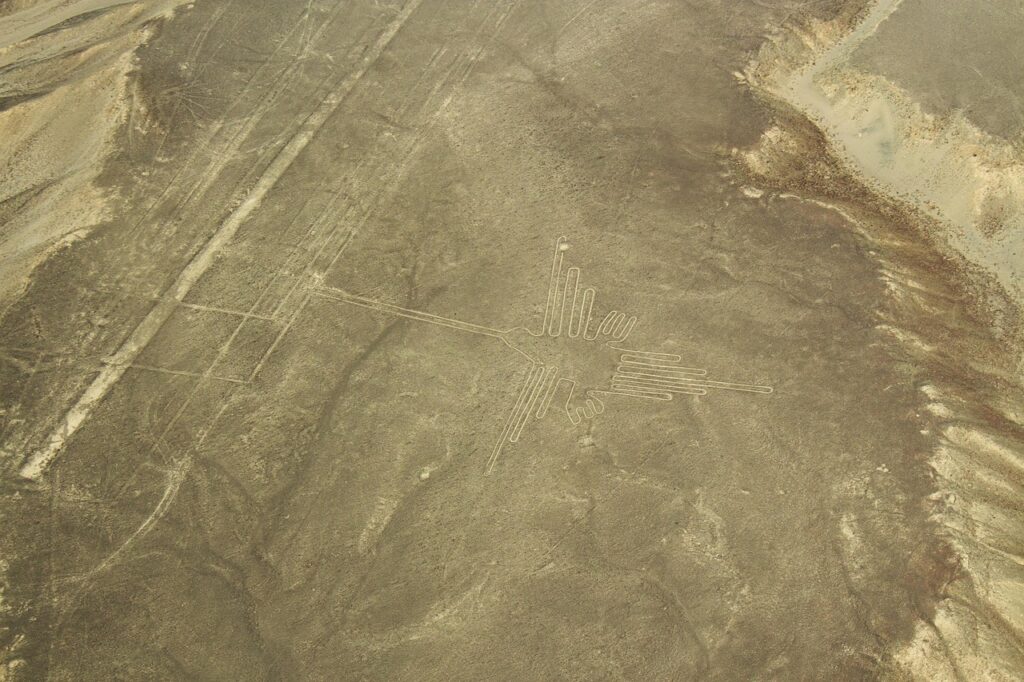
Drawings Only Gods Can See
Etched into the arid desert floor of southern Peru are hundreds of massive geoglyphs known as the Nazca Lines. Created between 500 BC and 500 AD, these lines depict animals, plants, and geometric shapes. They are so large-some measuring over 1,200 feet across-that their full forms can only be appreciated from the sky. This raises the impossible question: How did an ancient civilization design artwork that they themselves could never see?
Theories of Purpose
The lines were made by removing the reddish-brown iron oxide-coated pebbles to reveal the light-colored earth underneath. Because of the dry, windless climate, they have survived for two millennia.
- The Alien Theory: Popularized by Erich von Däniken in “Chariots of the Gods,” this theory suggests the long, flat geometric lines were landing strips for extraterrestrial spacecraft. While scientifically dismissed, it remains a favorite in pop culture.
- Water Rituals: Modern archaeologists believe the lines were walking paths for religious processions. In one of the driest places on Earth, these rituals were likely pleas to the gods for rain. The shapes correspond to constellations or sacred animals associated with water and fertility.
- Astronomical Calendar: Maria Reiche, a mathematician who dedicated her life to the lines, argued they acted as a giant astronomical calendar, pointing to the rising and setting of the sun and stars during solstices.
The Spider and the Monkey: The precision is baffling. The famous “Nazca Spider” is anatomically correct to a genus of spider found only in the Amazon rainforest, hundreds of miles away. How did the Nazca people know of it, and why did they draw it for the sky?