

Why Do We Romanticize the Past? The Hidden Psychology Behind Nostalgia, Memory Distortion, and Idealized Time
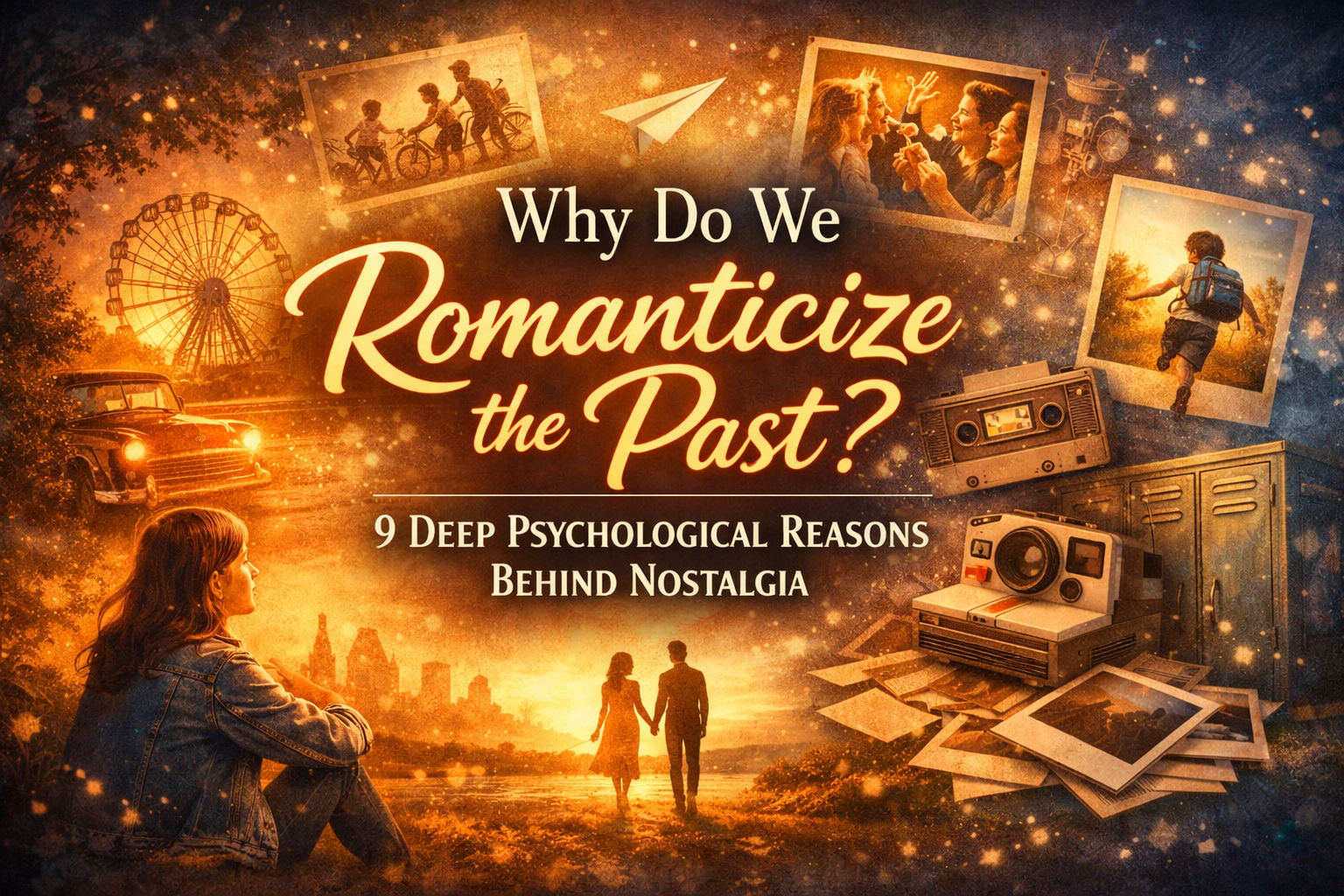
Almost everyone has felt it. A song plays from years ago and suddenly the past feels warmer, slower, and more meaningful than the present. You remember an old relationship more tenderly than you did while living it. You look back on school years, an old city, a previous job, childhood summers, or even a difficult phase of life and think, somehow, that was better. The details that once felt irritating, confusing, or painful fade into the background. What remains is an emotionally polished version of reality. The rough edges soften. The atmosphere glows. The past begins to feel less like history and more like a lost paradise.
This is the strange and powerful experience of romanticizing the past. It is more than ordinary memory. It is not simply remembering earlier periods of life. It is remembering them through a filter that emphasizes meaning, beauty, innocence, simplicity, emotional intensity, or belonging, often while minimizing complexity, boredom, uncertainty, conflict, and pain. The result can feel comforting, poetic, motivating, and deeply human. It can also make the present feel flat, disappointing, or emotionally inferior by comparison.
So why do we romanticize the past? Why does the mind polish old experiences until they seem more beautiful than they actually were? Why do we long for times that, if we could reenter them fully, might not feel nearly as perfect as we now imagine? And why does nostalgia sometimes soothe us while at other times keeping us stuck?
The answer lies in the psychology of memory, identity, emotion, uncertainty, loss, and meaning-making. Human beings do not store the past like a camera stores footage. We rebuild it each time we remember it. And in that rebuilding process, memory is influenced by who we are now, what we are missing, what we fear, what we regret, and what we wish life still contained.
This article explores why people romanticize the past, what nostalgia actually does in the brain and psyche, why idealized memory becomes stronger during difficult phases of life, when it becomes harmful, and how to keep the past meaningful without letting it quietly overpower the present. If you have ever wondered why old times feel better than they probably were, the answer is not that you are irrational. It is that memory is emotional, selective, protective, and deeply connected to your current needs.
What Does It Mean to Romanticize the Past?
Romanticizing the past means remembering earlier times in an idealized way. It involves highlighting what felt beautiful, emotionally alive, meaningful, exciting, simple, or pure while downplaying the parts that were frustrating, confusing, painful, inconvenient, or ordinary. This does not always happen consciously. In many cases, it is an automatic emotional process rather than a deliberate choice.
For example, you may remember a relationship mainly through its intimacy and chemistry while forgetting how often you felt anxious, misunderstood, or emotionally neglected. You may remember your teenage years as freer and more magical while forgetting the insecurity, loneliness, or confusion that also shaped them. You may miss a city, job, friendship circle, or season of life not because it was objectively better, but because it now represents a version of you that felt more connected, hopeful, alive, or open.
Romanticizing the past is not always false. Sometimes the past truly did contain things that your present life lacks. Sometimes earlier periods were more communal, more adventurous, more embodied, more hopeful, or less fragmented. But even when the longing has a basis in truth, memory rarely returns the full picture. It tends to compress complexity into emotional symbols. A place becomes “home.” A time becomes “simpler days.” A person becomes “the one who understood me.” A song becomes “who I used to be.”
This symbolic transformation is what gives romanticized memory its emotional force. It is not just about what happened. It is about what that time now means.
Why Memory Is Never a Perfect Recording
To understand why we romanticize the past, it helps to start with a basic truth: memory is reconstructive, not reproductive. Your mind does not store life as a perfectly preserved archive that you can replay unchanged. Instead, each time you remember something, you reconstruct it from pieces. Those pieces include sensory fragments, emotional tone, personal meaning, identity, later interpretation, and current mood.
That means memory is shaped not only by the original event, but also by the person remembering it now. Your current loneliness can make past belonging feel more radiant. Your present confusion can make old certainty feel more impressive. Your current stress can make former routines seem simpler than they felt at the time. The past is not recalled in a vacuum. It is filtered through the needs and emotional state of the present self.
Because of this, nostalgia is often less like opening a file and more like painting a scene from partial light. The scene may contain truth, but it is still being colored by your current emotional world.
The Emotional Function of Nostalgia
Nostalgia is not just sentimentality. Psychologically, it serves important functions. It can help maintain continuity of identity, restore meaning during uncertainty, reduce feelings of isolation, and create a sense of emotional warmth during hard times. In this sense, nostalgic reflection is not a flaw in the mind. It is one of the ways human beings regulate themselves.
When life feels unstable, the mind often reaches backward toward emotionally significant memories because those memories remind us that we have lived, loved, belonged, hoped, survived, and changed before. Nostalgia can reconnect us with parts of ourselves that feel distant in the present. It can remind us that our story is larger than our current mood, failure, or confusion.
This is why people often become more nostalgic during transitions, loneliness, burnout, grief, uncertainty, adulthood fatigue, or identity shifts. The mind is searching for continuity. It wants to remember that you existed in other emotional states before this one. It wants proof that life once felt full, connected, or meaningful. That longing is not trivial. It is often an attempt to stabilize the self.
Seven Major Reasons We Romanticize the Past
1. The Present Feels Uncertain or Unsatisfying
One of the biggest reasons people romanticize the past is that the present feels emotionally thin, stressful, confusing, or unstable. When now feels difficult, the mind naturally compares it to another time. That comparison rarely remains neutral. Instead, the past begins to look more beautiful because it is being contrasted with current discomfort.
This does not necessarily mean the past was better. It often means the present is harder than you want to admit. Romanticizing the past can therefore function as an indirect way of expressing dissatisfaction with your current life. You may say you miss who you were then, but beneath that might be a deeper truth: something essential feels missing now.
2. Painful Details Fade Faster Than Emotional Themes
Memory often loses practical discomfort before it loses emotional tone. The boredom, awkwardness, financial stress, daily annoyances, and ordinary frustrations of a life period may fade more quickly than the atmosphere or meaning associated with it. As a result, what remains is a distilled emotional essence rather than a full record.
This is why you may remember university years as magical while forgetting the deadlines, insecurity, and confusion. Or remember an old relationship as intense and alive while forgetting how often you felt emotionally unsafe. The past becomes easier to idealize because the mind retains emotional symbolism better than mundane friction.
3. The Past Represents a Version of You That You Miss
Often, what people miss is not only a time or place. They miss themselves inside it. You may long for a past era because you associate it with feeling younger, freer, braver, more hopeful, more attractive, less cynical, more connected, or more open to possibility. The nostalgia is not only about circumstances. It is about identity.
This is why an old song, city, room, season, hairstyle, or routine can hit so deeply. It does not simply remind you of external events. It reminds you of a self-state. The ache comes partly from sensing how far you have traveled away from that version of yourself.
4. Distance Creates Beauty
Psychological distance changes perception. When you are no longer inside the daily pressures of an experience, you can see its shape more artistically. Distance removes immediacy, and with it, many of the small irritations that once dominated your attention. The experience becomes a chapter instead of a mess in progress. That narrative distance makes beauty easier to perceive.
This happens with old homes, former jobs, relationships, travel memories, even painful seasons that later feel strangely meaningful. Once you are no longer managing them in real time, their symbolic or aesthetic qualities become more visible. Distance simplifies. Simplification invites romanticization.
5. Loss Increases Emotional Value
Human beings tend to value things more once they are gone or unavailable. Scarcity intensifies meaning. The fact that something cannot be reentered exactly as it was gives it emotional glow. You are no longer just remembering it. You are remembering it under the shadow of irretrievability.
That is why old friendships, former homes, lost routines, dead cultural eras, childhood spaces, and discontinued ways of life can feel almost sacred in memory. Their disappearance enhances their emotional weight. Loss creates reverence.
6. The Brain Prefers Meaningful Coherence
The mind likes stories more than chaos. Over time, it organizes life into chapters with themes. Instead of remembering a phase as randomly mixed, it compresses it into something coherent: “my carefree years,” “the innocent time,” “the golden era,” “the season when everything felt alive,” “the time before things changed.” These summaries are emotionally useful but psychologically reductive.
By turning complicated periods into meaningful stories, the brain makes life easier to carry. But those coherent stories often flatten contradiction. The result is a memory version that is smoother and more poetic than the original lived reality.
7. Nostalgia Helps Protect Against Existential Anxiety
There is also a deeper layer. Romanticizing the past can protect against mortality, emptiness, and the fear that life is slipping away too quickly. By revisiting emotionally rich memories, people reassure themselves that their lives have contained real meaning. The past becomes evidence that they have not only existed, but truly lived.
This matters because much nostalgia is not only about preference. It is about reassurance. The mind returns to emotionally charged memories to say, in effect, “My life mattered. I was there. I loved. I felt. I belonged somewhere. I was someone.”
Why We Romanticize Specific Periods Like Childhood, Old Relationships, and Past Eras
Childhood
Childhood is one of the most commonly romanticized life periods because it often symbolizes innocence, wonder, lower responsibility, first experiences, family rituals, sensory richness, and a less fragmented relationship to time. Even people with difficult childhoods may still romanticize certain textures of it: the smell of a room, weekend mornings, early friendships, cartoons, seasons, food, holidays, or the feeling that life was larger and slower.
But childhood memory is especially selective. Adults often remember emotional atmospheres without fully reconnecting to the vulnerability, dependence, confusion, or lack of control that also defined childhood. The result can be a longing for “simpler times” that were not actually simple while being lived.
Old Relationships
Romantic relationships are easily idealized in retrospect because they involve intensity, attachment, longing, intimacy, and identity merging. After a breakup, especially once immediate pain fades, memory may preserve chemistry, tenderness, specific beautiful moments, and the emotional aliveness of being desired or deeply involved. What fades more quickly may be conflict, inconsistency, incompatibility, emotional labor, anxiety, or how often the relationship failed to meet your deeper needs.
This does not mean every ex is being falsely idealized. But it does mean that longing for an old relationship often includes longing for how that chapter made you feel about yourself and life, not only the person.
Past Cultural Eras
People also romanticize decades, cities, scenes, subcultures, media periods, and lost cultural atmospheres. This is common because collective nostalgia provides identity and belonging. A past era can symbolize authenticity, creativity, community, slower living, better music, real human connection, or a world that felt less algorithmic and commercialized.
Sometimes these perceptions reflect real social changes. But often they also compress complexity. Every era had its own blindness, tension, exclusion, and discomfort. Nostalgia makes them look more unified and aesthetically complete than they were from within.
When Romanticizing the Past Becomes Harmful…Why Do We Romanticize the Past?
Nostalgia itself is not the problem. In many cases, it is healthy and even restorative. The problem begins when the past becomes so idealized that it diminishes the present. If you constantly compare current life to a polished emotional memory, the present will almost always lose. Real life cannot compete with a highly edited symbol.
Here are some signs that romanticizing the past may be becoming harmful:
- You feel chronically dissatisfied with the present because nothing feels as meaningful as before.
- You repeatedly long for former relationships, places, or versions of yourself while ignoring why they ended or changed.
- You use nostalgia to avoid making changes in your current life.
- You confuse emotional longing with evidence that the past should be recreated.
- You idealize old pain so much that you minimize what was actually difficult or damaging about it.
- You feel emotionally stuck in a chapter that no longer exists.
When nostalgia becomes a refuge from the unfinished demands of the present, it stops functioning as reflection and starts functioning as escape.
The Difference Between Honoring the Past and Escaping Into It
There is an important distinction between honoring the past and escaping into it. Honoring the past means valuing what it gave you without needing to live there psychologically forever. It allows memory to enrich your life without governing it. Escaping into the past means using nostalgia to avoid confronting unmet needs, painful truths, or necessary changes in the present.
Honoring says, “That mattered deeply, and I carry it with me.” Escaping says, “Nothing now can compare, so I live emotionally behind me.” The first is integrating. The second is stagnating.
One way to test where you are is to ask: does remembering the past make me feel more connected to life now, or less? Healthy nostalgia often expands you. Unhealthy idealization tends to shrink your relationship with the present.
What the Past Is Often Really Pointing To
One of the most useful insights about nostalgia is that it often points less to a literal desire to go back and more to an unmet need in the present. If you keep longing for old summers, maybe you need more slowness, nature, play, and spontaneity now. If you keep missing a former relationship, maybe you need intimacy, feeling chosen, emotional intensity, or honest connection. If you idealize your student years, maybe you miss curiosity, possibility, community, and a life not yet narrowed by repetition.
In other words, the past is often carrying clues. It is showing you qualities of experience that your current life may be lacking. The mistake is assuming the solution is to recover the exact old form. Usually that is impossible. The deeper task is to translate what the longing is telling you into present-day life.
This shift is powerful because it turns nostalgia from passive ache into active information. Instead of asking, “Why can’t life be like that again?” you begin asking, “What did that time contain that I need more of now?”
How Social Media Intensifies Romanticized Memory
Modern digital life amplifies romanticizing the past in unique ways. Old photo reminders, curated memory posts, throwback trends, archived chats, music algorithms, and selective online storytelling all reinforce emotional editing. You are often presented not with the full complexity of old life, but with its most photogenic fragments.
Social media also trains people to aestheticize their own lives while living them. This means that later memories are sometimes already pre-edited. Moments were framed, filtered, captioned, and emotionally packaged in real time. When you revisit them later, you are not only remembering the event. You are remembering its stylized version.
This can deepen the illusion that the past was more beautiful, more connected, or more meaningful than now. But often what you are comparing the present against is not the real past. It is a curated emotional highlight reel.
How to Stop Romanticizing the Past in a Way That Hurts You
1. Remember the Full Picture
When you catch yourself idealizing a period of life, gently ask what is missing from the memory. What was difficult then? What did you struggle with? What did you cry about, doubt, fear, or wish were different? This is not about ruining beautiful memories. It is about restoring complexity.
The goal is not cynical correction. It is emotional honesty. A fuller picture weakens the power of unrealistic comparisons.
2. Identify What You Actually Miss
Be precise. Do you miss the person, or how desired you felt? Do you miss the city, or the freedom you had there? Do you miss being younger, or feeling more hopeful? Do you miss the routine, or the sense of belonging it gave you? The more accurately you identify the true object of longing, the more possible it becomes to address it in the present.
3. Build the Qualities, Not the Replica
You may never recreate a lost era exactly. But you can often rebuild some of the qualities you miss. If the past symbolizes community, seek more community. If it symbolizes creativity, return to making things. If it symbolizes slowness, reduce unnecessary noise and speed. If it symbolizes feeling alive, pursue greater depth rather than exact repetition.
This is how you use nostalgia constructively. You translate longing into design.
4. Let the Past Be Beautiful Without Making the Present Inferior
Something can have been special without becoming the standard by which all current life fails. A beautiful chapter does not have to become a permanent measure of value. The fact that something mattered deeply does not mean your best experiences are behind you. It means your life is capable of meaning.
5. Notice When Nostalgia Is Covering Grief
Sometimes what looks like romanticizing the past is actually grief in elegant clothing. You are not just sentimental. You are mourning a version of life that ended. You are grieving youth, possibility, innocence, a family structure, a city, a relationship, a belief system, a body, a dream, or a self you can no longer fully return to.
If grief is underneath, then what you need is not correction but mourning. Mourning allows the past to remain meaningful without requiring it to remain active as a fantasy refuge.
Can Romanticizing the Past Ever Be Good?
Yes, absolutely. Nostalgia can support psychological resilience, identity continuity, gratitude, belonging, and emotional warmth. Remembering meaningful times can restore hope during isolation and remind you that you have known love, beauty, and aliveness before. It can deepen appreciation for your own life story.
The key is whether the memory is being used as nourishment or substitution. If it nourishes your sense of self and helps you move forward, it is serving you. If it substitutes for present engagement, it may be quietly trapping you.
Why the Past Feels So Beautiful Even When It Was Messy
Ultimately, the reason the past can feel so beautiful is that memory is not only a record of events. It is a meaning-making system. It keeps what mattered, reshapes what hurt, and organizes experience into symbols that help you understand who you have been. The beauty you feel in memory is often real, but it is rarely complete. It is beauty seen through distance, loss, identity, and longing.
The past glows partly because it is over. It is finite. It has edges now. You can hold it as a chapter. The present does not yet have that shape. It is still unresolved, unfinished, and filled with uncertainty. That is why it feels harder to romanticize while living it.
But one day, much of what feels ordinary now may also glow in retrospect. That thought can be strangely helpful. It reminds you that the present is not necessarily less meaningful than the past. It is simply too close for its outline to be clear.
Final Thoughts
If you have been wondering why you romanticize the past, the answer is not that you are weak, stuck, or irrational. It is that memory is selective, emotional, and shaped by your current needs. You may be using nostalgia to protect identity, soothe uncertainty, soften grief, recover meaning, or reconnect with lost parts of yourself. That is deeply human.
But the past should not become a place where your emotional life permanently lives. Its role is not to compete with the present until the present loses. Its role is to remind you of what matters, what formed you, and what qualities of life are worth seeking again in new forms.
The healthiest relationship with memory is one in which you can say: yes, that chapter was beautiful. Yes, I miss it. Yes, it shaped me. And no, I do not need to live behind me to honor what it gave me. That balance is where nostalgia becomes wisdom rather than escape.
And often, when you stop asking the present to resemble the past exactly, you make room for it to become meaningful in its own entirely different way.