

Why You Feel Emotionally Numb Sometimes (1-And What It Really Means)
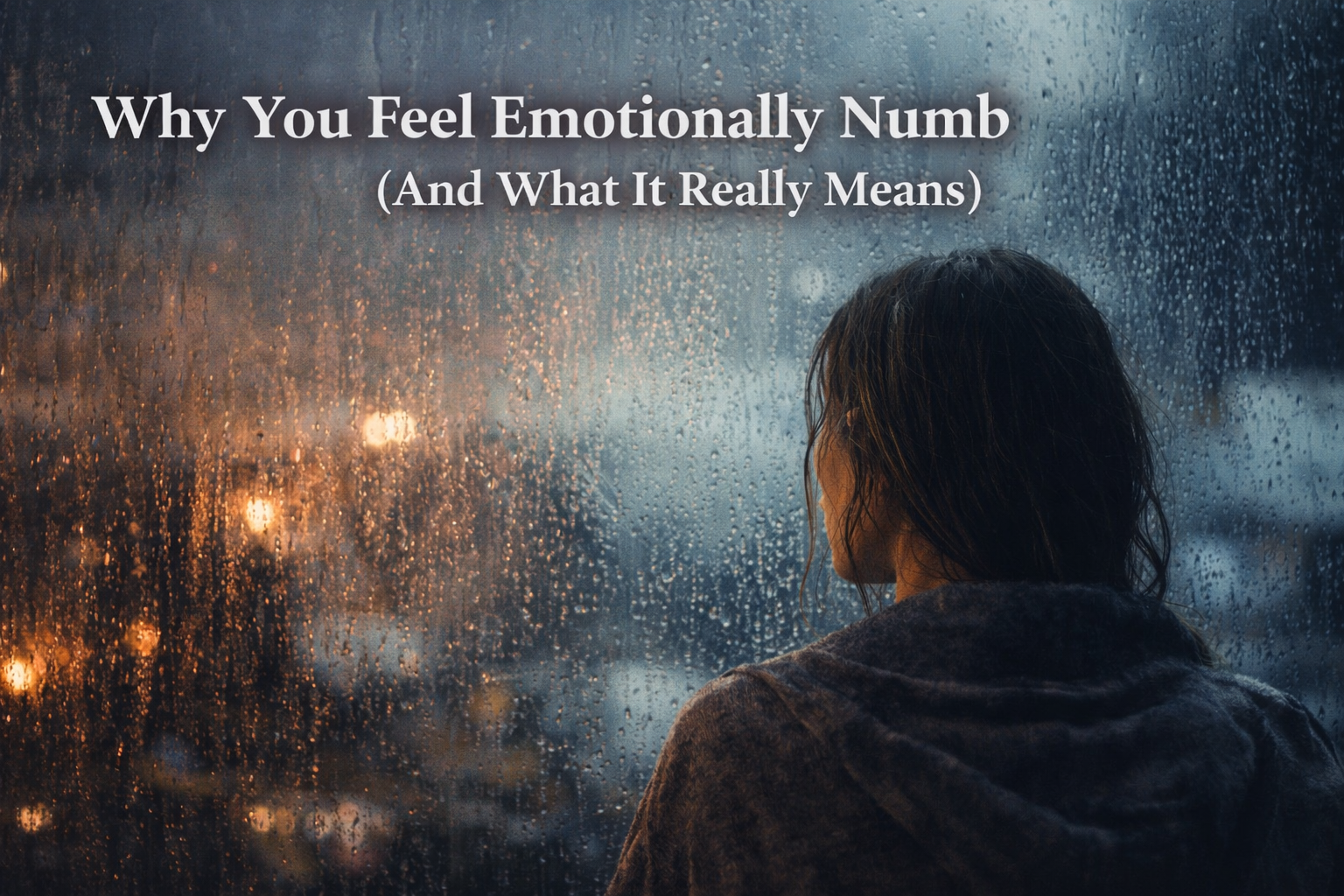
Emotionally numb is one of those phrases people often use quietly, almost with hesitation. They do not always say it dramatically. In fact, many people say it in a flat, tired, almost confused way. They say they do not feel sad exactly, but they do not feel alive either. They are not necessarily crying, panicking, or falling apart. They are functioning.
They are replying to messages, going to work, finishing tasks, making plans, and even laughing in the right places. But something inside feels muted. Distant. Blurred. As if life is happening through a layer of glass instead of directly in the heart. That experience can be frightening because it feels unfamiliar, yet it is also more common than many people realize.
Emotional numbness is often misunderstood because people assume that emotions only matter when they are intense. They think something must be wrong only when they are overwhelmed, anxious, heartbroken, or visibly unstable. But there is another kind of struggle that receives less attention: not feeling much at all.
That state can be harder to explain because it does not always look dramatic from the outside. You may seem calm to everyone else while privately feeling disconnected from your inner world. You may still care about your responsibilities, but your emotional reactions seem delayed, weak, or strangely absent. Things that should matter seem far away. Things that used to move you barely touch you. Even joy can feel distant, as if your mind recognizes that a moment is good while your body and emotions fail to join in.
This is why emotional numbness can feel so unsettling. It does not always resemble the emotional pain people expect. Instead, it often feels like absence. You may look at your own life and wonder why you cannot connect with it properly. You may ask yourself whether you are becoming cold, whether you are broken, whether you are secretly depressed, or whether something in you has simply shut down. In many cases, numbness is not a sign that you are empty. It is a sign that your inner system is trying to protect you, slow you down, or manage more pressure than it can process all at once.
That idea matters because emotional numbness is rarely random. It usually has a function. It may be linked to stress, burnout, grief, trauma, disappointment, prolonged suppression, mental overload, emotional fatigue, or a deep fear of vulnerability. It can also happen when a person has spent so long being strong, productive, composed, or emotionally controlled that their feelings begin to flatten under the weight of constant self-management. In that sense, numbness is not always the absence of emotion. Sometimes it is what happens when emotion has been pushed, contained, overworked, or silenced for too long.
If you have ever said, “I don’t feel anything lately,” or “I know I should care more, but I just feel flat,” this article is for you. The goal here is not to over-dramatize the experience or turn it into a vague aesthetic of sadness. The goal is to understand what emotional numbness really is, why it happens, what it can reveal about your inner state, and how to respond to it with more clarity and less self-judgment.
What It Really Means to Feel Emotionally Numb
To feel emotionally numb is not the same thing as being emotionless. That distinction is important. Most emotionally numb people still have feelings. The issue is that those feelings seem blocked, muted, delayed, confusing, or difficult to access. You may know something matters to you, but not feel it fully in the moment. You may understand that an event should make you happy, angry, grateful, or sad, yet your actual internal reaction feels strangely distant. Sometimes numbness feels like emptiness. Other times it feels like emotional fog. And in some cases, it feels like a low, constant detachment from life itself.
Many people describe emotional numbness as moving through the day on autopilot. They do what needs to be done, but their inner world feels reduced. Moments that used to carry warmth now feel neutral. Music that once affected them sounds flat. People they love may still matter to them, but they struggle to emotionally “reach” that sense of love. Even pain can become abstract. This is one reason numbness can be so confusing: it is not always loudly painful, yet it creates a subtle kind of suffering because it interrupts your relationship with meaning, attachment, and vitality.
There is also a difference between peace and numbness. Peace feels grounded. It feels clear, settled, spacious, and emotionally alive, even when calm. Numbness feels disconnected. It often carries an undertone of absence, dullness, or distance. Peace lets you feel without being controlled by feeling. Numbness often prevents you from feeling fully at all. This is why people who are emotionally numb may look composed from the outside while internally sensing that something essential is missing.
In psychological terms, emotional numbness can be understood as a reduction in emotional responsiveness. That reduction may happen because your brain and nervous system are overburdened, because your emotions have been suppressed for too long, or because part of you has decided that feeling fully is currently too costly. Seen that way, numbness is not always dysfunction in the simplest sense. It can be a protective adaptation. The mind sometimes lowers emotional intensity when it believes the system cannot safely process what is already there.
Why Emotional Numbness Happens
There is no single reason why a person becomes emotionally numb. Different people arrive at the same feeling through very different paths. Still, some patterns appear again and again.
1. Chronic Stress and Mental Overload
One of the most common causes of emotional numbness is prolonged stress. When a person lives in a constant state of pressure, their system can stop prioritizing emotional richness. If your days are full of deadlines, tension, unresolved conflict, overthinking, sleep deprivation, and nonstop demands, your body may focus more on survival than on emotional presence. In that state, you may still function, but the softer, more expressive parts of your emotional life begin to fade into the background.
This is especially true when stress has no clear endpoint. Short-term stress can be intense but manageable because the mind expects relief. Long-term stress is different. It teaches the body that vigilance is normal. Over time, the emotional system becomes tired. Instead of feeling everything sharply, it begins to flatten experience. This can look like numbness, but underneath it is often exhaustion.
2. Burnout
Burnout is not only about being tired. It often includes emotional depletion, cynicism, mental fog, and reduced capacity to care in the way you used to. When someone has given too much energy for too long without enough recovery, recognition, meaning, or emotional support, numbness can develop as part of the collapse. This happens in work, caregiving, parenting, relationships, school, and even personal growth journeys where a person has been trying too hard to hold themselves together.
Burnout-related numbness often carries a particular feeling: things that once mattered now feel emotionally flat. You may still understand their importance, but the spark is missing. This is not laziness or moral failure. It is often a sign that your internal resources have been stretched beyond what they can sustain.
3. Emotional Suppression
Some people become numb not because their feelings disappeared, but because they became too practiced at hiding them. If you have spent years telling yourself to stay strong, stay productive, stay calm, stop being dramatic, stop needing too much, and keep moving, you may have trained yourself to disconnect from your own emotional signals. At first, suppression can look like strength. It helps you perform, function, and remain composed. But over time, if everything intense is pushed down, the whole emotional range can become harder to reach.
Human emotions do not always obey selective control. When you repeatedly mute grief, fear, anger, or tenderness, you may also weaken access to joy, excitement, and closeness. The emotional system works as a whole. Trying not to feel certain things can gradually reduce your ability to feel many things with full clarity.
4. Trauma and Self-Protection
Emotional numbness is also common after traumatic experiences or prolonged emotional pain. Trauma does not always lead to visible chaos. Sometimes it leads to shutdown. If the mind decides that feeling fully is too threatening, it may reduce emotional intensity as a protective response. In that sense, numbness can be understood as a survival strategy. It is the nervous system saying, in effect, “This is too much to process directly, so I am lowering the volume.”
This does not only happen after major obvious trauma. Repeated smaller emotional injuries can also create numbness over time. Long-term invalidation, unstable relationships, constant criticism, emotional neglect, betrayal, unresolved grief, or years of feeling unsafe can all contribute to a detached emotional style. A person may not even realize how much they are carrying until they notice that they no longer feel much at all.
5. Depression
Emotional numbness can also be part of depression, though not everyone who feels numb is clinically depressed. Depression is often misunderstood as constant sadness, but many people with depression describe feeling flat, disconnected, empty, or emotionally absent rather than visibly miserable. They may not cry often. They may not even feel intense sadness all the time. Instead, they may feel a low emotional shutdown, reduced pleasure, lack of motivation, and difficulty connecting to things that once felt meaningful.
This is one reason people can miss the seriousness of their own state. If they are not dramatically upset, they may assume they are fine. But ongoing numbness, especially when paired with fatigue, hopelessness, disconnection, or loss of interest, deserves careful attention.
6. Unprocessed Grief and Disappointment
Grief does not always arrive as tears. Sometimes it arrives as quiet emotional reduction. When a person loses something important, whether a relationship, a version of themselves, a dream, a season of life, or a sense of safety, the mind may temporarily dull emotional contact. This can happen after heartbreak, family conflict, major change, identity collapse, or any experience that forces a painful internal reorganization. You may not feel the grief directly at first. You may feel numbness instead.
In that sense, numbness can be the frozen edge of sadness. It can be what grief feels like before it becomes fully conscious.
What Emotional Numbness May Be Trying to Tell You
If numbness often has a function, then it also carries information. It may not speak in a direct voice, but it usually points toward something.
Your System May Be Overloaded
One of the clearest meanings of emotional numbness is simple overload. You may have been carrying too much for too long. Too many responsibilities. Too many disappointments. Too many decisions. Too much self-control. Too much unspoken pressure. When a system is overloaded, it does not always collapse dramatically. Sometimes it lowers emotional availability because full feeling would add one more thing it cannot currently hold.
You May Be Protecting Yourself From Something Painful
Numbness often suggests protection. There may be feelings under the surface that your mind does not fully trust you to process yet. That does not mean you are weak. It means part of you is trying to help you survive. The problem is that protection becomes painful too when it lasts too long. What starts as defense can become disconnection.
You May Be Living Too Far From Yourself
Sometimes emotional numbness is not only about pain. Sometimes it is about distance from your own inner life. You may be so focused on functioning, pleasing, performing, adapting, or maintaining control that you have drifted away from honest contact with yourself. In those moments, numbness can become a signal that your life is running, but your emotional self is not fully inside it. You may be present in body and absent in feeling.
You May Need Recovery, Not More Pressure
Many people respond to numbness by trying harder. They force productivity, social interaction, self-improvement, positivity, discipline, or performance. But emotional numbness often does not improve through pressure. It often improves through safety, slowing down, rest, honest reflection, and gradual reconnection. If you are numb, the answer may not be to demand more from yourself. It may be to create conditions in which feeling becomes safer again.
Signs That Emotional Numbness Is Affecting Your Daily Life
Because numbness can be subtle, it is helpful to recognize how it shows up practically. You may be dealing with emotional numbness if you notice patterns like these:
You go through meaningful moments without feeling much emotionally, even when you know they matter. You struggle to feel excitement about things you used to enjoy. You find yourself detached in conversations, relationships, or experiences that would normally affect you. You feel strangely distant from your own sadness, anger, or love. You care in theory but feel disconnected in practice. You avoid emotional conversations because you do not know what you would even say. You keep functioning, but life feels muted and low-resolution. You say “I’m fine” not because you feel good, but because “fine” is easier than explaining the absence of feeling.
In more severe cases, numbness may also come with isolation, hopelessness, loss of motivation, sleep problems, mental fog, irritability, or a lingering sense that nothing is reaching you properly. If those patterns are strong or persistent, it is important not to dismiss them.
Why Emotional Numbness Can Feel So Scary
Many people fear numbness more than sadness because sadness still feels alive. Sadness hurts, but it confirms contact. Numbness can feel eerie because it creates distance not only from pain, but from meaning. When your emotions feel dim, you may begin to question your identity. Am I still myself? Do I still care? Why don’t I feel what I should feel? Why can’t I connect?
This fear is understandable. Emotions help us orient ourselves. They tell us what matters, what hurts, what fulfills us, what needs attention, and where we feel connected. When that emotional feedback becomes weak or inconsistent, life can feel psychologically unfamiliar. You may start analyzing yourself excessively, trying to force feeling, or worrying that something permanent has changed in you.
But emotional numbness is usually not proof that you are permanently damaged. More often, it is a message from an overwhelmed or overprotective system. The message may be uncomfortable, but it is not meaningless. It is pointing to a need that has probably gone unaddressed for too long.
How to Start Reconnecting With Your Emotions
There is rarely a fast, dramatic fix for emotional numbness. Reconnection is usually gradual. It happens less like flipping a switch and more like restoring sensitivity to something that has been dulled by overload or defense.
1. Stop Judging Yourself for Feeling Numb
Self-judgment makes numbness harder to understand. If your inner dialogue is full of phrases like “What is wrong with me?” or “I should be over this” or “Why can’t I just feel normal?” then you add pressure to a system that likely needs safety. Try replacing judgment with curiosity. Instead of asking, “Why am I like this?” ask, “What might my system be protecting me from or trying to manage right now?” That shift matters more than it seems.
2. Reduce Overload Where You Can
If your emotional flatness is connected to chronic stress or burnout, you will likely need to reduce inputs before you can recover feeling. This may mean better sleep, fewer obligations, stronger boundaries, less constant stimulation, more quiet, less emotional labor, or more honest rest. Not all overload can be removed instantly, but even small reductions can help your system stop living in survival mode.
3. Reconnect With the Body
Emotions are not only mental. They also live in the body. Sometimes numbness softens when a person begins to reconnect physically through walking, stretching, breathing, grounding, warm showers, exercise, rest, music, or quiet time without constant digital distraction. The goal is not to force a feeling. The goal is to signal safety and presence. A body that feels constantly rushed or dysregulated rarely opens easily to emotional depth.
4. Name What You Can, Even If It Feels Small
You may not be able to access deep feeling immediately, but you can begin by naming small things honestly. Instead of demanding an emotional breakthrough, ask simpler questions. Do I feel tired? Disappointed? Pressured? Distant? Irritated? Heavy? Empty? Numbness often begins to soften when language returns. Naming is not dramatic, but it rebuilds emotional contact.
5. Notice What You Have Been Avoiding
Sometimes numbness protects you from specific feelings or truths. Maybe you have been ignoring grief, resentment, fear, loneliness, or the fact that a part of your life is draining you. Maybe you have been performing competence for so long that you no longer know how to admit pain. If numbness is repeatedly showing up, it can help to gently ask what topic, memory, relationship, or pressure seems connected to it.
6. Talk to Someone Safe
Emotional numbness can become more entrenched in isolation. A safe conversation, whether with a therapist, a trusted friend, or a grounded supportive person, can help restore emotional movement. You do not have to explain everything perfectly. Sometimes simply saying, “I feel emotionally flat lately and I don’t really know why,” is already a meaningful act of reconnection.
When You Should Take Emotional Numbness Seriously
Temporary emotional flattening can happen during stressful seasons and may ease with rest, reflection, and support. But if numbness lasts for a long time, interferes with daily life, damages your relationships, or comes with hopelessness, deep fatigue, dissociation, depression, or thoughts of harming yourself, it is important to seek professional help. Emotional numbness can be part of more serious mental health struggles, and you do not have to figure that out alone.
It is also worth paying attention if numbness keeps recurring. Even if it comes and goes, repeated emotional shutdown often suggests that some core pressure remains unprocessed. A pattern deserves attention even when it is not constant.
The Hidden Truth About Emotional Numbness
The hidden truth about numbness is that it is rarely about not caring. More often, it appears because something in you has cared too much for too long without enough repair. It can develop because you were overloaded, hurt, disappointed, exhausted, or trained to suppress what you feel. It can show up because your system decided distance was safer than full contact. In that sense, emotional numbness is not always a lack of depth. Sometimes it is what depth looks like when it has been strained past its current limit.
That does not mean numbness should be romanticized. It can be painful, disorienting, and deeply lonely. But understanding it as information rather than personal failure changes the way you respond. It allows you to stop treating yourself like a machine that malfunctioned and start treating yourself like a person whose internal signals deserve attention.
Final Thoughts
If you feel emotionally numb sometimes, it does not automatically mean you are broken, cold, or permanently disconnected. It may mean you are overwhelmed. It may mean you are burned out. It may mean your emotions have been suppressed for too long. It may mean your mind is protecting you from pain it does not yet know how to process safely. Or it may mean you have drifted too far into functioning and too far away from feeling.
The important thing is not to dismiss the experience. Numbness is still a form of communication. It may be quiet, but it says something real. It says your inner world needs attention, gentleness, and honesty. And while reconnection may take time, the return of feeling often begins with one simple shift: instead of asking why you are failing to feel, ask what your numbness is trying to protect, slow down, or reveal.
Sometimes the most meaningful emotional recovery does not begin with intensity. It begins with noticing that the silence inside you is saying more than you thought.