

Guilt When Resting: 9 Powerful Reasons You Struggle to Relax
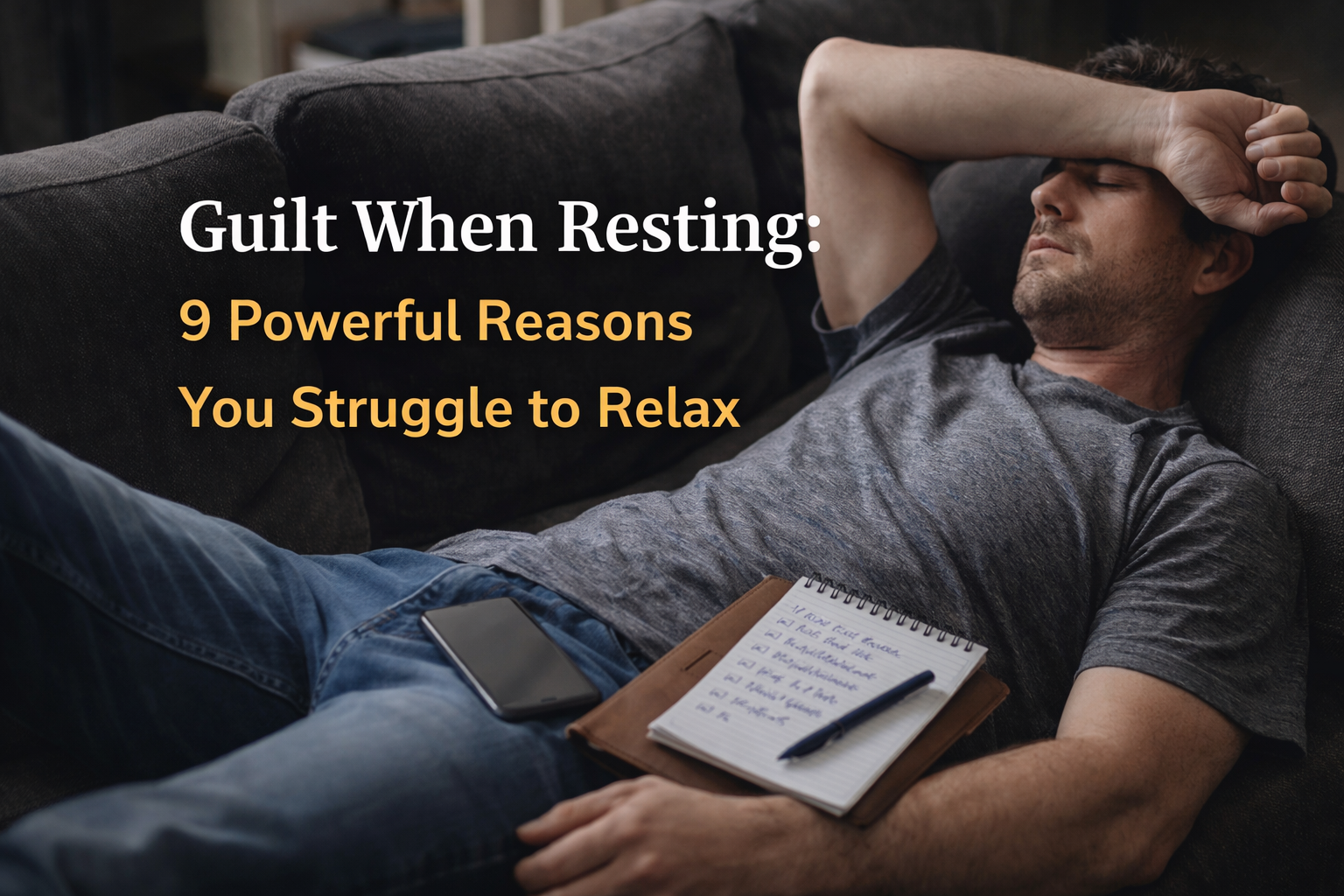
Guilt When Resting… Have you ever collapsed onto your couch after a long day, only to be struck by an overwhelming wave of guilt for taking a moment to breathe? You scroll through your to-do list, mentally tallying the tasks left undone, and suddenly, that well-deserved rest feels like a betrayal of your hard work. It’s a familiar struggle: you push yourself to the limit, yet the moment you pause, that nagging voice in the back of your mind whispers that you haven’t earned the right to relax.
If this inner conflict resonates with you, you’re not alone. Many of us grapple with the heavy burden of guilt when we dare to prioritize self-care, even after investing all our energy into our responsibilities. So, why do we feel this way? Let’s dive into the complexities of guilt and rest, and explore the deeper reasons behind why we find it so hard to allow ourselves to simply unwind.
The Evolutionary or Psychological Reason Behind Guilt When Resting
Feeling guilty when you rest, even after hard work, is a common psychological phenomenon that can be traced back to our evolutionary history. From an evolutionary standpoint, humans have developed a strong work ethic as a survival mechanism. Our ancestors who worked diligently to gather food and create shelter were more likely to survive and reproduce. This ingrained belief in the value of constant productivity can lead to feelings of guilt when we take time to rest.
Societal Expectations and Cultural Influences
In modern society, the emphasis on productivity and achievement is pervasive. Many cultures equate self-worth with work output, leading to an internalized pressure to remain busy. This societal conditioning can create a cognitive dissonance where individuals feel they must constantly justify their need for rest, further intensifying feelings of guilt.
Real-Life Examples or Famous Case Studies
Case Study: The Workaholic Executive
A well-known case study involves a high-powered executive who consistently worked 80-hour weeks. Despite being successful and financially secure, the executive often felt guilty during vacations, believing that time off meant falling behind. Eventually, this led to burnout, illustrating how guilt over resting can have detrimental effects on mental health and productivity.
Example: The Artist’s Block
Another example can be seen with many artists who battle creative blocks. They may feel guilty for not producing art, even when they’ve been working hard on previous projects. This guilt can stifle creativity and lead to a cycle of overwork and burnout, ultimately hindering their artistic expression.
5 Actionable Coping Mechanisms or Takeaways
- Acknowledge Your Feelings: Recognize and validate your feelings of guilt as a natural response, rather than suppressing them.
- Set Boundaries: Establish clear work-life boundaries to create designated times for both work and rest, reducing the overlap that leads to guilt.
- Practice Mindfulness: Engage in mindfulness techniques such as meditation or deep breathing to center yourself and alleviate guilt during rest periods.
- Reframe Your Thoughts: Shift your perspective by viewing rest as a crucial component of productivity, essential for maintaining long-term efficiency and creativity.
- Develop a Self-Care Routine: Create a regular self-care routine that prioritizes rest and relaxation, making it a non-negotiable part of your life.
Did You Know? A study published in the Journal of Occupational Health Psychology found that employees who take regular breaks and time off report higher levels of job satisfaction and lower stress levels, debunking the myth that constant work leads to greater productivity.
Ultimately, the guilt we feel when resting, despite our hard work, often stems from deeply ingrained beliefs about productivity and self-worth.
Have you ever experienced guilt when taking a break, and how do you cope with those feelings?
Why Rest Can Feel Emotionally Unsafe
For many people, rest is not physically difficult. It is emotionally difficult. The body may be exhausted, but the moment you stop, a wave of inner resistance appears. Instead of relief, you feel tension. Instead of peace, you feel accusation. A quiet voice in your mind begins listing what is unfinished, what could still be done, and what your pause might say about your character. This is what makes guilt around rest so confusing. You are not simply tired. You are tired and unable to feel fully allowed to recover.
This often happens because rest has stopped feeling neutral. Somewhere along the way, it became emotionally coded as laziness, weakness, waste, selfishness, or lost time. Once that meaning attaches itself to rest, the act of slowing down no longer feels like care. It feels like a risk. You may know intellectually that human beings need recovery, but emotionally the pause still feels dangerous. It threatens your self-image, your sense of control, or your belief that your value comes from output.
That is why rest guilt can feel so sharp even after objectively demanding effort. The issue is not whether you have done enough. The issue is whether your nervous system and self-concept know how to treat stopping as safe. For many people, they do not.
Guilt When Resting and the Link Between Worth and Productivity
One of the strongest drivers of guilt when resting is the belief that your worth must be continuously earned. In this mindset, rest becomes difficult because it produces nothing visible. You are not achieving, helping, performing, or proving. You are simply being. For someone whose identity has become wrapped around usefulness, that can feel deeply uncomfortable. The silence of rest creates a confrontation with a question many people spend their lives trying to avoid: Who am I when I am not producing?
When self-worth is tied to output, busyness starts to feel morally good. Exhaustion becomes evidence of effort. Being overwhelmed becomes a strange kind of validation. Rest, by contrast, feels like a threat to the identity structure itself. If you are not actively doing, then the mind starts scanning for what justifies your place. It may conclude that you have not earned the break yet, that someone else deserves rest more, or that you should at least finish a few more things before you let yourself stop.
This is one reason highly responsible people often struggle the most with relaxing. Their competence has been rewarded for so long that they begin confusing usefulness with identity. Once that happens, rest does not just interrupt work. It interrupts the very pattern they use to feel secure and valuable.
How Childhood Messages Can Shape Rest Guilt
Many people do not develop guilt around rest out of nowhere. They learn it. Sometimes the lessons were explicit. Perhaps they grew up hearing that lazy people fail, idle time is wasted, or only hard workers deserve respect. In other cases, the lesson was more indirect. A child may have noticed that caregivers were only calm when everything was handled, only approving when performance was strong, or only affectionate when the child was being productive, responsible, or helpful.
In homes where rest was mocked, ignored, or treated as indulgent, children often learn to stay in motion emotionally and practically. In homes where adults were chronically stressed, overworked, or resentful, children may absorb the idea that exhaustion is normal and stopping is dangerous. Some children even become the “responsible one” early, learning to monitor others, anticipate needs, and stay useful as a way of preserving safety or connection. For them, rest may feel not only undeserved but disloyal.
These early messages do not disappear automatically in adulthood. They often become internal rules. Even if no one around you is pressuring you now, an older voice may still live inside your mind, evaluating your rest as if it were a moral test.
Why Modern Culture Makes It Worse
Even if you did not grow up with strong rest guilt, modern culture can intensify it dramatically. Productivity is treated almost like a virtue system. People are praised for hustling, optimizing, multitasking, and pushing through fatigue. Rest is often marketed not as a human need, but as a tool for becoming more productive later. Even self-care gets framed in performance language. The message is rarely, “You deserve rest because you are human.” It is more often, “Rest so you can get back to functioning at a high level.”
This subtle framing matters. It means rest is rarely allowed to exist on its own terms. It must justify itself. It must be efficient, strategic, and somehow still connected to output. As a result, many people never truly learn how to rest without measuring whether the rest was productive enough. They may lie down while mentally reviewing goals, take a break while feeling behind, or schedule “recovery” so tightly that it becomes another task.
In a culture that glorifies busyness, guilt when resting becomes almost socially reinforced. You are not only fighting your personal history. You are also resisting a larger system that treats constant motion as proof of significance.
The Hidden Fear Beneath the Guilt
Guilt often looks like self-criticism on the surface, but underneath it there is usually fear. Fear of falling behind. Fear of becoming irrelevant. Fear of disappointing others. Fear of seeing what you feel when you stop. Fear that if you let yourself rest, you might not start again with the same intensity. For some people, overworking is not just habit. It is regulation. It keeps them distracted, validated, or emotionally buffered. Rest removes that buffer.
This is why rest can feel unexpectedly exposing. The moment activity drops, emotions that were kept in the background may rise. Sadness, anger, loneliness, resentment, or emptiness can become more noticeable. In that sense, guilt may function partly as a defense. It keeps you moving so you do not have to meet whatever is waiting underneath the motion.
Understanding this is important because it changes the question. Instead of only asking, “Why do I feel guilty resting?” you may need to ask, “What do I become afraid of when I stop?” The answer is often where the deeper healing work begins.
Guilt When Resting Can Be a Burnout Warning Sign
When guilt makes rest impossible, burnout becomes much more likely. Burnout is not only about working too much. It is also about losing the ability to recover. If your body rests while your mind continues attacking you, the nervous system never fully gets the message that the threat has ended. You may be technically off the clock but still physiologically activated. Over time, this creates exhaustion that sleep alone may not fix.
People in this pattern often describe feeling tired all the time but unable to relax. They collapse physically but stay mentally on duty. They feel irritable during downtime, guilty during weekends, and anxious during vacations. Even when they have time to recover, their inner world does not allow recovery to land. That is a major red flag, because it means the issue is no longer just workload. It is the internalization of pressure.
In this sense, guilt around rest is not a harmless quirk. It can be one of the mechanisms that keeps chronic stress alive. If the nervous system never gets permission to come down, depletion becomes the baseline.
How Perfectionism Fuels the Problem
Perfectionism and rest guilt often reinforce each other. If your standards are constantly moving, rest will always feel premature. There will always be one more improvement to make, one more task to finish, one more area where you could have done better. Perfectionism creates the illusion that rest should come after completion, but completion never truly arrives. The bar just moves again.
This means a perfectionistic person may rarely feel they have “earned” rest, because the criteria keep changing. Even when they do pause, they may continue mentally editing what they already did, criticizing how the day went, or planning how to compensate tomorrow. In this way, perfectionism steals the psychological permission needed for genuine restoration.
It also reframes rest as weakness. If you believe strong people should always be capable, productive, and in control, then needing a pause feels embarrassing rather than normal. Rest becomes evidence of inadequacy rather than evidence of being human. That distortion is one of the reasons perfectionism can be so physically costly over time.
What Healthy Rest Actually Looks Like
Healthy rest is not the same as collapse. Collapse happens when the system has been pushed too far and can no longer keep going. Rest is a chosen act of recovery before collapse becomes necessary. It includes physical stillness, but also emotional permission. Real rest means you are not only pausing activity, but also loosening the inner pressure to justify your existence while you pause.
That kind of rest can take different forms. For some people it means sleep, quiet, and solitude. For others it means playful activity, time in nature, light movement, creative hobbies, or being with people who do not demand performance. The key is not the exact form. The key is whether the activity reduces strain instead of becoming another venue for self-judgment.
This distinction matters because many people “rest” in ways that keep them activated. They scroll while feeling guilty, watch shows while mentally working, or take breaks that are filled with self-criticism. The body may be still, but the mind is still in labor. True rest requires a little more gentleness than that.
How to Start Challenging the Guilt
The first step in challenging rest guilt is noticing the script without immediately obeying it. When the thought appears-“I should be doing more,” “I have not earned this,” “I’m wasting time”-pause and treat it as a learned pattern rather than a fact. You do not need to argue aggressively with it. You only need to stop granting it automatic authority.
It can help to respond with something simple and grounded: “Rest is part of the work.” “My body is not a machine.” “Stopping now helps me continue later.” “Worth is not measured by constant output.” These statements may feel unnatural at first, especially if your inner critic is loud, but repetition matters. New permission often sounds unbelievable before it starts to feel true.
You can also start making rest smaller and more deliberate. Ten minutes with your phone away. A meal eaten without multitasking. A walk with no productivity agenda. A break that you do not spend mentally justifying. These short moments help retrain the nervous system to tolerate non-productive time without panic.
Why Boundaries Are Part of Healing
If you feel guilty resting, boundaries often become essential. Without boundaries, there is always more that could be done for work, family, messages, responsibilities, or other people’s needs. That endless accessibility makes guilt stronger because rest never has a clear protected edge. It feels interruptible, negotiable, and vulnerable to being overruled at any moment.
Boundaries create a container. They say, “This is work time, and this is non-work time.” “This is what I can offer, and this is where I stop.” They do not remove guilt automatically, but they reduce the chaos that guilt feeds on. If every demand remains open-ended, the mind will always find evidence that you should still be doing something else.
Many people discover that rest becomes easier not only when they change their mindset, but when they change the structure of their lives. Clear stopping points help the nervous system trust that rest is allowed, not stolen.
When Rest Guilt Is Really About Resentment
Sometimes guilt around rest hides another feeling: resentment. A person may be over-functioning so consistently that they no longer know what it feels like to stop without consequences. They may be carrying too much at home, at work, or emotionally for others. In that case, guilt can cover the anger of not being supported enough. Rest feels impossible not just because of internal beliefs, but because the system around them truly does demand too much.
This matters because not every guilt pattern is solved purely inside the mind. Sometimes the person does need more help, more fairness, more shared responsibility, or more honest conversations about what they are carrying. If your rest always triggers chaos because nobody else steps in, the problem is not only your psychology. It is also your environment.
Recognizing this can be relieving. It helps separate internalized pressure from real overload. Both matter, but they are not the same, and they do not require exactly the same response.
When Professional Support Can Help
If guilt around resting feels chronic, severe, or tied to burnout, anxiety, depression, trauma, or compulsive productivity, professional support can be very useful. Therapy can help you identify where the guilt came from, what beliefs sustain it, and what emotions emerge when you begin slowing down. It can also help you build more realistic standards for worth, work, and recovery.
This is especially important if rest triggers intense distress, panic, or shame, or if you no longer know how to stop without feeling empty or unsafe. In those cases, the issue is often bigger than time management. It is about identity, regulation, and the meanings attached to being still.
Support can help you learn that rest is not a reward for perfect performance. It is a condition of being a functioning human being. For many people, that idea has to be relearned slowly and with care.
Final Thoughts
Feeling guilty when resting, even after hard work, is often rooted in more than simple habit. It can grow from old messages, perfectionism, productivity culture, burnout, fear, and the deep belief that worth must be continuously earned. That is why rest can feel so emotionally loaded. It is not just a pause. It touches identity, control, and self-value.
But guilt is not proof that rest is wrong. In many cases, it is proof that your nervous system has been taught to mistrust recovery. The good news is that this can change. With awareness, boundaries, self-compassion, and repeated experiences of safe, non-performative rest, the mind can begin to loosen its grip.
You do not have to earn your humanity through exhaustion. And you do not have to finish everything before you deserve to breathe. Rest is not the opposite of being responsible. Sometimes it is the most responsible thing you can give yourself.