

Misophonia vs Sensory Overload: 9 Powerful Reasons Certain Sounds Feel Painful
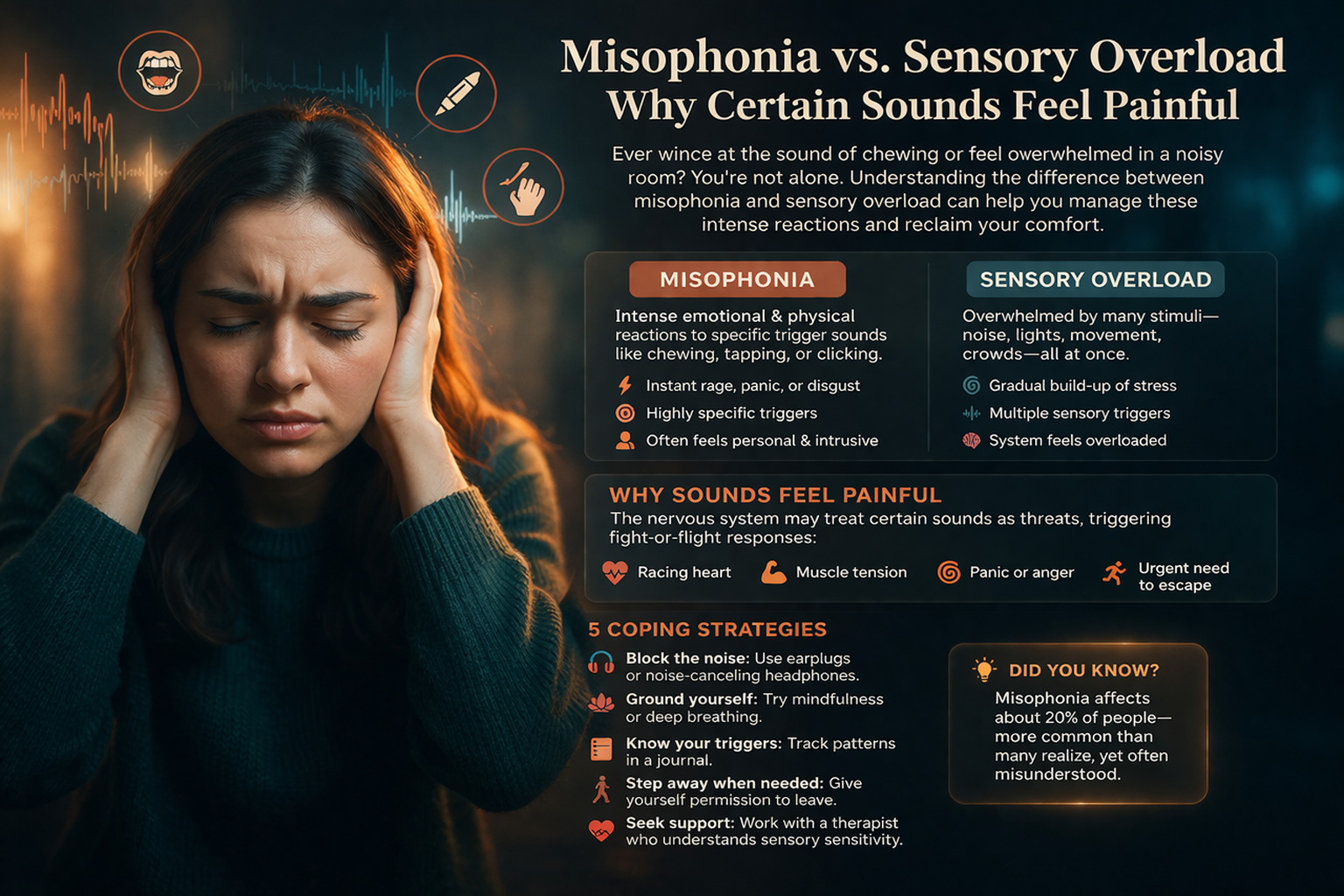
Misophonia vs Sensory Overload… Have you ever been in a quiet room, only to be jolted from your thoughts by the sound of someone chewing their food? As the rhythmic crunching echoes in your ears, a wave of discomfort washes over you, almost as if the sound is piercing through your very being. Or perhaps you find yourself gritting your teeth in frustration when a pen clicks incessantly nearby, each click sending ripples of irritation through your body. For many, these moments are more than just minor annoyances; they are experiences that can trigger intense emotional and physical reactions.
If you’ve ever wondered why certain sounds seem to invade your mind and body in such a profound way, you’re not alone. In this exploration of misophonia and sensory overload, we’ll delve into the complex relationship between sound and our sensory experiences, uncovering the reasons why some noises can feel almost painfully intrusive. Get ready to uncover the depths of your auditory sensitivities and understand the science behind the sounds that affect you most.
Misophonia vs Sensory Overload: Why Certain Sounds Feel Physically Painful
The Evolutionary or Psychological Reason Behind It
Misophonia and sensory overload are complex conditions that can significantly affect an individual’s quality of life. From an evolutionary perspective, it is suggested that heightened sensitivity to certain sounds may have developed as a survival mechanism. In our ancestral environment, being able to detect and respond to subtle auditory cues could have been crucial for avoiding predators or locating food sources. This hyper-awareness of sound, however, can lead to negative reactions when exposed to specific noises, such as chewing or tapping.
Psychologically, misophonia is characterized by strong emotional reactions to particular sounds, which can range from irritation to outright rage. Research indicates that individuals with misophonia may have altered neural pathways that trigger these responses, causing them to experience sounds in a way that feels physically painful. Sensory overload, on the other hand, is often related to conditions such as autism spectrum disorder or sensory processing disorder, where the brain struggles to process multiple stimuli at once, leading to overwhelming feelings of stress and discomfort.
Real-Life Examples or Famous Case Studies
Numerous individuals have shared their experiences with misophonia and sensory overload, shedding light on how these conditions can manifest in daily life. For instance, actress Jodie Foster has openly discussed her struggles with misophonia, detailing how certain sounds, like a person chewing loudly, can trigger intense feelings of anxiety and anger. Similarly, Dr. Amanda McGowan, a psychologist specializing in sensory processing disorders, has documented numerous case studies of clients who experience extreme discomfort in environments filled with background noise, such as bustling cafes or crowded events.
Another notable case is that of Timothy M., a college student who found that the sounds of his classmates typing on laptops during lectures would cause him to lose focus and feel physically agitated. By sharing these experiences, it becomes evident that misophonia and sensory overload are more than mere annoyances; they can significantly impact social interactions, academic performance, and overall mental health.
5 Actionable Coping Mechanisms or Takeaways
- Identify Triggers: Keep a journal to document specific sounds that trigger your misophonia or sensory overload. Understanding your triggers can help you develop strategies to manage your reactions.
- Use Noise-Canceling Headphones: Invest in high-quality noise-canceling headphones or earplugs to help block out irritating sounds in public spaces.
- Practice Mindfulness Techniques: Engage in mindfulness exercises such as meditation or deep-breathing techniques to help calm your mind when faced with triggering sounds.
- Create a Calm Environment: Designate a quiet space at home where you can retreat when feeling overwhelmed by noise. Use soft lighting and calming scents to enhance relaxation.
- Seek Professional Help: If misophonia or sensory overload significantly affects your daily life, consider consulting a therapist who specializes in sensory processing issues for tailored coping strategies.
Did You Know? Misophonia affects approximately 20% of the population, yet it remains largely misunderstood and under-researched in the psychological community.
In summary, while misophonia and sensory overload both highlight the profound impact that certain sounds can have on our physical and emotional well-being, they stem from different underlying mechanisms and responses to auditory stimuli.
Have you ever experienced a sound that felt physically painful to you, and how did you cope with that sensation?
Why Certain Sounds Feel So Deeply Intrusive
For people who experience intense sound sensitivity, the reaction is rarely just about annoyance. That is one of the most misunderstood parts of both misophonia and sensory overload. Outsiders may assume the person is being dramatic, irritable, or overly picky. But internally, the experience is often far more intense. A chewing sound, repetitive tapping, throat clearing, breathing noise, clicking pen, or background hum can feel invasive in a way that is difficult to explain. It is as if the sound does not simply enter the ears. It reaches straight into the nervous system.
This is why phrases like “just ignore it” are usually unhelpful. The person often is not choosing to focus on the sound. Their body is reacting automatically. The sound may trigger tension, panic, anger, disgust, agitation, or the urgent need to escape. It can feel physical, emotional, and immediate all at once. The reaction is not happening because the person lacks tolerance or maturity. It is happening because their sensory and emotional systems are processing that sound with unusual intensity.
Understanding this difference is important. Mild irritation is part of everyday life. What happens in misophonia and sensory overload often goes far beyond that. The sound becomes disproportionately charged, and the body responds as if something significant is happening, even when the environment appears harmless to everyone else.
What Misophonia Actually Means
Misophonia is often described as a strong emotional and physical reaction to specific trigger sounds. These sounds are usually repetitive and often human-generated, such as chewing, sniffing, slurping, tapping, pen clicking, lip smacking, or breathing noises. What makes misophonia distinctive is that the reaction is not simply based on loudness or general chaos. It is often tied to very particular sounds that provoke immediate emotional intensity.
Many people with misophonia describe the experience as instant. The trigger happens, and within seconds the body floods with irritation, rage, panic, disgust, or the overwhelming urge to get away. They may know the reaction is stronger than the situation seems to justify, but that awareness does not stop the reaction. In fact, the mismatch between the smallness of the sound and the size of the internal reaction can make the whole experience even more distressing.
Misophonia can also be relational. The same sound may be more triggering when it comes from a specific person, especially someone emotionally close. That can make family dinners, shared workspaces, classrooms, or quiet rooms especially difficult. The person is not choosing to single anyone out. The nervous system is simply responding with heightened threat or disgust to a narrow set of cues.
What Sensory Overload Usually Feels Like
Sensory overload is often broader than misophonia. Instead of reacting intensely to one or two specific sounds, the brain may struggle to manage multiple incoming stimuli at once. Noise, lights, movement, textures, social demands, and environmental unpredictability can all pile up until the system begins to feel overwhelmed. In that state, even ordinary sensory input can start feeling unbearable.
When sensory overload happens, the issue is not necessarily one chewing sound or one pen click. It is the cumulative effect of too much information arriving faster than the brain can comfortably process it. A crowded café, a bright office, a busy classroom, a shopping center, or a loud family gathering can all become too much. The person may feel mentally foggy, physically tense, emotionally irritable, or desperate to retreat somewhere quiet and predictable.
Unlike misophonia, which is often highly trigger-specific, sensory overload tends to involve total system strain. Sound may still be the main issue, but it is usually part of a larger overload picture. A person might say, “Everything feels too loud, too bright, too close, too much.” The distress comes not from one single trigger alone, but from an overwhelmed nervous system that can no longer filter input effectively.
Misophonia vs Sensory Overload: The Core Difference
The simplest way to understand the difference is to look at pattern and scope. Misophonia usually centers on specific trigger sounds that cause a rapid and intense emotional or physical response. Sensory overload is usually broader and happens when the overall environment becomes too stimulating for the brain to process comfortably. Both can involve sound sensitivity, but the structure of the experience is different.
In misophonia, a person may be completely fine until one particular sound begins. Then the reaction arrives fast and forcefully. In sensory overload, a person may gradually become more distressed as multiple forms of input build up over time. Misophonia often feels targeted. Sensory overload often feels cumulative.
That said, the two can overlap. Someone with sensory sensitivity may also have misophonia. A person with misophonia may be more vulnerable to overload when already stressed or overstimulated. This is why the distinction is useful, but not always perfectly clean. Human nervous systems are complex, and many people experience elements of both patterns at once.
Why the Reaction Can Feel Physical, Not Just Emotional
Many people assume sound sensitivity is “all in your head,” but the body is deeply involved. When a trigger sound appears, the nervous system may respond as though it has detected a threat. Muscles tighten. Breathing changes. Heart rate increases. Skin may feel hot or prickly. The jaw may clench. The person may feel an intense urge to escape, cover their ears, lash out, or shut down. This is why the discomfort can feel physically painful rather than merely irritating.
The body does not always distinguish cleanly between emotional threat and sensory threat. If a sound has become linked to danger, intrusion, helplessness, or overwhelm, the nervous system may react quickly and powerfully. In misophonia, the reaction often has a fight-or-flight quality. In sensory overload, the reaction may feel more like full-system flooding or collapse. Either way, the physical body is responding, not just the thinking mind.
This helps explain why willpower alone rarely solves the problem. You cannot simply reason your way out of a nervous system state that has already begun. Cognitive understanding can help later, but in the moment the body often needs regulation, distance, or relief more than explanation.
The Nervous System and Sound Processing
The nervous system is constantly filtering information, deciding what matters and what can fade into the background. For many people, repetitive sounds such as chewing or clicking get filtered out quickly. For others, those same sounds remain highly salient, as if the brain cannot stop prioritizing them. This difference in filtering is one reason sound sensitivity can feel so confusing to people who do not experience it.
When sound processing is more sensitive, the brain may treat certain noises as unusually important. Instead of fading away, the sound stays sharp and central. The person becomes increasingly aware of it, and with that awareness often comes emotional charge. If the sound has been paired with previous distress, anticipation can make the response even stronger. The body may tense before the trigger has even fully repeated itself.
This is especially hard in environments where the sound cannot easily be escaped. A person may feel trapped between wanting to remain socially appropriate and feeling internally overwhelmed. The longer the sound continues, the more the nervous system may escalate. What starts as discomfort can quickly become genuine suffering.
Why Repetitive Human Sounds Are So Triggering
One of the most puzzling features of misophonia is that human-generated repetitive sounds often trigger the strongest responses. Chewing, sniffing, lip smacking, throat clearing, tapping, and breathing noises are among the most commonly reported triggers. There are a few reasons this may happen.
First, repetitive human sounds are difficult to ignore because they carry pattern and social presence. They often come from close proximity, and they are not neutral background noise. Second, they can feel intrusive because they originate from another person’s body, which can create a sense of violation or lack of control. Third, if a person has had repeated distress around those sounds before, the trigger becomes conditioned. The body learns the pattern and reacts earlier each time.
In some cases, the social context makes the sound even harder to bear. The person may feel trapped by politeness, unable to leave, unable to ask for change, and unable to stop hearing it. That combination of repetition, closeness, and helplessness can make the trigger feel much larger than the sound itself.
How Stress Makes Everything Worse
Stress lowers the nervous system’s tolerance for sensory input. A person who can usually cope with mild noise may become intensely reactive when already tired, anxious, emotionally strained, or overstimulated. This is true for both misophonia and sensory overload. The sound may be the immediate trigger, but the background level of stress often determines how sharp the reaction becomes.
When the nervous system is already carrying too much, it has less flexibility. Filtering weakens. Irritation rises faster. Recovery takes longer. A pen click that might normally be manageable suddenly feels unbearable. A crowded room becomes impossible. A chewing sound that once caused mild discomfort now causes immediate rage or panic. The sound has not changed, but the system receiving it has.
This is why self-understanding matters so much. Sometimes the question is not only, “Why is this sound bothering me?” but also, “How overloaded was I before the sound even started?” Managing the overall stress load often reduces the intensity of sensory reactions more than people expect.
The Emotional Reactions Behind Misophonia
Misophonia is often associated with anger, but the emotional picture is wider than that. Some people feel rage, others feel panic, disgust, agitation, shame, helplessness, or the urge to cry. The reaction may be so intense that the person feels embarrassed by it, especially if others around them seem unaffected. This can create a second layer of suffering: not just the trigger itself, but the shame of reacting so strongly.
The emotion often makes more sense when seen through the nervous system lens. If the body is reacting as though something intrusive or threatening is happening, strong emotion is a natural outcome. Anger may arise because the sound feels invasive. Panic may arise because escape feels difficult. Disgust may arise because the sound feels viscerally unbearable. Helplessness may arise because the trigger seems small to others but overwhelming internally.
These reactions are not signs of bad character. They are signs that the sound is hitting a very sensitive internal pathway. The goal is not to judge the reaction morally, but to understand it accurately enough to manage it with more compassion and skill.
How Sensory Overload Shows Up in Daily Life
Sensory overload often affects far more than the immediate moment. A person may avoid crowded stores, noisy restaurants, open offices, public transport, busy classrooms, or social gatherings because these environments create too much input. They may need more recovery time after ordinary activities. They may become irritable, withdrawn, exhausted, or mentally foggy when overstimulated. The outside world can begin to feel demanding in a way others do not fully see.
This can create practical problems in work, relationships, parenting, school, and social life. What seems like a minor inconvenience to others can feel like a full-body strain to the person experiencing it. Because the distress is often invisible, they may be misunderstood as difficult, antisocial, moody, or dramatic. In reality, they may simply be trying to keep their nervous system from tipping into overload.
Recognizing sensory overload as a real regulation issue rather than a personality flaw can be deeply validating. It shifts the focus away from blame and toward support, pacing, and environmental adjustment.
The Link to Autism, ADHD, and Sensory Processing Differences
Sensory overload is often discussed in connection with autism, ADHD, and sensory processing differences, although it can happen outside those contexts too. People with these neurotypes may process environmental input more intensely or less predictably, making sound, light, touch, and movement harder to filter or organize. This does not mean every sound-sensitive person is autistic or has ADHD, but it does mean sensory differences are often part of a broader neurological pattern.
For some people, auditory overwhelm is one piece of a larger sensory profile that includes sensitivity to clothing textures, bright light, crowded spaces, or sudden changes. For others, the issue is much more narrow and may look more like classic misophonia. Understanding the wider pattern can help people find strategies that work better for their specific nervous system rather than trying to force themselves into environments that constantly dysregulate them.
The more personalized the understanding becomes, the more effective support usually is. Sound sensitivity is not one-size-fits-all, and the best coping approaches reflect that.
Why Certain Sounds Start Anticipatory Stress
For many people, the trigger is not only the sound itself but the anticipation of it. If you know someone nearby tends to chew loudly, sniff repeatedly, or click a pen, your body may start tensing before the sound even begins. This is a conditioned response. The nervous system has learned the pattern and prepares in advance.
Anticipatory stress can make the experience even more exhausting because it extends distress beyond the actual sound. Now the person is not only reacting during the trigger. They are bracing before it, monitoring for it, and staying tense afterward. This can make shared meals, meetings, classrooms, and family spaces feel mentally consuming.
Anticipation also increases sensitivity. The more you fear the trigger, the more central it becomes in attention. The sound then arrives into a system that is already activated, which often makes the reaction feel sharper and more immediate.
What Actually Helps in the Moment
In the moment, relief usually matters more than analysis. If a trigger sound is causing intense distress, practical regulation often helps more than trying to argue with yourself. Noise-canceling headphones, earplugs, white noise, stepping outside, changing seats, taking a short break, or using a calming sensory anchor can all reduce the nervous system load quickly. These are not signs of weakness. They are tools.
Breathing more slowly, softening the jaw, unclenching the hands, and orienting visually to the room can also help calm the body enough to reduce escalation. If the environment is overwhelming, leaving it may be the most effective option. Many people delay relief because they worry about appearing rude or difficult, but waiting too long often makes recovery much harder.
The goal in the moment is not to prove you can tolerate unbearable input. The goal is to help your nervous system come back within a workable range. Once you are more regulated, you can think more clearly about what happened and what support you need.
Long-Term Coping Without Shame
Long-term coping often starts with understanding your patterns instead of fighting them blindly. Notice which sounds trigger you, which environments increase overload, what times of day you are more sensitive, and how sleep, stress, and emotional state affect your threshold. This information helps you plan proactively instead of only reacting once you are already overwhelmed.
It also helps to reduce self-blame. Many sound-sensitive people spend years criticizing themselves for reactions they do not fully control. But shame rarely improves regulation. It usually adds another layer of stress, which makes triggers harder to tolerate. Compassion is not indulgence here. It is practical. A calmer relationship to your own sensitivity often creates more room to manage it effectively.
Professional support can also help, especially if sound sensitivity is disrupting work, school, relationships, or daily functioning. A therapist familiar with sensory issues, anxiety, or nervous system regulation may help you identify patterns, reduce secondary fear, and build strategies that fit your life.
Why Validation Matters So Much
One of the hardest parts of living with misophonia or sensory overload is feeling misunderstood. When people around you treat the reaction like overdramatizing, it can create loneliness on top of distress. You may begin doubting yourself, hiding your reactions, or forcing yourself to endure too much in order to seem “normal.” That usually makes everything worse.
Validation does not mean every trigger can be removed or every environment can be perfectly controlled. It means recognizing that the experience is real. It means understanding that certain sounds truly do hit your system differently. That recognition alone can reduce a tremendous amount of internal conflict. When people feel believed, they often become better able to respond with skill instead of panic or shame.
Whether the sensitivity is misophonia, sensory overload, or some combination of both, it deserves to be taken seriously. Not because the person is fragile, but because the nervous system experience is genuinely intense.
Final Thoughts
Misophonia vs sensory overload is not really a question of which one is “worse.” It is a question of understanding why certain sounds affect you so strongly. Misophonia tends to involve immediate, specific reactions to particular trigger sounds, often human-generated and repetitive. Sensory overload tends to involve a broader flood of environmental input that overwhelms the nervous system over time. Both can make sound feel far more intrusive and painful than most people realize.
If certain noises seem to pierce through you, hijack your emotions, or make your whole body react, that does not mean you are overreacting for no reason. It means your nervous system is processing those sounds in a way that is more intense, more loaded, or more difficult to filter than what many others experience. That difference is real, and it matters.
With better understanding, supportive tools, stress management, and self-compassion, these experiences often become more manageable. You may not be able to control every sound in the world, but you can learn more about how your system works, what helps it regulate, and how to build a life that feels less hostile to your senses. That shift alone can be deeply empowering.