

Online Gambling Addiction: The Psychological Architecture and Neurobiological Mechanics of Digital Compulsion 1
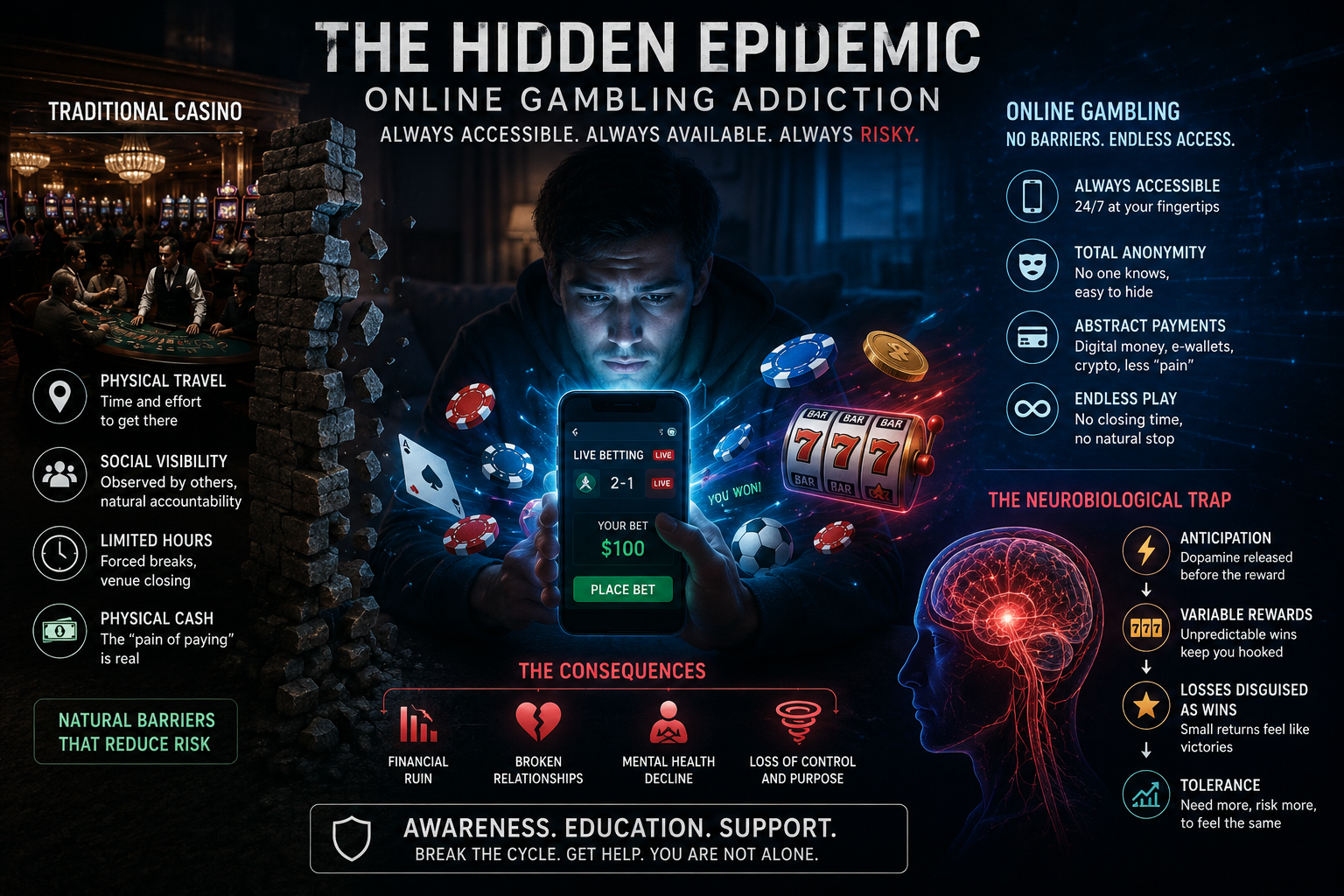
Online gambling addiction has rapidly evolved from a niche behavioral concern into a full-scale global public health crisis. In the era of traditional brick-and-mortar casinos, the path to compulsive betting was obstructed by physical, social, and temporal friction. An individual had to physically travel to a venue, interact with cashiers, endure the gaze of peers, and operate within fixed opening hours.
The digital transformation of the betting industry has systematically dismantled these barriers, creating an environment where the casino is no longer a destination, but a permanent, omnipresent fixture inside the user’s pocket. This frictionless access has fundamentally reshaped the cognitive and behavioral patterns of vulnerable individuals, leading to a highly isolated, accelerated form of dependency that traditional psychological frameworks are struggling to contain.
The Structural Evolution: From Brick-and-Mortar to Ubiquitous Screens
The transition of wagering from physical tables to digital interfaces is not merely a change of medium; it is a profound alteration of the user experience designed to maximize cognitive capture. In a physical casino, the environment is highly structured but distinct from everyday life. When a player steps outside the building, there is a natural psychological boundary that signals the end of the gambling episode. Online platforms completely erase this boundary. The integration of gambling software into mobile devices means that the transition between routine daily activities-such as working, commuting, or spending time with family-and high-stakes wagering occurs within a fraction of a second.
This eradication of environmental friction has created a phenomenon known as continuous availability. Because online betting portals operate twenty-four hours a day, seven days a week, users are never forced to pause and reflect on their behavior due to external operational constraints. The absence of physical cash further accelerates this cycle. Behavioral economics has long established that the “pain of paying” is significantly reduced when transaction methods are abstract. In virtual casinos, real money is converted into digital points, credit card balances, or cryptocurrency fractions. This tokenization distances the gambler from the financial reality of their actions, muting the psychological alarm systems that typically trigger when cash leaves a physical wallet.
Furthermore, the social dynamic of gambling has experienced a radical inversion. Traditional gambling spaces are inherently semi-public, providing a degree of informal social surveillance. A player losing thousands of dollars at a blackjack table is observed by dealers, pit bosses, and fellow patrons, which can sometimes induce healthy shame or intervention. Digital wagering, conversely, is practiced in complete isolation. This absolute privacy removes social stigma, allowing individuals to hide their escalating behavior from loved ones until catastrophic financial or psychological damage has already occurred. The anonymity of the screen serves as a protective shield for the addiction, allowing it to incubate undisturbed in the routines of everyday life.
The Neurobiological Engine: Dopamine and the Variable Ratio Schedule
To understand why online gambling addiction is so uniquely resilient to conventional willpower, one must analyze the neurological mechanisms exploited by digital betting interfaces. Human brain chemistry evolved to reward exploration, learning, and resource acquisition through the release of dopamine, a neurotransmitter primarily associated with anticipation and reward prediction. When an outcome is uncertain but potentially highly rewarding, the brain releases surges of dopamine not when the reward is received, but during the period of intense anticipation leading up to the event.
Online platforms leverage this neurobiological vulnerability by utilizing what B.F. Skinner identified as a variable ratio schedule of reinforcement. In this system, rewards are delivered after an unpredictable number of responses. Because the brain cannot predict which specific click, spin, or bet will yield a payout, it remains in a state of hyper-arousal. The proximity of a smartphone ensures that this state of anticipation can be renewed indefinitely. Each refresh of a live sports betting feed or each spin of a digital slot machine acts as a micro-injection of dopamine, reinforcing the behavioral loop even when the vast majority of outcomes result in financial loss.
Modern digital gambling software has refined this process through a highly deceptive design tactic known as “Losses Disguised as Wins” (LDWs). This is particularly prevalent in multi-line digital slot simulators. For instance, a player might wager five dollars on a single spin across multiple lines and receive a return of two dollars. Economically, this is a net loss of three dollars.
However, the software engineered for these games responds with celebratory audio-visual cues: flashing lights, upbeat music, and animations depicting a triumphant victory. Neuroimaging studies indicate that the gambler’s brain processes these partial losses identically to actual wins. The mesolimbic dopamine pathway is stimulated, creating a cognitive illusion that the player is winning, which encourages them to continue playing despite a rapidly depleting bankroll.
Over time, chronic exposure to these artificial dopamine spikes leads to down-regulation, a process where the brain reduces the number of active dopamine receptors to protect itself from overstimulation. Consequently, the individual develops a profound tolerance. The everyday activities that once brought pleasure-such as meaningful work, hobbies, or interpersonal relationships-begin to feel dull and unrewarding. The gambler requires higher stakes, faster game pacing, and longer sessions just to achieve a baseline level of psychological satisfaction, trapping them in a compulsive cycle driven by the avoidance of depressive withdrawal symptoms rather than the pursuit of genuine enjoyment.
Cognitive Distortions and the Illusion of Control in Virtual Environments
The human brain is naturally wired to seek patterns and establish causal relationships between actions and outcomes. While this trait is foundational to human intelligence, it becomes highly maladaptive within the context of online gambling, where outcomes are governed entirely by mathematical algorithms and Random Number Generators (RNGs). Digital platforms exploit this pattern-seeking tendency, fostering severe cognitive distortions that sustain the addiction even in the face of overwhelming empirical evidence of financial ruin.
The most pervasive of these distortions is the illusion of control, which is heavily amplified by the interactive nature of online interfaces. In traditional lotteries or physical roulette, the player is largely passive. Online sportsbooks, live-dealer digital card rooms, and in-play betting apps, however, give the user an immense sense of agency.
The ability to research complex statistics, cash out bets early via algorithmic features, choose specific virtual tables, or interact with live digital chat rooms tricks the brain into believing that analytical skill or personal intuition can overcome statistical house edges. Players confuse familiarity with probability, believing that their deep knowledge of a sport or a specific digital game layout gives them a mathematical advantage that does not exist.
This illusion is closely tied to the “near-miss” effect, a powerful psychological trigger that online gambling developers meticulously program into their software. A near-miss occurs when an outcome stops just short of a major win-such as two matching symbols on a slot reel with the third symbol stopping just millimeters away from the payline, or a sports parlay bet failing because of a last-second point change. Objectively, a near-miss is a total loss; no financial reward is granted.
Psychologically, however, the brain interprets a near-miss as a sign of progress, an indication that the player is “almost winning” and that the next attempt will surely yield the desired jackpot. Rather than discouraging the user, near-misses trigger a profound neurological drive to re-engage, prompting immediate subsequent wagers.
As losses inevitably accumulate, the gambler falls prey to the classic cognitive trap known as “chasing losses.” Driven by the sunk cost fallacy, the individual rationalizes that their current financial deficit is temporary and can be fully recovered by placing larger, riskier bets. In the digital environment, this behavior is supercharged by the speed of transactions. In a matter of seconds, an individual can transfer funds from a savings account, apply for an instant digital loan, or max out a credit card directly through the wagering app.
The immediacy of the digital interface prevents the intervention of rational thought, allowing a cognitive distortion to transform a minor financial setback into an absolute economic catastrophe within a single evening of isolated play.
The Behavioral Economics of Digital Currency and Financial Abstractization
One of the most insidious contributors to the severity of online gambling addiction is the deliberate abstractization of financial value within digital ecosystems. Human beings have a deeply rooted evolutionary understanding of physical resources. When a person holds physical fiat currency, they feel its weight, count the individual bills, and visually witness the physical reduction of their wealth as they hand it over to another person. This tactile feedback creates an immediate psychological barrier to spending, acting as a natural regulator of financial risk-taking.
Digital betting environments completely divorce the player from this tactile reality. By forcing users to deposit money into digital wallets where it is represented as a mere numerical display, a series of casino chips, or a balance of internal credits, platforms exploit a vulnerability known as the “monopoly money effect.” When capital is decoupled from its physical form, its psychological value drops precipitously. The user no longer views a hundred-dollar bet as a representation of hours of hard labor or a week’s worth of household groceries; instead, it is perceived merely as a digital unit required to activate a game mechanism.
The integration of advanced digital payment methods has exacerbated this issue. Features such as “one-click” deposits, automated bank transfers, and biometric authentication (such as facial recognition or fingerprint scanning) are explicitly designed to remove any lingering cognitive reflection during the transaction process. The moment of financial commitment is made so seamless that it bypasses the executive functions of the prefrontal cortex. A user experiencing an emotional crisis or an intense dopamine withdrawal state can liquidate real-world assets with a subconscious touch of a finger, completely unaware of the long-term material consequences until the betting session ends and the clinical state of hyper-arousal subsides.
In recent years, the rise of cryptocurrency integration within unregulated online casinos has taken this financial abstractization to an extreme. Cryptocurrencies, by their very nature, carry a high degree of price volatility and are natively detached from traditional financial banking systems. When a gambler wagers fractions of a Bitcoin or Ethereum, the calculations required to determine the real-world value of that wager add a layer of cognitive complexity that the brain actively avoids during high-stress betting states. This allows online platforms to obscure the true scale of the financial devastation being inflicted, accelerating the descent from casual entertainment into severe, life-altering financial dependency.
Clinical Diagnoses and Therapeutic Frameworks for Online Gambling Addiction
Effectively treating online gambling addiction demands a departure from antiquated therapeutic models developed during the era of physical casinos. Because the digital environment provides constant access and immediate reinforcement, the clinical manifestation of this disorder is often more compressed and severe than its traditional counterparts. Diagnosing this condition requires a deep assessment of behavioral economics, digital habits, and underlying psychiatric co-morbidities. Mental health professionals must look beyond standard checklists and evaluate the specific ways software interfaces interact with an individual’s executive functioning and neurological vulnerabilities.
The diagnostic criteria outlined in contemporary psychiatric manuals emphasize an escalating need to wager increasing amounts of capital, restive irritability during attempts to curtail play, and the recurrent use of wagering as a dysfunctional coping mechanism for emotional distress. In the virtual space, these symptoms are heavily amplified. The transition from active participation to absolute dependency occurs rapidly because digital platforms systematically remove the physical rest periods that naturally disrupt behavioral loops. Clinical evaluation must therefore track digital markers, such as late-night wagering sessions, the utilization of multiple betting applications simultaneously, and the integration of high-interest digital credit facilities, all of which indicate a profound loss of behavioral autonomy.
Therapeutic interventions must target the deeply rooted cognitive distortions that digital interfaces are engineered to produce. Cognitive Behavioral Therapy (CBT) remains the foundational standard for clinical treatment, but it must be heavily adapted for the digital landscape. Traditional CBT focuses on identifying external triggers, such as passing a physical casino or a betting shop. In the digital era, however, the trigger is permanently embedded within the individual’s primary tool for professional and social communication: their smartphone.
Consequently, modern therapeutic frameworks must shift their focus from simple environmental avoidance to intense internal cognitive restructuring. This involves systematically dismantling the illusion of control, educating patients on the mathematical reality of random number generation algorithms, and exposing the deceptive audio-visual design tactics used by applications to mimic near-wins and mask financial losses.
Neurological Rehabilitation and Pharmacological Horizons
Because chronic exposure to high-velocity digital wagering causes severe down-regulation of dopamine receptors within the brain’s reward pathways, treatment strategies cannot rely solely on psychological counseling. The neurobiological damage inflicted by constant, algorithmically optimized dopamine spikes requires structured neurological rehabilitation. In the early phases of cessation, individuals experience acute withdrawal symptoms characterized by profound anhedonia, severe anxiety, cognitive deficits, and intense psychological cravings. These symptoms are a direct result of a starved mesolimbic pathway, which has grown dependent on the artificial hyper-stimulation of digital slot machines or live-betting feeds to achieve baseline functioning.
To stabilize the brain chemistry of patients undergoing severe withdrawal, clinical research has increasingly turned toward pharmacological interventions. Opioid antagonists, such as naltrexone, have demonstrated significant efficacy in mitigating the compulsive drive associated with behavioral addictions. By blocking the mu-opioid receptors, these medications blunt the intense rush of pleasure and anticipation that accompanies a placed bet, effectively breaking the neurochemical link between the behavior and its chemical reward. Additionally, selective serotonin reuptake inhibitors (SSRIs) are frequently deployed to address the profound emotional dysregulation and co-morbid depressive states that either trigger or result from the financial ruin of compulsive wagering, providing a stable emotional foundation upon which psychological therapy can take root.
Beyond medication, long-term neurological recovery requires deliberate engagement in activities that promote neuroplasticity and restore natural dopamine sensitivity. Patients must be guided to participate in high-effort, delayed-reward behaviors such as rigorous physical exercise, learning complex new skills, or engaging in collaborative community projects. These activities slowly retrain the prefrontal cortex to value long-term achievements over the instant, effortless gratification provided by digital interfaces. This process is inherently slow and requires months of sustained abstinence, making short-term relapse a constant risk that must be managed through strict technological barriers.
Technological Intervention: Weaponizing Software for Harm Reduction
Given that willpower alone is frequently insufficient to counter the predatory algorithms driving modern digital wagering, the integration of advanced technological barriers is an indispensable component of successful recovery. Since the primary vehicle of the addiction is software, the immediate environment of the individual must be modified using robust counter-software designed to disrupt access. This strategy, known as digital self-exclusion, transfers the burden of regulation from the compromised executive functions of the individual to automated, unyielding system protocols.
Modern harm-reduction ecosystems utilize specialized network-level blocking software, such as Gamban or BetBlocker, which operate across all user devices. Unlike basic browser extensions that are easily disabled during moments of intense craving, these enterprise-grade tools integrate deeply with the operating system kernel. They systematically block access to tens of thousands of known gambling domains, sportsbooks, skin-betting sites, and unregulated cryptocurrency casinos worldwide. Furthermore, these systems employ heuristic analysis to identify and restrict access to newly launched wagering applications before they are officially categorized, ensuring that the user cannot exploit gaps in existing databases during a psychological crisis.
At the institutional level, national self-exclusion registries like GamStop represent a critical infrastructure for public health defense. When an individual registers with these centralized systems, they voluntarily authorize a legal ban that prevents every licensed gambling operator within that jurisdiction from accepting their wagers or sending them targeted marketing materials for a period ranging from months to years. For these systems to be effective, however, they must be combined with financial friction. Many progressive banking institutions now offer switchable “gambling blocks” within their mobile banking apps.
Once activated, these blocks immediately freeze any transaction carrying a gambling merchant category code (MCC). Crucially, deactivating this block requires a mandatory forty-eight-hour cooling-off period, creating a temporal buffer that allows an intense, impulsive craving to subside before real financial assets can be compromised.
Regulatory Deficits and the Imperative for Global Policy Reform
The current global epidemic of digital wagering dependency is fundamentally sustained by profound regulatory deficits. Legislative frameworks worldwide have failed to keep pace with the rapid technological evolution of the digital betting industry. While physical casinos remain strictly bound by geographic zoning laws, age verification protocols, and transparent tax structures, online platforms exploit jurisdictional arbitrage. Many of the most predatory virtual casinos operate out of offshore tax havens with minimal regulatory oversight, allowing them to ignore basic consumer protection standards, deploy highly deceptive dark UX patterns, and target vulnerable populations without fear of legal reprisal.
To address this systemic failure, public policy must undergo a radical paradigm shift that prioritizes collective public health over corporate profitability. Regulatory bodies must establish stringent, legally binding standards for algorithmic transparency. Software developers must be forced to disclose the exact mechanisms governing their random number generators, and the use of deceptive design tactics-such as “Losses Disguised as Wins” and calculated near-miss loops-must be legally categorized as predatory and banned from consumer-facing interfaces. Furthermore, advertising standards must be aggressively overhauled. The omnipresent bombardment of sports wagering commercials during live athletic events, often fronted by trusted celebrity figures, must be heavily restricted or eliminated, mirroring the historical public health campaigns executed against the tobacco industry.
Moreover, modern legislation must hold digital platforms financially accountable for the systemic harms they engineer. Governments should mandate the implementation of automated, real-time affordability checks. If a user’s deposit velocity or overall loss metric deviates significantly from their verified socioeconomic baseline, the platform must be legally required to freeze the account pending an independent human review. Failure to enforce these preventative measures should result in catastrophic corporate fines and the immediate revocation of operational licenses. Only by introducing severe financial and legal liabilities can states force the digital entertainment industry to dismantle the predatory architectures currently driving millions toward financial and psychological collapse.
Synthesizing the Path Forward in a Digital-First Era
Mitigating the profound societal impacts of digital wagering dependency requires an unprecedented level of cooperation between clinical psychologists, software engineers, financial institutions, and legislative bodies. The traditional view of addiction as a personal moral failing or a simple lack of discipline is entirely obsolete when confronted with multi-billion-dollar algorithmic engines designed explicitly for cognitive capture. The digital environment has transformed risk into a highly addictive, frictionless consumer commodity that is permanently accessible to the global population.
True recovery, both for the individual and for society, demands a comprehensive reconstruction of our digital environments. We must consciously design systems that reintroduced healthy friction into online transactions, protect developing minds from gamified financial exploitation, and provide accessible, shame-free pathways toward clinical rehabilitation. As artificial intelligence and predictive analytics continue to advance, the systems driving behavioral compilation will inevitably become even more personalized and persuasive. Establishing robust ethical boundaries around software design and financial transactions is no longer merely an economic issue; it is a fundamental prerequisite for safeguarding human psychological autonomy and well-being in a digital-first world.
The Affiliate Marketing Pipeline and the Streamer Culture Hyper-Normalization
The contemporary proliferation of online gambling addiction cannot be detached from the systemic revolution in digital marketing and content creation. Traditional casinos relied on localized advertising, billboards, and late-night television slots, all of which were subject to strict regulatory oversight and age-gating mechanisms. The modern digital betting ecosystem, however, has engineered a decentralized promotional apparatus driven by affiliate marketing networks and live-streaming platforms. By embedding wagering content into the daily media consumption of millions, operators have managed to strip away the historical stigma associated with compulsive betting, reframing high-stakes risk as an aspirational lifestyle commodity.
At the vanguard of this normalization is the phenomenon of casino streaming on platforms like Kick and Twitch. Influencers with massive, highly impressionable adolescent audiences are secured via multimillion-dollar sponsorship contracts by unregulated cryptocurrency casinos. These creators stream themselves for hours, operating digital slot machines or high-stakes roulette wheels with unlimited corporate credit. Because the capital they are wagering is artificially provided by the platform itself, these streamers display an absolute detachment from the psychological pain of financial loss.
They react to catastrophic losses with humor or indifference, while hyper-inflating the emotional euphoria of algorithmically boosted victories. This distorted representation creates a profound cognitive dissonance in the viewer’s mind, cementing the false belief that astronomical financial risk is a harmless, highly lucrative form of modern entertainment.
This cultural pipeline operates on a predatory economic structure known as the affiliate revenue-share model. Streamers and content creators do not merely receive a flat fee for their promotional services; instead, they are provided with unique tracking links or promotional codes to distribute to their audience. When a viewer registers an account using these links, the affiliate creator receives a permanent percentage-frequently ranging from twenty-five to fifty percent-of the net financial losses that individual incurs on the platform.
This creates a deeply unethical symbiosis where the creator’s long-term corporate profitability is directly tied to the financial devastation of their own community, incentivizing influencers to actively encourage loss-chasing behaviors and dismiss the warning signs of severe dependency among their followers.
The Micro-Transaction Shadow Economy: Skin Gambling and Esports Integration
The structural boundaries of online gambling addiction have been further expanded through the exploitation of virtual item economies within mainstream competitive video games, a phenomenon widely documented as skin gambling. In titles such as Counter-Strike and Dota 2, players can acquire cosmetic modifications for their digital equipment, known as “skins,” through randomized in-game mechanics or direct marketplace transactions. Over the past decade, these virtual assets have evolved from simple aesthetic enhancements into highly liquid, decentralized alternative currencies with real-world valuations fluctuating from pennies to tens of thousands of dollars.
Predatory third-party betting operators exploit the open Application Programming Interfaces (APIs) of digital distribution platforms like Valve’s Steam to construct unregulated, subterranean wagering networks. Players can link their gaming profiles to these external websites, depositing their virtual skins into digital escrow accounts to utilize them as betting chips for digital roulette, coin-flips, or esports match wagering. Because these transactions are executed entirely through virtual items rather than traditional fiat currency, operators successfully evade domestic banking regulations, anti-money laundering protocols, and age-verification mandates. This enables millions of underage individuals to engage in high-velocity, structurally pure gambling under the guise of casual video gaming.
The psychological impact of skin wagering on developing brains is exceptionally severe. Because the medium of exchange is a colorful digital weapon skin associated with recreational play, the cognitive barrier to risk is entirely neutralized. An adolescent does not process the wager of a rare digital item as the liquidation of hundreds of dollars of real-world capital. Furthermore, the integration of these mechanics with the hyper-competitive ecosystem of esports ensures that youth are continuously exposed to betting narratives. Professional competitive matches are frequently bracketed by live skin-wagering odds, normalizing the practice of financial speculation on athletic performance and embedding gambling mechanics into the foundational identity of digital youth culture.
Socioeconomic Stratification and the Regressive Extraction Matrix
An objective examination of online gambling addiction reveals that it functions as a highly regressive economic extraction mechanism that disproportionately destabilizes vulnerable socioeconomic demographics. While the marketing narratives deployed by digital betting conglomerates project an image of democratic financial opportunity and upward class mobility, the empirical reality demonstrates that the structural algorithms of virtual wagering systematically siphon capital away from low-income communities, exacerbating systemic wealth inequality and municipal decay.
In lower socioeconomic environments, the psychological motivation driving compulsive betting shifts from a pursuit of recreational stimulation to a desperate survival strategy known as “economic escapism.” Individuals trapped in low-wage, stagnant employment or facing severe inflationary pressures utilize online sportsbooks and localized digital lotteries as a high-risk mechanism to generate emergency capital for fundamental necessities-such as rent, medical debt, or utilities. Online platforms aggressively exploit this financial desperation by geographically targeting push notifications, localized bonus offers, and high-payout marketing campaigns at specific postcodes characterized by high unemployment and financial insecurity, ensuring that the predatory infrastructure is densest where consumer vulnerability is highest.
Conversely, the manifestation of digital wagering dependency among high-income, white-collar professionals presents a distinct but equally destructive pathology. In these demographics, the addiction is frequently shielded by the individual’s substantial financial baseline and high-functioning professional reputation. Corporate executives, financial analysts, and legal professionals utilize high-stakes online card rooms or leveraged derivatives trading platforms to replicate the intense stress and cognitive demands of their professional environments. Because these individuals possess rapid access to substantial credit lines, corporate assets, and liquid investments, their downward spiral is often masked until millions of dollars have been extracted. When the financial tipping point is reached, the collapse is catastrophic, frequently involving massive corporate fraud, embezzlement, and systemic institutional ruin that shatters entire professional ecosystems.
Adversarial AI: Machine Learning as a Defensive Architecture
As the predictive algorithms utilized by digital betting operators become increasingly sophisticated at capturing human attention, the mitigation of online gambling addiction requires the development of an equally advanced, adversarial technological shield. If the primary vehicle of extraction is automated machine learning, then public health defense must weaponize counter-algorithms explicitly designed to identify, disrupt, and neutralize predatory retention loops before they inflict permanent neurological or financial devastation on the user.
Defensive AI frameworks operate by integrating directly with the data streams of financial networks, consumer device operating systems, or responsible gaming portals. These machine learning models are trained on massive, anonymized datasets of historical compulsive betting trajectories, allowing them to recognize the subtle, multi-dimensional behavioral signatures that precede a total loss of impulse control. Long before a user explicitly realizes they are entering a state of hyper-arousal or loss-chasing, the defensive
AI detects specific markers: microscopic increases in typing velocity, erratic screen navigation, rapid adjustments to wager sizing, and the execution of deposits during typical sleeping hours. Upon detection, the adversarial system can execute real-time, automated interventions-such as dynamically injecting mandatory cooling-off periods, throttling the game’s interface speed, or temporarily locking the user’s digital banking API to force a rational pause.
Furthermore, these defensive technologies can be deployed to systematically dismantle the personalized marketing apparatus of betting operators. By analyzing incoming push notifications and emails via natural language processing (NLP), defensive software can identify and intercept predatory bonus offers or behavioral re-engagement triggers sent by casino algorithms, filtering them out before they reach the user’s visual field. For this defensive architecture to achieve maximal public health utility, however, it must be mandated by legislative bodies as a non-negotiable software layer built natively into mobile operating systems and banking applications. By shifting the technological equilibrium from the exploitative operator to an automated guardian system, society can finally establish a balanced digital infrastructure that protects human cognitive autonomy from algorithmic capture.