

Why Do I Get Irritated When Someone Copies Me: 7 Psychology Insights
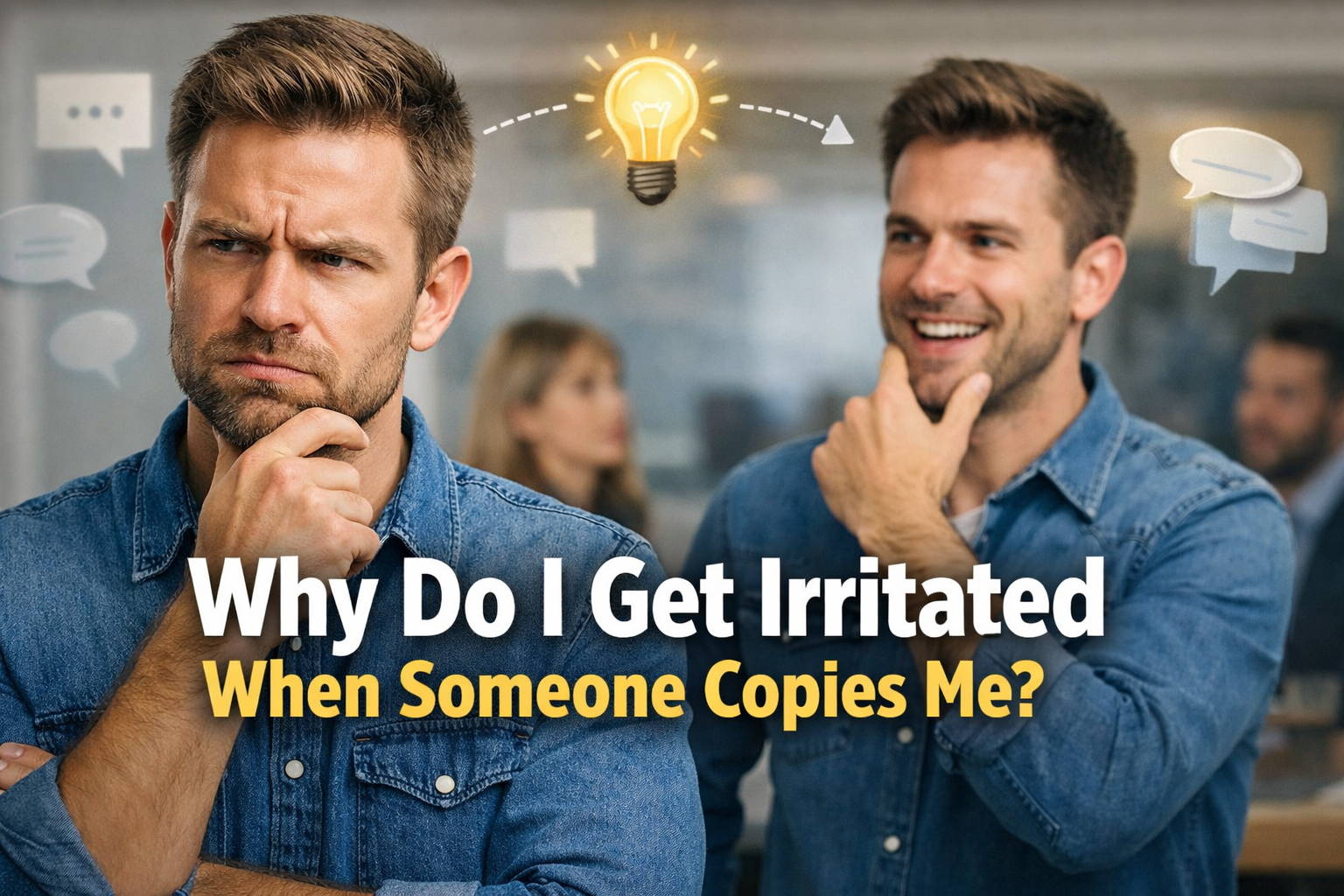
Why Do I Get Irritated When Someone Copies Me… Have you ever felt a sudden surge of annoyance when someone closely mirrors your thoughts, ideas, or even your mannerisms? Imagine this: you’re in a meeting, passionately sharing your innovative concept, and moments later, a colleague echoes your words as if they were their own.
Frustration bubbles up inside you, and you can’t help but wonder, “Why does this bother me so much?” This visceral reaction is more common than you might think, and it taps into deeper psychological triggers that shape how we perceive originality and authenticity. In a world where imitation is often seen as flattery, why does the act of being copied leave us feeling so irritated? Join us as we delve into the intricacies of echo reactions in psychology and explore the underlying reasons behind this all-too-familiar frustration.
Why Do I Get Irritated When Someone Copies Me? (Echo Reaction Psychology)
The Evolutionary or Psychological Reason Behind It
The phenomenon of feeling irritated when someone copies us can be traced back to both evolutionary and psychological perspectives. From an evolutionary standpoint, imitation can be perceived as a threat. Historically, individuals who stood out or were innovative were more likely to receive social recognition and resources. When someone imitates our ideas or behaviors, it can evoke feelings of insecurity, as it diminishes our uniqueness and threatens our social status.
Psychologically, this reaction can be tied to our self-esteem and identity. When others replicate our actions or thoughts, it can trigger a sense of loss of control or autonomy over our personal expression. This echo reaction is often rooted in the need for validation and acknowledgment; if our originality is copied without credit, it can lead to feelings of frustration and resentment.
Real-life Examples or Famous Case Studies
Throughout history, many individuals have experienced the irritation of being copied. One notable example is the case of Steve Jobs and Bill Gates. Jobs was known for his innovative approach to technology, and when Gates began to adopt similar strategies, it sparked tension between the two tech giants. Their rivalry illustrates how imitation can lead to feelings of competition and irritation.
Another case is that of musicians in the creative industry. Artists like Madonna and Lady Gaga have publicly addressed their feelings of irritation when their styles or ideas are replicated. Such instances highlight how even the most successful individuals encounter the emotional response of irritation when they perceive their originality is being undermined.
5 Actionable Coping Mechanisms or Takeaways
- Acknowledge Your Feelings: Recognize and validate your emotions when someone imitates you. Understanding your reaction is the first step in addressing it.
- Focus on Your Uniqueness: Remind yourself of your unique qualities and contributions. Celebrate your individuality instead of focusing on the imitation.
- Practice Mindfulness: Engage in mindfulness techniques to reduce feelings of irritation. Breathing exercises or meditation can help you manage your emotional responses.
- Communicate Openly: If someone is copying you in a way that feels intrusive, consider having a respectful conversation about it. Expressing your feelings can lead to understanding.
- Shift Your Perspective: Reframe the situation by viewing imitation as a form of flattery. Recognizing that others may admire your work can help reduce irritation.
Did You Know? Studies have shown that the brain reacts to imitation in similar ways as it does to competition, activating areas associated with social aggression. This explains why we may feel an instinctive irritation when others copy us.
In essence, the irritation felt when someone copies you stems from a deep-rooted psychological response that highlights our need for individuality and validation.
Have you ever experienced a situation where someone imitated you, and how did it make you feel?
Why Being Copied Can Feel Like a Threat to Identity
At a deeper level, irritation often appears because being copied can feel like an identity violation. Most people do not simply hold ideas, tastes, gestures, or ways of speaking as neutral behaviors. They weave them into their sense of self. Your humor, style, phrasing, opinions, creative approach, or even the way you explain things may feel like part of what makes you recognizably you. When someone mirrors those traits too closely, the reaction is not always about the behavior alone. It can feel as though something personal has been taken without permission.
This is especially true when originality matters to your self-esteem. People who value independence, creativity, intelligence, or authenticity often react more strongly because being copied seems to blur the line between what is uniquely theirs and what anyone can suddenly perform. The irritation is not necessarily about arrogance or possessiveness. It is often about emotional boundaries. Human beings need to feel that their inner world has some definition and ownership. When copying feels too close, too fast, or too shameless, it can seem like that boundary is being crossed.
This is one reason imitation can feel so different depending on the relationship. If a close friend lightly adopts one of your favorite phrases, it may feel affectionate. If a coworker repeats your exact idea moments after dismissing it, the same act can feel infuriating. The emotional meaning is shaped not only by the copying itself, but by context, trust, credit, timing, and power.
The Difference Between Admiration and Appropriation
One of the reasons people get confused about this feeling is that imitation is often described as flattery. Sometimes it is. Human beings learn through imitation, bond through mirroring, and show admiration by borrowing from one another. Children do it openly. Friends do it subtly. Lovers do it unconsciously. Entire cultures evolve through shared influence and adaptation. So why does copying sometimes feel warm and other times feel deeply irritating?
The answer usually lies in the difference between admiration and appropriation. Admiration leaves room for your authorship. It often comes with acknowledgment, warmth, and a sense that your influence is being appreciated rather than erased. Appropriation, by contrast, can feel as though someone is taking what was yours and presenting it as if it emerged from them naturally. The first creates connection. The second creates a sense of theft.
This distinction matters because many people tell themselves they should not be bothered. They think, “I should just take it as a compliment.” But your emotional system may be reacting to the absence of respect rather than the presence of imitation. Being inspired by someone is one thing. Flattening or stealing their contribution is another. Your irritation may be accurately picking up on that difference long before your mind fully explains it.
Why Timing Changes Everything
Timing plays a huge role in whether being copied feels flattering or maddening. If someone adopts an idea, style, or phrase long after you introduced it, the emotional charge may be low. But when the copying happens immediately, especially in the same room or the same conversation, it can create a powerful sense of erasure. The closeness in time makes the act feel less like influence and more like interception.
This is common in professional settings. You share an insight in a meeting, it receives little response, and minutes later someone restates it with slightly different wording and gets credit. What hurts is not just that the idea was repeated. It is that the social reward seems to have been detached from your contribution and reassigned. Your brain is not only reacting to imitation. It is reacting to status displacement.
Immediate copying can also feel aggressive because it leaves no room for your individuality to breathe. It creates the sensation that your expression is being mirrored back before it has even had time to belong to you. That can feel intrusive in a way that delayed influence does not. The nervous system picks up on this quickly, which is why irritation can arise almost instantly.
Social Status and Recognition
Part of the irritation behind being copied often has to do with recognition. Human beings are social creatures, and social recognition matters more than people like to admit. We want our contributions, creativity, and self-expression to be seen accurately. When someone copies us and gets praise, agreement, or approval without acknowledging the source, the irritation often intensifies because a social reward feels misallocated.
This is one reason the emotional response can feel stronger in public than in private. A copied joke among friends may irritate you a little. A copied idea in front of a boss, audience, or client may provoke much stronger anger because there are visible stakes attached to being recognized correctly. In those moments, copying does not just feel annoying. It feels unfair.
That sense of unfairness is important. It means the emotion is not only about ego. It may be about justice, effort, and the desire for an accurate social mirror. People want the world to reflect who contributed what. When that reflection gets distorted, irritation is often the mind’s way of protesting the distortion.
Why Copying Can Trigger Competition
Imitation can also activate competitive instincts. Even if you do not consciously see yourself as competitive, someone copying you can create the feeling that you are being crowded or challenged in your own space. If another person adopts your style, tone, humor, or ideas, part of you may wonder whether there is still room for your distinctiveness to stand out. This can feel particularly sharp in environments where originality is linked to value, such as creative work, leadership, social influence, or public identity.
In those settings, copying may trigger the fear that your edge is being reduced. If what makes you recognizable can be easily reproduced, then what protects your place? That is often the hidden anxiety beneath the irritation. It is not always “Stop copying me” in a childish sense. It may be “I do not want to become invisible inside something I created or embodied first.”
This competitive layer is also why copying can stir stronger feelings when you already feel insecure. If your sense of worth is shaky, imitation may feel less like admiration and more like displacement. What a more secure person experiences as mildly irritating, an insecure person may experience as deeply threatening. The act is similar, but the emotional terrain it lands in is very different.
Mirror Reactions and the Uncanny Effect
There is also something psychologically unsettling about seeing ourselves reflected too directly in another person. Human beings often like resemblance in small doses. It helps build connection, familiarity, and trust. But when mirroring becomes too obvious or too exact, it can trigger discomfort. This is sometimes close to an uncanny effect. The other person starts to feel less like themselves and more like a distorted echo of you.
That can create a strange kind of irritation because it disrupts normal social distance. People expect others to be influenced by them sometimes, but they also expect other people to remain distinct. When that distinction blurs too much, the interaction can start to feel artificial, performative, or invasive. It is as though the social mirror has been placed too close to your face.
This is especially relevant when someone copies your mannerisms, tone of voice, or personal style rather than your ideas. Those traits often feel more intimate. They are part of your embodied self, not just your intellectual output. So when they are mirrored back in a way that feels excessive, the reaction can be surprisingly visceral. The body often reads it as a boundary disturbance before the mind has time to label it.
Why Some People Copy More Than Others
Not everyone who copies is manipulative or malicious. Some people imitate because they admire you. Some do it because they are socially anxious and unconsciously borrow cues from others to feel safer. Some are highly suggestible and absorb the styles or language of the people around them without much awareness. Others may be trying to affiliate, belong, or signal closeness. In these cases, the copying may be more about insecurity than disrespect.
But there are also cases where imitation is strategic. A person may copy to gain credibility, blend into a group, extract social value, or compete more effectively. In those situations, the copying can feel colder and more deliberate. Often, your emotional reaction is sensitive to this difference even before you consciously understand it. You may sense whether the imitation feels warm, clumsy, insecure, admiring, opportunistic, or parasitic.
Understanding this can help you respond more accurately. Not every copier needs the same reaction. Some situations require compassion, some require boundaries, and some require direct correction. The more clearly you understand the motive and context, the less likely you are to overreact or underreact.
Why It Hurts More in Creative or Personal Spaces
Being copied tends to hurt most in areas where you feel personally expressed. If someone copies a generic habit, you may not care. But if they copy your creative work, your distinctive style, your emotional language, or a personal story you shared, the reaction may be much stronger. That is because these things often carry symbolic ownership. They are not just outputs. They are extensions of self.
Creative people often feel this especially strongly because their work is not purely functional. It comes from an internal process that may involve imagination, vulnerability, experimentation, and lived experience. When someone takes the surface result without respecting the depth behind it, the copying can feel flattening. It reduces something meaningful into something transferable.
This is also why the emotional sting may remain even if the copier “means well.” Intent matters, but impact matters too. If something precious to you gets mirrored back without care, your system may still experience that as loss, distortion, or disrespect. Recognizing that does not make you petty. It makes you human.
5 Actionable Ways to Handle the Irritation
1. Identify what exactly feels threatened. Ask yourself whether the irritation is about lack of credit, blurred identity, competition, boundary violation, or simple annoyance. Naming the real trigger reduces confusion and helps you respond more intelligently.
2. Separate unconscious mirroring from disrespectful copying. Some people imitate naturally as part of social bonding. Others do it in a way that erases you. The difference matters. Try not to treat every echo as theft, but do not ignore your instincts when the imitation feels exploitative.
3. Communicate clearly when credit matters. In professional or creative settings, it is okay to reclaim authorship. This can be done calmly and directly: “Yes, that is the idea I raised earlier, and I’d like to build on it.” You do not need drama to restore accuracy.
4. Strengthen your sense of self outside the copied trait. If someone copying you completely destabilizes you, it may help to widen your identity. Your value is bigger than one idea, one aesthetic, one phrase, or one behavior. Grounding in that broader sense of self makes imitation feel less annihilating.
5. Decide when the best response is distance. Some people repeatedly copy in ways that feel invasive, competitive, or draining. In those cases, reducing closeness may be healthier than endlessly analyzing their motives. Not every pattern needs to be tolerated just because it is subtle.
When Irritation Becomes a Clue About Your Own Needs
Sometimes this irritation is not only about the other person. It can also reveal something about your own needs. Perhaps you are craving more recognition. Perhaps you feel unseen in general, so copying becomes the final insult. Perhaps you are struggling to feel original, and another person’s imitation touches a deeper fear that you are not secure in your own voice. In these cases, the irritation is still real, but it also contains information.
That information can be useful. It may point to the need for stronger boundaries, more public ownership of your ideas, more confidence in your uniqueness, or more honest conversations about respect. It may also show you where your self-worth has become too dependent on being singular or first. The goal is not to blame yourself for feeling bothered. It is to use the feeling as a signal rather than only as a complaint.
Emotions often reveal both an external issue and an internal vulnerability. When you understand both, your response becomes more grounded. You stop treating the irritation as either completely irrational or completely obvious. You start seeing it as layered, which is usually where the truth lives.
Final Thoughts
If you get irritated when someone copies you, that reaction usually makes psychological sense. It often reflects a mix of identity protection, need for recognition, sensitivity to unfairness, fear of being displaced, and discomfort with blurred personal boundaries. What looks like a small annoyance on the surface may be touching deeper questions about authenticity, selfhood, and social value.
The key is not to shame yourself for the reaction or to assume every instance of imitation is hostile. Instead, try to understand what kind of copying is happening, what it means in that context, and what part of you feels threatened by it. Sometimes the right response is to let it go. Sometimes it is to reclaim credit. Sometimes it is to create more distance. And sometimes it is to strengthen your own sense of self so that imitation loses some of its sting.
In the end, irritation at being copied is often less about vanity than about wanting your expression to remain connected to you. That is a deeply human desire. We all want to feel that what comes from us is seen accurately, respected properly, and not quietly absorbed without acknowledgment. Once you understand that, the reaction becomes much easier to trust and much easier to manage.