

Unlocking Apophenia 1: Why Nonsense Resounds with Meaning!
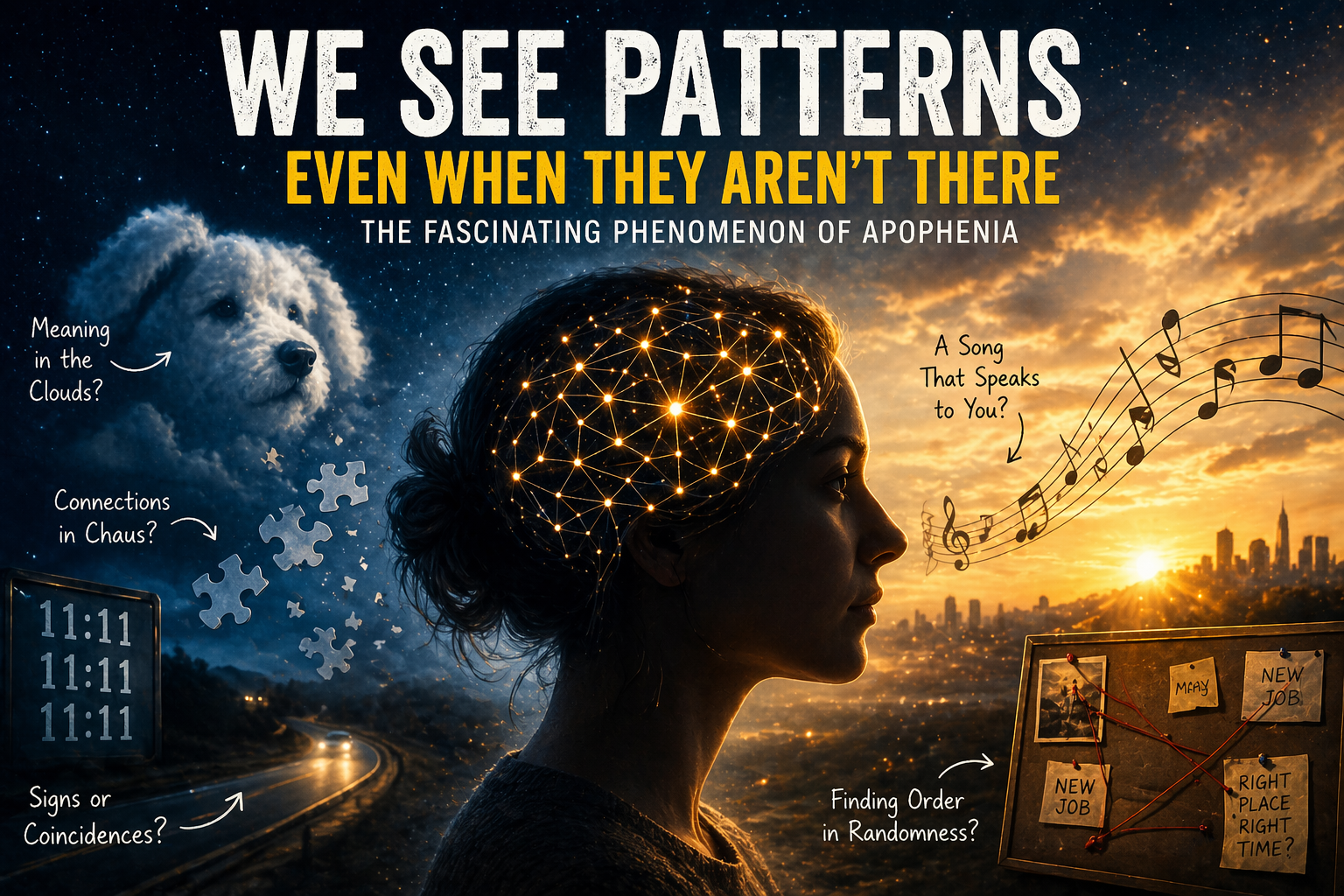
unlocking apophenia 1 Unlocking Apophenia… Have you ever found yourself staring at the clouds, convinced that one fluffy formation looks just like your childhood pet, or perhaps listening to a random song on the radio and feeling as if its lyrics are speaking directly to your life’s dilemmas? These moments, where our minds connect the dots in seemingly chaotic patterns, can evoke a sense of wonder, nostalgia, or even clarity.
It’s as if the universe is whispering secrets only we can hear, but is it true meaning we’re uncovering, or just a trick of the mind? In a world overflowing with noise and randomness, our innate desire to find order and significance can sometimes lead us to profound insights-or simply to delightful coincidences. Join me as we explore the fascinating phenomenon of apophenia in our everyday lives, and discover why we are wired to seek patterns in the absurdity around us.
The Evolutionary or Psychological Reason Behind Apophenia
Apophenia refers to the human tendency to perceive meaningful patterns in random data. This phenomenon is deeply rooted in our evolutionary development and cognitive processes.
Evolutionary Perspective
From an evolutionary standpoint, the ability to detect patterns was crucial for survival. Early humans who could recognize patterns in their environment-such as identifying predators or finding food-had a better chance of survival. This instinctive pattern recognition led to enhanced decision-making, which ultimately contributed to the success of our species.
Unlocking Apophenia… Psychological Perspective
Psychologically, apophenia is linked to cognitive biases that influence how we interpret information. Our brains are wired to seek meaning, which can lead us to make connections that may not exist. This phenomenon is closely related to concepts such as pareidolia, where we see familiar shapes in random stimuli, like faces in clouds or animals in rock formations. This cognitive shortcut helps us make sense of the chaos around us.
Real-life Examples or Famous Case Studies
Apophenia manifests in various aspects of everyday life, from superstitions to conspiracy theories. Here are a few notable examples:
1. The Monty Hall Problem
This well-known probability puzzle illustrates how people often misinterpret randomness. Contestants believe they can predict outcomes based on previous results, showcasing apophenia in decision-making.
2. The 9/11 Conspiracy Theories
After the tragic events of September 11, 2001, numerous conspiracy theories emerged. Many individuals sought patterns in unrelated events to support their beliefs, demonstrating a classic case of apophenia.
3. The Stock Market
Investors often see trends or patterns in stock price fluctuations, interpreting them as indicators of future performance. This can lead to irrational investment decisions driven by the desire to find meaning in noise.
4. Everyday Superstitions
Many people hold superstitions, such as avoiding black cats or carrying lucky charms, based on perceived patterns that link certain actions to good or bad outcomes. These beliefs are fueled by apophenia, as individuals draw connections between unrelated events.
5 Actionable Coping Mechanisms or Takeaways
- Practice Critical Thinking: Challenge your assumptions and evaluate evidence before drawing conclusions.
- Stay Informed: Educate yourself about cognitive biases to recognize when apophenia might be influencing your thoughts.
- Engage in Mindfulness: Cultivate awareness of your thought processes to help differentiate between genuine patterns and random occurrences.
- Seek Diverse Perspectives: Discuss your ideas with others to gain insights and challenge your interpretations of events.
- Limit Exposure to Noise: Reducing consumption of sensationalized media can help minimize the tendency to perceive false patterns.
Did You Know? The term ‘apophenia’ was coined by psychologist Klaus Conrad in 1958, primarily to describe the experiences of individuals with schizophrenia, who often perceive patterns that do not exist.
Conclusion
The ability to perceive meaningful patterns in random data, or apophenia, underscores our innate desire to find order and significance in the chaos of everyday life.
Have you ever experienced a moment where you found unexpected connections in seemingly unrelated events?
Apophenia in Relationships, Culture, and Personal Identity
Have you ever experienced a moment where you found unexpected connections in seemingly unrelated events? If so, you are far from alone. In fact, those moments may reveal more about the architecture of the human mind than about the world itself. Apophenia is not simply an occasional mental quirk; it is a deeply woven feature of consciousness. It appears in how we interpret love, loss, coincidence, identity, ambition, and even our own life stories. We are not passive observers of reality. We are active meaning-makers, constantly arranging fragments into narratives that feel coherent, emotionally resonant, and psychologically satisfying.
Consider how often people construct personal myths around relationships. A person meets someone with the same birthday as their late grandparent and immediately senses destiny. Another notices that each major breakup in their life seems to happen in autumn, and suddenly the season itself becomes emotionally charged with symbolism. These interpretations may not be factually significant in any objective sense, yet they feel true because they organize emotional experience into a pattern. The mind does not merely record events; it edits, highlights, links, and frames them. Through apophenia, isolated details become signs, and signs become stories.
This tendency is especially powerful in moments of uncertainty. When life feels unstable, random events become difficult to tolerate as random. A missed call, a delayed train, an unexpected compliment, or a strange dream can begin to feel like part of a larger message. Uncertainty creates psychological discomfort, and apophenia often offers relief by providing a sense of hidden structure. It reassures us that events are not simply happening without reason. Even when the pattern is imagined, the comfort it provides can feel very real.
Why the Brain Prefers Meaning Over Randomness
To understand why apophenia is so persistent, it helps to examine the brain’s basic priorities. Human cognition evolved not for philosophical accuracy but for survival, efficiency, and action. In a dangerous environment, it was often more useful to assume there was a pattern than to wait for perfect evidence. If rustling grass might signal a predator, overreacting could save a life. If a certain berry patch seemed to produce food seasonally, noticing that pattern could help a tribe survive winter. Pattern detection became one of our greatest advantages, even if it sometimes generated false positives.
In modern life, however, the same mental machinery operates in environments far more abstract and information-dense than those in which it evolved. We now face endless streams of headlines, statistics, notifications, social media posts, charts, symbols, and personal memories. Our brains still try to turn all of this into meaningful structure. The result is a mind constantly searching for themes, signs, and hidden causes in an overwhelming sea of data. Sometimes this leads to scientific discovery, creative insight, or emotional clarity. At other times, it leads to superstition, paranoia, overconfidence, or poor judgment.
What makes apophenia so compelling is that it often feels indistinguishable from intuition. Many people do not experience it as “seeing patterns that are not there.” They experience it as a gut feeling, a deep knowing, or a sudden moment of certainty. That subjective confidence can be misleading. The emotional vividness of a connection is not proof of its accuracy. A pattern can feel profound and still be false. Yet because emotional intensity is often mistaken for truth, apophenia can become self-reinforcing.
The Fine Line Between Insight and Illusion
It would be a mistake to treat all pattern recognition with suspicion. Human progress depends on recognizing relationships between things that others have not yet noticed. Scientists discover laws, artists create metaphors, writers build narratives, and entrepreneurs identify market shifts because they can detect patterns. The issue is not pattern recognition itself. The issue is whether the pattern is tested, grounded, and open to revision. Apophenia becomes problematic when the mind stops asking whether a pattern is valid and begins defending it as unquestionable truth.
This is why the line between insight and illusion can be so thin. A researcher notices a recurring anomaly and investigates it carefully. That may lead to a breakthrough. Another person notices the same anomaly and immediately constructs a grand explanation without evidence. That may lead to a false belief. In both cases, the initial spark comes from pattern recognition. What matters is what happens next. Does curiosity lead to testing, or does certainty lead to distortion?
In everyday life, this distinction matters more than we often realize. A person may notice that they always feel anxious after spending time with a certain friend. That pattern could offer genuine self-knowledge. Another person may notice that three stressful events happened on days when they wore a specific color and begin to avoid it. Both are examples of detecting connections, but only one is likely grounded in a meaningful causal relationship. Healthy thinking does not suppress pattern recognition. It refines it.
How Apophenia Shapes Memory
Memory is not a perfect archive. It is a reconstructive process, and apophenia plays a major role in shaping it. We remember events not only as they happened, but also as they fit into the stories we tell ourselves afterward. Once a pattern is believed, memory begins to cooperate with it. Moments that support the pattern become more vivid, while contradictory examples fade or lose emotional weight. Over time, this can make a false pattern feel increasingly obvious.
Imagine someone who believes they are always “the unlucky one” in their family. They may recall failed opportunities, awkward social moments, and financial setbacks with striking clarity. Meanwhile, successes, acts of kindness, and moments of resilience may be minimized. The pattern of bad luck starts to feel like an objective fact, when in reality it may be partly sustained by selective attention and memory. Apophenia does not simply influence what we notice. It influences what we store, revisit, and emotionally rehearse.
This dynamic can affect self-esteem, relationships, and long-term decisions. If a person repeatedly extracts the same negative meaning from random setbacks, they may begin to live inside a pattern that was never fully real. In this way, perceived patterns can become self-fulfilling. A belief born from coincidence may eventually shape behavior strongly enough to produce real consequences.
Apophenia in the Digital Age
The modern information environment amplifies apophenia in ways earlier generations could scarcely imagine. Social media platforms reward engagement, not careful reasoning. Content that suggests hidden truths, dramatic patterns, or secret explanations spreads quickly because it activates emotion and curiosity. Algorithms then reinforce this process by showing users more of what they have already reacted to. A person who clicks on one mysterious connection may soon be surrounded by dozens of related claims, each appearing to confirm the last.
In such an environment, apophenia can escalate rapidly. A few loosely connected observations can become an entire worldview. Images, clips, slogans, statistics, and personal anecdotes are stitched together into narratives that feel too intricate to be accidental. Yet complexity itself is not evidence. A story can be elaborate and still be false. In fact, the most seductive false patterns are often those that explain many things at once. They offer a feeling of coherence in a fragmented world.
This does not mean all skepticism or alternative interpretation is misguided. The problem arises when the emotional reward of “figuring something out” becomes stronger than the discipline of verifying it. In the digital age, the thrill of pattern discovery is often public, shareable, and socially reinforced. That makes it harder to step back and ask the quiet question that matters most: is this connection actually real, or does it simply satisfy my need for meaning?
Creativity, Spirituality, and the Beauty of Pattern
Despite its risks, apophenia is not merely a flaw to be eliminated. It is also bound up with some of the most beautiful aspects of being human. The same mind that sees faces in clouds can also write poetry, compose music, invent myths, and find symbolism in ordinary moments. Much of art depends on our capacity to perceive resonance between seemingly unrelated things. A photograph of an empty chair can evoke grief. A certain melody can feel like winter. A passing comment can suddenly illuminate an entire stage of life. These are not errors in the crude sense. They are expressions of a mind built to connect.
Spiritual experience often operates in a similar space. Many people describe meaningful coincidences, recurring symbols, or uncanny timing as moments of guidance or transcendence. Whether those interpretations point to something metaphysical or to the deep pattern-seeking habits of the mind is a question that different individuals answer in different ways. What matters psychologically is that such experiences can provide comfort, purpose, and a sense of belonging in a larger story. The human need for meaning is not irrational. It is central to emotional life.
The challenge, then, is not to become coldly mechanical or to strip the world of wonder. It is to remain capable of awe without becoming captive to illusion. We can appreciate symbolic meaning while recognizing that not every striking coincidence is a hidden message. We can enjoy the emotional richness of pattern without abandoning discernment. That balance allows us to stay imaginative without becoming gullible, and reflective without becoming obsessive.
When Apophenia Becomes Harmful
Although mild apophenia is common, there are situations in which it becomes distressing or dangerous. When people begin seeing threatening, highly personalized, or rigid patterns everywhere, daily functioning can suffer. They may interpret neutral events as targeted messages, perceive ordinary coincidences as proof of persecution, or become unable to tolerate ambiguity at all. In clinical contexts, extreme pattern attribution can be associated with psychosis, paranoia, or delusional thinking. This is one reason the concept originally appeared in psychiatric literature.
It is important to approach this topic with nuance and compassion. The presence of apophenic thinking does not automatically indicate illness. Many psychologically healthy people experience moments of exaggerated pattern recognition, especially during stress, grief, exhaustion, or emotional upheaval. The concern arises when the perceived patterns become rigid, increasingly disconnected from evidence, and resistant to any alternative explanation. At that point, they stop being curious interpretations and become organizing beliefs that distort reality.
Stress is a particularly powerful trigger. Under high emotional pressure, the brain seeks certainty more urgently. Sleep deprivation, anxiety, and chronic overwhelm can all increase the likelihood of perceiving false connections. This is one reason people going through loss or major life transitions sometimes become more superstitious or more convinced that random events carry special meaning. The mind is trying to restore order. Understanding that impulse can reduce shame and open space for healthier coping strategies.
How to Respond More Wisely to Perceived Patterns
If apophenia is part of normal human psychology, the goal is not to eliminate it completely. The goal is to respond to it more wisely. The first step is to create a pause between noticing a pattern and believing it. A pattern can be interesting without being true. Simply naming that distinction can prevent impulsive conclusions. Instead of saying, “This must mean something,” it can help to ask, “What are the possible explanations here?”
Another useful practice is evidence balancing. When you notice a pattern, look deliberately for examples that challenge it. If you think you always fail when you take risks, search for times when risk brought growth or unexpected reward. If you believe a sequence of events proves that everyone is against you, look for evidence of neutrality, support, or coincidence. This does not mean dismissing your feelings. It means refusing to let one emotionally persuasive interpretation monopolize reality.
Journaling can also be surprisingly effective. Writing down perceived patterns, the emotions attached to them, and the evidence for and against them creates distance from immediate intuition. Over time, this helps reveal whether a pattern is consistent, exaggerated, or entirely situational. It also builds metacognition, the ability to think about your own thinking. The more aware you become of how your mind constructs meaning, the less likely you are to be ruled by automatic interpretations.
Conversations with grounded, thoughtful people matter too. Other minds can interrupt the closed loop of self-confirmation. When you explain a perceived pattern to someone else, their questions may reveal assumptions you had not noticed. Diverse perspectives do not eliminate subjectivity, but they can expose blind spots. Sometimes the most valuable response is not immediate agreement or disagreement, but a question that returns you to reality-testing.
Teaching Ourselves to Tolerate Uncertainty
One of the deepest antidotes to harmful apophenia is learning to tolerate uncertainty. This is easier said than done. Human beings crave closure, and ambiguity can feel emotionally expensive. Yet not every event has a hidden lesson, and not every coincidence points toward destiny. Sometimes things happen without symbolic significance. Sometimes a song feels perfectly timed because our minds are primed to notice relevance. Sometimes a random sequence is only a random sequence.
Tolerating that possibility does not make life empty. On the contrary, it can make our relationship to meaning more honest. Meaning becomes something we engage with thoughtfully rather than something we force onto every occurrence. We stop demanding that every cloud contain a message and begin allowing some things to be simply beautiful, strange, or fleeting. That freedom can be profoundly calming.
Paradoxically, accepting uncertainty can also sharpen genuine insight. When we no longer need every pattern to be true, we become better at recognizing the ones that actually matter. We stop flooding our minds with noise and start paying attention with more discipline. The result is not less meaning, but better meaning.
The Human Need to Narrate Experience
At its core, apophenia reveals that human beings are narrative creatures. We do not merely live through events; we assemble them into stories that explain who we are, what matters, and where we are going. This narrative impulse can be healing. It helps us survive grief, understand change, and maintain identity through chaos. But it can also tempt us into over-interpretation, especially when randomness threatens our sense of control.
There is something deeply moving about this tension. We long for the world to be legible. We want signs that we are on the right path, reassurance that pain has purpose, and hints that our lives are part of something more coherent than scattered moments. Apophenia sits right at that intersection between longing and cognition. It shows how emotional need and mental habit work together to generate perceived meaning.
Perhaps that is why the phenomenon feels so familiar. It is not just about statistics, illusions, or mistaken assumptions. It is about the ordinary human act of reaching beyond confusion toward understanding. Even when we get it wrong, the impulse itself reveals something tender and universal: we want our lives to make sense.
Living With Wonder Without Losing Ground
The healthiest response to apophenia may be neither cynical dismissal nor blind trust, but a mature form of curiosity. We can notice patterns, enjoy them, reflect on them, and even be moved by them without instantly surrendering to them. We can ask what a perceived pattern reveals about our fears, hopes, and current emotional state. Sometimes the value of a pattern lies not in whether it is objectively real, but in what it shows us about what we are searching for.
If you keep seeing reminders of a person you miss, perhaps that does not mean the universe is sending you coded messages. Perhaps it means your grief is active, your memory is alert, and your love remains present. If you hear a lyric that feels uncannily personal, perhaps it is not prophecy. Perhaps it is recognition. Art feels intimate because human experience contains recurring emotional structures. We recognize ourselves in it because we are patterned beings living patterned emotional lives.
There is no need to strip the magic from such moments. The aim is simply to hold them gently. Let them inspire thought, not domination. Let them invite reflection, not rigid certainty. The cloud that looks like your childhood pet may still fill you with warmth. The song lyric that lands at the right moment may still help you feel understood. Meaning does not always need to be supernatural to be profound.
Final Reflection
Apophenia reminds us that the human mind is both brilliant and vulnerable. It is capable of extraordinary insight, yet always tempted by illusions that feel comforting, dramatic, or beautifully coherent. We are wired to search for order because order once protected us, and because meaning still sustains us. That search can lead to creativity, resilience, connection, and wonder. It can also lead us astray when we stop questioning the stories we build.
The real lesson is not that we should stop seeing patterns. It is that we should become more conscious of how and why we see them. By pairing curiosity with critical thinking, emotional honesty with evidence, and imagination with humility, we can navigate the strange dance between randomness and meaning more wisely. We can appreciate the mind’s desire to connect the dots without assuming every connection is destiny.
And perhaps that is the most human conclusion of all: we will always search the noise for something recognizable, something intimate, something that tells us we are not adrift. Sometimes we will find truth. Sometimes we will find coincidence. Often, we will find a little of ourselves reflected back in the patterns we create. In that reflection lies both the risk and the beauty of apophenia.
schema:Article -->Read also: Home | Related unlocking Guides.